Pest Control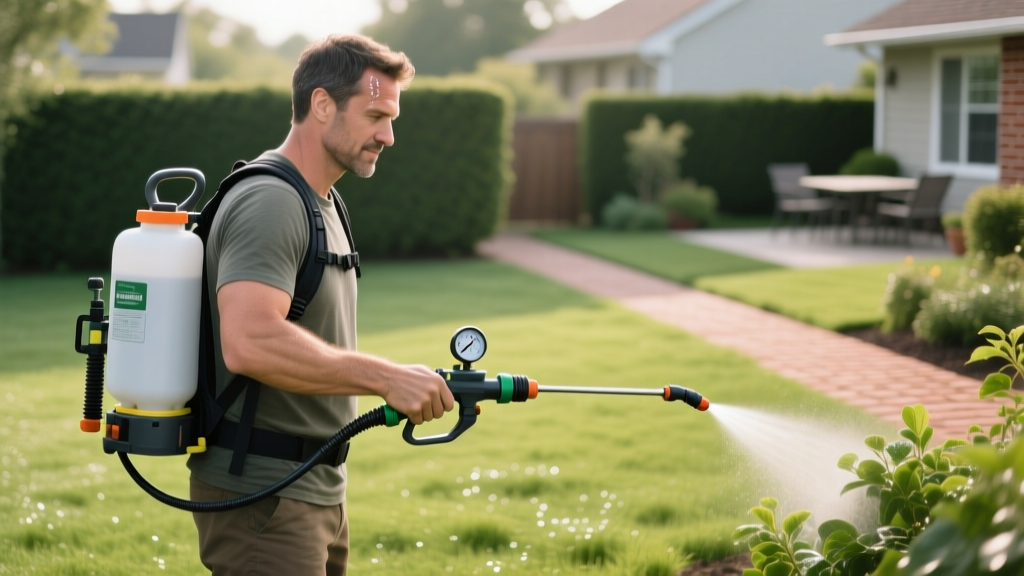
The Ultimate Guide to Backpack Sprayers for Lawn Pest Control
Sarah ChenPublished
The Role of Backpack Sprayers in Integrated Pest Management
When executing an Integrated Pest Management (IPM) strategy, the precise application of control products is just as critical as the selection of the product itself. Whether you are targeting soil-dwelling grubs with an imidacloprid drench or treating the perimeter of your home for ticks and ants using bifenthrin, the delivery method dictates your success. For most residential lawns and mid-sized properties, the backpack sprayer remains the undisputed champion of pest control equipment. It offers a superior balance of capacity, mobility, and pressure control compared to hose-end sprayers or small hand-pump bottles.
However, owning a backpack sprayer is only the first step. Understanding how to select the right model, choose the appropriate nozzle, calibrate the output, and maintain the equipment ensures that you apply the exact dosage required to eliminate pests without harming the environment or wasting expensive chemicals.
Manual vs. Battery-Powered: Choosing Your Equipment
The market is dominated by two primary types of backpack sprayers: manual pump and battery-powered. Your choice should depend on the size of your property, the frequency of your pest control routines, and your budget.
Manual Pump Sprayers (such as the Chapin 20000 or Solo 418) require the user to physically pump a handle to build pressure inside the tank. They are lightweight, highly reliable, and easy to repair. However, the pressure fluctuates as you spray, requiring you to stop and re-pump every few minutes to maintain an optimal 40 PSI (pounds per square inch) for consistent droplet size.
Battery-Powered Sprayers (like the Field King 190328 or Chapin Li-Ion models) utilize a rechargeable lithium-ion battery to power an internal diaphragm pump. They provide a constant, unwavering pressure from the first drop to the last, which is crucial for uniform pesticide application. They are heavier and more expensive but significantly reduce operator fatigue on large properties.
| Feature | Manual Pump Sprayer | Battery-Powered Sprayer |
|---|---|---|
| Pressure Consistency | Variable (drops between pumps) | Constant (regulated by switch) |
| Weight (Empty) | Lighter (approx. 4-5 lbs) | Heavier (approx. 8-10 lbs) |
| Average Cost | $40 - $80 | $120 - $250 |
| Best Application | Small yards, spot treatments | Large lawns, perimeter pest control |
| Maintenance | Requires O-ring lubrication | Battery care, pump winterization |
Nozzle Selection: The Secret to Targeted Pest Control
The nozzle is the most important component of your sprayer. It dictates the droplet size, spray pattern, and application rate. Using the wrong nozzle can lead to pesticide drift, poor coverage, or chemical runoff.
Flat Fan Nozzles
Flat fan nozzles (such as the TeeJet 8002 or 110-degree flat fan) produce a wide, even sheet of liquid. These are ideal for soil-applied insecticides and broad-spectrum weed control. When treating for white grubs, chinch bugs, or armyworms, you want the chemical to reach the soil surface evenly without overlapping heavily, which a flat fan nozzle facilitates perfectly.
Adjustable Cone Nozzles
Cone nozzles produce a circular, hollow-cone spray pattern that can be adjusted from a pinpoint stream to a fine mist. These are best for foliar treatments and perimeter sprays. If you are targeting ticks in tall grass, mosquitoes in shrubbery, or spraying a foundation barrier for ants and spiders, the fine mist of a cone nozzle ensures the product coats the leaves and vertical surfaces where these pests harbor.
The 128th Acre Method: Step-by-Step Calibration
Calibration is the process of determining exactly how much liquid your sprayer applies over a specific area. Applying too little pesticide will fail to control the infestation, while applying too much is illegal, environmentally hazardous, and wasteful. According to Penn State Extension, the 'Ounce Method' (or 128th acre method) is the most reliable way to calibrate a backpack sprayer because it simplifies the math entirely.
- Measure a Test Area: Mark off an area of exactly 1,000 square feet (e.g., 20 feet by 50 feet) on your driveway or a patch of short grass.
- Fill with Water: Fill your backpack sprayer with clean water to a specific, easily visible fill line. Do not use actual pesticides for calibration.
- Spray the Area: Spray the 1,000 square foot test area using your normal walking pace, standard pumping rhythm, and the exact nozzle you intend to use. Maintain a consistent height (usually 18-24 inches above the ground).
- Measure the Deficit: Return to your fill station and use a graduated measuring cup to add water back into the tank until it reaches your original fill line.
- The Magic Conversion: The number of fluid ounces of water it takes to refill the tank is exactly equal to the number of gallons per acre (GPA) your sprayer is applying. For example, if you add 40 ounces of water to refill the tank, your sprayer outputs 40 GPA.
Once you know your GPA, you can consult your pesticide label. If the label requires 2 ounces of Bifenthrin per 1,000 square feet, and you know your sprayer outputs 40 ounces of water per 1,000 square feet, you simply mix 2 ounces of chemical into every 40 ounces (or equivalent ratio) of water in your tank.
Essential PPE and Safety Protocols
Handling concentrated pesticides requires strict adherence to safety protocols. The Environmental Protection Agency (EPA) mandates specific Personal Protective Equipment (PPE) for pesticide handlers to prevent dermal absorption and inhalation risks.
- Gloves: Always wear unlined, chemical-resistant nitrile or neoprene gloves. Never use leather or cotton gloves, as they absorb chemicals and hold them against your skin.
- Eye Protection: Wear wrap-around safety goggles to protect against splashes and accidental upward drift when spraying low-lying pests.
- Clothing: Wear long sleeves, long pants, and closed-toe shoes with socks. Consider a dedicated Tyvek suit for extensive perimeter treatments or when applying highly toxic restricted-use products.
- Mixing Location: Always mix chemicals outdoors or in a highly ventilated area, preferably on a concrete driveway where spills can be immediately contained and neutralized with an absorbent material like cat litter.
Cleaning, Maintenance, and Winterization
A poorly maintained sprayer will leak, clog, and degrade, leading to inaccurate applications and potential skin exposure. The National Pesticide Information Center (NPIC) emphasizes the importance of thorough decontamination after every use.
The Triple-Rinse Method
After emptying your tank, fill it 1/4 full with clean water, shake vigorously, and spray the water out through the wand to flush the hoses and nozzle. Repeat this process three times. If you were spraying an oil-based pesticide or a stubborn wettable powder, add a few drops of mild dish soap or a specialized tank cleaner during the first rinse.
O-Ring and Seal Care
The rubber O-rings on the pump handle and wand connections are prone to drying out and cracking. Once a month, remove the O-rings and lubricate them with silicone grease. Never use petroleum jelly (Vaseline) or WD-40, as petroleum products will cause the rubber to swell, degrade, and ultimately fail, resulting in dangerous chemical leaks onto your hands and back.
Winterization
If you live in a climate with freezing winters, you must winterize your sprayer to prevent the internal pump diaphragm from cracking. After your final triple-rinse, pump a small amount of RV antifreeze (propylene glycol) through the system until it exits the nozzle. Store the sprayer indoors, out of direct sunlight, with the pressure relief valve engaged to keep the seals relaxed.
Conclusion
Mastering the backpack sprayer transforms you from a passive homeowner into an active, highly effective turf manager. By investing in the right equipment, calibrating meticulously using the 128th acre method, selecting the proper nozzle for your target pest, and maintaining your gear, you ensure that your pest control efforts are safe, legal, and devastatingly effective against lawn-destroying insects.