
Landscaping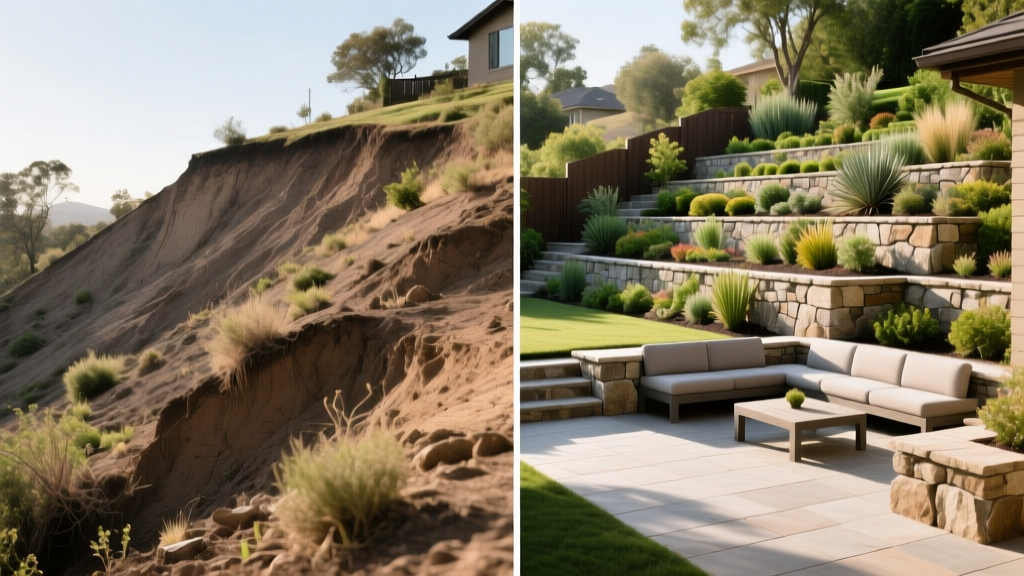
Backyard Slope Transformation: Before and After Terracing
David ParkPublished
The Before State: Battling a Steep, Eroding Backyard Slope
For many homeowners, a steeply graded backyard is less of an outdoor oasis and more of a muddy, unusable hazard. In this before and after landscaping case study, we explore the dramatic transformation of a suburban property featuring a severe 35% grade slope. Before the renovation, the backyard was essentially a wasteland. Every heavy rainstorm resulted in severe topsoil erosion, sending muddy runoff directly toward the home's foundation. The homeowners had attempted to grow turfgrass on the incline, but the combination of rapid water runoff, poor soil retention, and the sheer difficulty of mowing a 35% grade meant the grass was perpetually patchy, yellowed, and thin.
Beyond the aesthetic nightmare, the slope posed a genuine safety hazard. Navigating the yard after a rain shower was akin to walking on a slip-and-slide. The homeowners realized that simply throwing more grass seed or laying down cheap erosion control blankets was a temporary bandage on a structural landscaping problem. They needed a permanent, functional, and beautiful solution. The goal was to reclaim the lost square footage, eliminate the foundation-threatening runoff, and create a multi-level outdoor living space that the family could actually use and enjoy.
Planning the Transformation: Terracing and Retaining Walls
The design phase focused on a concept known as terracing. By breaking the single, steep drop-off into three distinct, level platforms, the landscape architect could effectively neutralize the destructive force of gravity and water runoff. The plan called for three tiered retaining walls constructed from segmental retaining wall (SRW) blocks. Specifically, the design utilized Allan Block Classic units in a slate gray color to provide a modern, structured look that contrasted beautifully with the surrounding natural foliage.
When planning structural landscaping on a slope, it is vital to understand local building codes and engineering requirements. According to guidelines often referenced by the National Association of Landscape Professionals (NALP), any retaining wall exceeding four feet in height typically requires a stamped engineering plan and specific municipal permits. To avoid the immense cost and red tape of structural engineering, the design intentionally capped each individual terraced wall at a maximum height of three and a half feet, creating a cascading, stepped effect that was both visually appealing and legally straightforward to build.
Step-by-Step Execution: Building the Bones
The transformation began with heavy excavation. A mini-excavator was brought in to carve out the three distinct tiers, moving roughly 40 cubic yards of native clay-heavy soil. The importance of a proper base cannot be overstated in slope transformations. For the lowest wall, which would eventually support a heavy paver patio, the contractor excavated a trench 12 inches deep and 24 inches wide. This trench was filled with a 6-inch base of 3/4-inch crushed angular limestone, which was mechanically compacted using a vibrating plate compactor to achieve a minimum of 98% Standard Proctor density.
Once the base was set, the first course of Allan Block units was laid. Because the yard had a natural lateral slope in addition to the vertical drop, the first course required careful stepping and leveling to ensure the wall followed the natural contour of the land without dipping or rising unnaturally. As the walls were stacked, a crucial component was introduced: geogrid. For the middle and upper tiers, layers of biaxial geogrid were placed between the block courses and extended back into the compacted soil fill. This geogrid acts as a structural tie-back, essentially locking the retaining wall into the hillside and preventing the immense hydrostatic pressure of the wet soil from pushing the wall outward over time.
Material and Cost Breakdown
Transforming a slope is an investment in both property value and structural integrity. Below is a breakdown of the primary materials and estimated costs for this 1,200-square-foot terraced transformation.
| Material Category | Specific Product / Type | Quantity Used | Estimated Cost |
|---|---|---|---|
| Retaining Wall Blocks | Allan Block Classic (Slate Gray) | 450 Units | $3,150 |
| Base and Backfill | 3/4-inch Crushed Limestone & 57 Stone | 25 Tons | $1,100 |
| Drainage Systems | 4-inch Perforated Corrugated Pipe & Fabric | 150 Linear Feet | $350 |
| Geogrid Reinforcement | Biaxial Geogrid (Rolls) | 4 Rolls | $800 |
| Patio Pavers | Techo-Bloc Blu 60mm (Shale Gray) | 400 Sq. Ft. | $2,400 |
| Topsoil and Mulch | Screened Loam & Hardwood Bark Mulch | 15 Cu. Yds. | $750 |
Note: Labor costs, excavation machinery rentals, and permit fees are not included in this materials-only breakdown. Professional installation for a project of this scale typically ranges from $8,000 to $15,000 depending on regional rates and site accessibility.
Solving the Drainage Puzzle
A retaining wall is only as good as the drainage system behind it. Water trapped in the soil behind a wall creates hydrostatic pressure, which is the number one cause of retaining wall bulging and failure. During the backfilling process, a 4-inch perforated drainage pipe was installed directly behind the base course of every wall, wrapped in a protective landscape fabric sock to prevent silt clogging. This pipe was graded to daylight at the lower edges of the property, safely routing groundwater away from the walls.
Furthermore, managing the surface water runoff from the terraced beds was critical to protect the home's foundation. By incorporating shallow swales and integrating permeable jointing sand between the Techo-Bloc patio pavers, the landscape was designed to absorb and slow down rainwater. This approach aligns closely with the stormwater management principles outlined by the Environmental Protection Agency (EPA), which advocates for green infrastructure techniques that mimic natural hydrology to reduce runoff volume and improve water quality.
The After State: A Multi-Level Outdoor Oasis
The difference between the before and after states was nothing short of miraculous. The lowest tier was transformed into a sprawling, level patio using Techo-Bloc pavers, complete with an integrated fire pit and low-voltage LED uplighting to illuminate the wall faces at night. The middle tier became a lush, transitional garden bed, featuring a winding pathway of flagstone stepping stones that allowed the homeowners to easily walk from the lower patio to the upper yard without needing a steep, dangerous staircase.
The uppermost tier was dedicated to a privacy screen and a small vegetable garden, which now received optimal, unobstructed sunlight. By terracing the slope, the family effectively gained over 800 square feet of flat, usable outdoor living space that had previously been written off as dead zone. The erosion completely stopped, the muddy runoff was eliminated, and the structural integrity of the home's foundation was secured.
Plant Selection for Terraced Beds
Choosing the right plants for a terraced slope is vital for long-term erosion control and aesthetic appeal. The soil in raised retaining wall beds tends to drain faster and dry out more quickly than ground-level soil. Therefore, drought-tolerant, deep-rooted plants are essential. To select the most appropriate species, the landscape designer utilized the extensive horticultural databases provided by the Missouri Botanical Garden, which offers incredible resources for identifying plants suited to specific soil drainage profiles and erosion control needs.
The planting strategy included the following hardy, slope-stabilizing varieties:
- Creeping Juniper (Juniperus horizontalis): Planted along the upper lip of the retaining walls, these evergreen groundcovers spill beautifully over the block edges while their extensive root systems lock the topsoil in place.
- Stella de Oro Daylilies (Hemerocallis): Used in mass plantings on the middle tier, their dense, fibrous root mats are exceptional for holding soil, and they provide vibrant, low-maintenance summer color.
- Switchgrass (Panicum virgatum): Positioned as vertical accents, this native ornamental grass features roots that can reach up to 10 feet deep, acting as natural soil anchors while adding graceful movement to the landscape.
- Creeping Phlox (Phlox subulata): Integrated into the sunny crevices of the rock features, providing a brilliant carpet of spring blooms that requires virtually zero upkeep.
Final Thoughts on Slope Landscaping ROI
Transforming a steep, eroding backyard slope into a terraced masterpiece is one of the most impactful landscaping projects a homeowner can undertake. While the initial investment in excavation, engineering, and high-quality materials like segmental blocks and geogrid is significant, the return on investment is multifaceted. You are not only protecting your home from water damage and soil erosion but also drastically increasing your property's usable square footage and curb appeal. As this before and after case study demonstrates, with proper planning, strict adherence to drainage principles, and thoughtful plant selection, an unusable hillside can be reborn as the crown jewel of your outdoor living space.

