Tree Care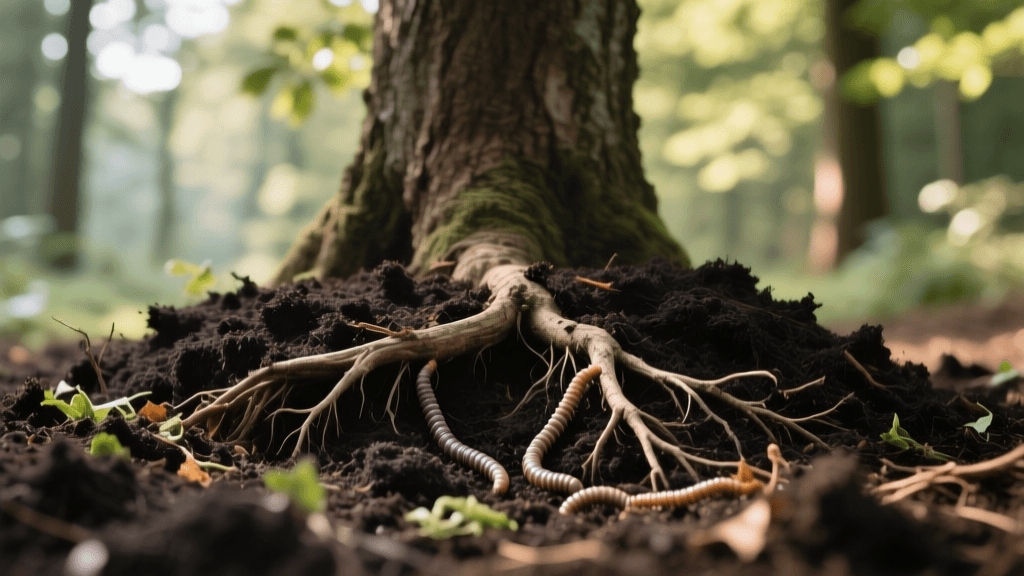
How to Use Compost and Organic Mulch for Tree Soil Health
The Hidden Ecosystem Beneath the Canopy
When we admire a towering oak, a vibrant maple, or a delicate flowering dogwood, our eyes are naturally drawn upward to the sprawling canopy. However, the true secret to a tree's longevity, structural integrity, and disease resistance lies hidden underground. Tree soil health is the foundation of all arboriculture, yet it is frequently ignored in residential landscapes. In urban and suburban environments, natural topsoil is often stripped away during construction, leaving trees to struggle in compacted, nutrient-poor subsoil. By strategically applying compost and organic mulch, homeowners and landscape professionals can rebuild the soil food web, improve moisture retention, and foster the mycorrhizal fungal networks that trees rely on for nutrient uptake.
Unlike lawn grasses, which thrive in frequent, shallow watering and regular synthetic fertilization, trees require a deep, biologically active soil profile. The vast majority of a tree's feeder roots—the tiny, hair-like roots responsible for absorbing water and nutrients—are located in the top six to twelve inches of the soil. When this zone becomes compacted or depleted of organic matter, the tree slowly declines. This comprehensive guide will walk you through the practical, actionable steps of using compost and mulch to revitalize your tree's root zone, complete with specific measurements, product recommendations, and seasonal timing.
Compost vs. Mulch: Understanding the Differences
A common mistake in landscape maintenance is using the terms 'compost' and 'mulch' interchangeably. While both are derived from organic matter, they serve distinctly different purposes in tree care. Compost is fully decomposed organic material that is incorporated into or top-dressed onto the soil to provide nutrients, improve soil structure, and introduce beneficial microbes. Mulch, on the other hand, consists of larger, slower-decomposing materials (like wood chips or bark) applied to the soil surface to retain moisture, regulate temperature, and suppress weeds.
To achieve optimal tree soil health, you often need to use both in tandem. Below is a comparison chart detailing the best materials, application rates, and estimated costs for residential tree care.
| Material | Primary Function | Application Rate | Best Time to Apply | Estimated Cost (Per Cubic Yard) |
|---|---|---|---|---|
| Screened Compost | Nutrient & Microbe Inoculation | 1/4 to 1/2 inch layer | Spring or Early Fall | $30 - $50 |
| Arborist Wood Chips | Moisture Retention & Temp Control | 2 to 4 inches deep | Year-round | $15 - $25 (Often Free) |
| Leaf Mold | Soil Structure & Fungal Support | 1 to 2 inches deep | Late Fall | $20 - $40 |
| Pine Bark Fines | Weed Suppression & Acidification | 2 to 3 inches deep | Spring | $35 - $45 |
Sourcing Materials and Testing Your Soil
Before purchasing truckloads of compost, it is crucial to understand your starting point. A standard soil test from a local university extension office or a private lab like Logan Labs typically costs between $15 and $30. This test will reveal your soil's pH, cation exchange capacity (CEC), and baseline macronutrient levels. Most shade trees prefer a slightly acidic to neutral pH (6.0 to 7.0). If your soil is highly alkaline, applying a top-dressing of acidic compost (like pine bark fines or peat-based blends) can help gently lower the pH over time.
When sourcing compost, look for products that carry the US Composting Council's Seal of Testing Assurance (STA). This certification ensures the compost has been tested for pathogens, heavy metals, and proper carbon-to-nitrogen ratios. Avoid cheap, unverified 'topsoil' blends from big-box stores, as these often contain high levels of woody debris that can tie up nitrogen in the soil as they continue to decompose. For mulch, contact local arborists or your municipal waste facility. Fresh arborist wood chips are often available for free and are considered the gold standard for tree mulching by professional arborists.
Step-by-Step Guide to Compost Top-Dressing
Top-dressing is the process of applying a thin layer of compost directly over the root zone without aggressively tilling the soil, which can sever vital feeder roots. Follow these steps for safe and effective application:
- Step 1: Clear the Base. Remove any grass, weeds, or old, matted mulch from the area immediately surrounding the trunk. Grass competes heavily with tree roots for water and nutrients.
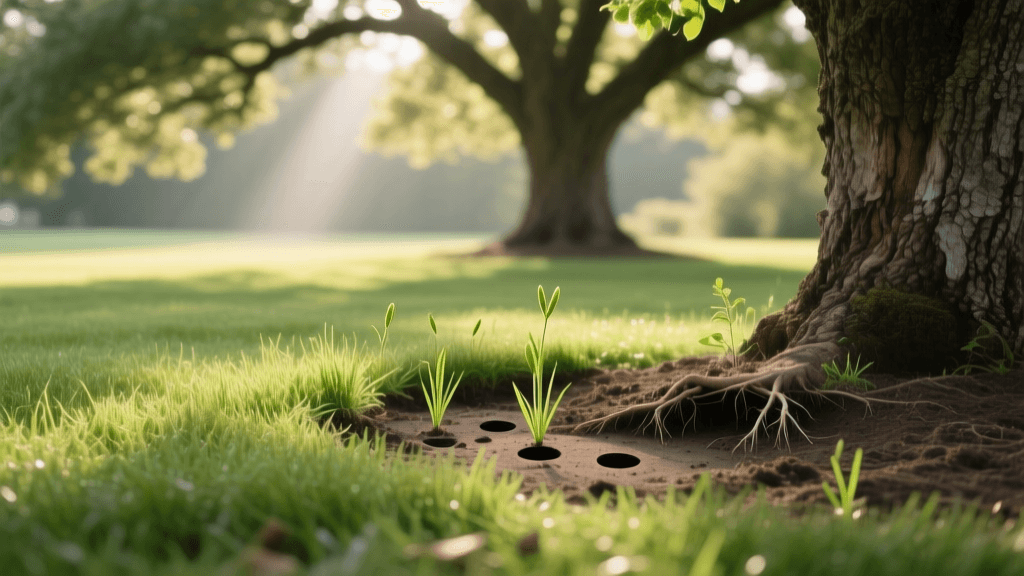
- Step 2: Alleviate Mild Compaction. If the soil is heavily compacted, use a manual lawn core aerator or a broadfork to gently pull soil plugs from the ground within the tree's drip line (the outer edge of the canopy). Do not use heavy rotary tillers.
- Step 3: Apply the Compost. Spread a 1/4 to 1/2 inch layer of high-quality screened compost evenly across the aerated area. Extend this application out to the drip line, or at least a 5-foot radius for younger trees.
- Step 4: Water Deeply. Immediately water the area with roughly 1 inch of water to help wash the compost microbes and nutrients down into the soil profile and prevent the compost from drying out and blowing away.
The 3-3-3 Rule for Proper Mulching
Once the compost has been applied and watered in, it is time to apply the protective mulch layer. According to the University of Minnesota Extension, proper mulching mimics the natural forest floor, protecting roots from extreme temperature fluctuations and mechanical damage from string trimmers. However, improper mulching is one of the leading causes of urban tree decline.
To avoid damaging your trees, strictly adhere to the '3-3-3 Rule' of mulching:
- 3 Inches Deep: Apply mulch to a depth of 2 to 4 inches. Any deeper, and you risk suffocating the soil, preventing oxygen from reaching the feeder roots, and creating a habitat for rodent pests.
- 3 Feet Wide (Minimum): The mulch ring should extend at least 3 feet from the trunk in all directions, though extending it to the drip line is vastly superior for mature trees.
- 3 Inches Away from the Trunk: This is the most critical rule. Mulch should never touch the bark of the tree.
Warning: The Dangers of Volcano Mulching
Piling mulch high against the trunk of a tree—a practice known as 'volcano mulching'—is highly detrimental. As noted by the Clemson Cooperative Extension, mulch piled against the bark keeps the trunk constantly moist, leading to fungal infections, bark decay, and the development of girdling roots that eventually strangle the tree. Always shape your mulch like a wide, flat donut, not a volcano.
Remedying Severely Compacted Urban Soils
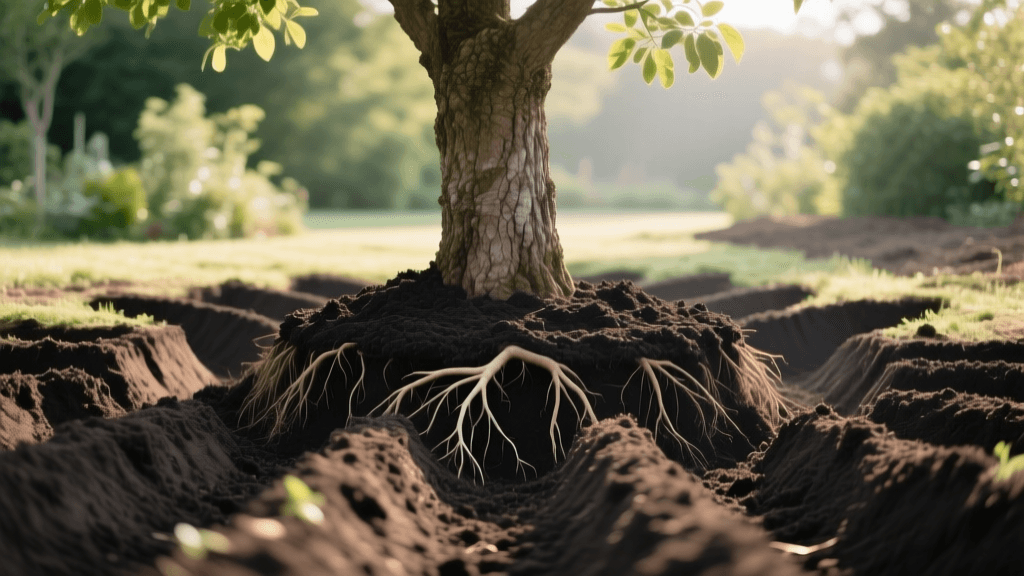
In older neighborhoods or newly constructed homes where heavy machinery has severely compacted the clay subsoil, simple top-dressing may not be enough. In these cases, a technique called 'radial trenching' or 'vertical mulching' is highly effective. This involves using an air spade (a tool that uses compressed air to excavate soil without cutting roots) or a mechanical auger to dig narrow trenches or holes radiating outward from the trunk, starting about 3 feet away from the base. These trenches, typically 4 to 6 inches wide and 8 to 12 inches deep, are then backfilled with a mixture of coarse compost, biochar, and expanded shale. This creates permanent channels for oxygen, water, and nutrients to penetrate deep into the root zone, dramatically improving tree soil health in heavily degraded landscapes.
Seasonal Timing and Maintenance Schedule
Timing your soil amendments correctly ensures that the tree can utilize the benefits when it needs them most.
- Early Spring (Post-Thaw): This is the ideal time to apply a light 1/4 inch top-dressing of compost just as the tree breaks dormancy. The spring rains will help integrate the organic matter, providing a slow-release nutrient boost for the upcoming growing season. Refresh your mulch layer if it has decomposed below the 2-inch mark over the winter.
- Late Fall (Post-Dormancy): After the leaves have dropped and the tree has entered dormancy, apply a slightly thicker layer of compost (up to 1/2 inch) and a fresh layer of arborist wood chips. This winter blanket insulates the soil, protecting shallow feeder roots from freeze-thaw cycles that can heave and tear delicate root tissues.
- Summer Maintenance: Avoid applying heavy compost in the heat of summer, as the microbial activity can generate excess heat and stress the tree. However, you can add a thin layer of mulch to retain soil moisture during drought conditions. The Morton Arboretum highly recommends maintaining a consistent mulch ring year-round to buffer summer soil temperatures.
Conclusion
Transforming the soil health around your trees is not a one-time fix, but an ongoing stewardship practice. By understanding the distinct roles of compost and mulch, adhering to proper application depths, and strictly avoiding the trunk with your organic amendments, you can recreate the rich, biologically diverse environment that trees naturally crave. Whether you are nurturing a newly planted sapling or trying to revitalize a declining century-old oak, investing time and resources into the soil food web will yield dividends in the form of vibrant foliage, robust structural growth, and a resilient landscape for decades to come.