Tree Care
Revitalize Compacted Tree Soil With Compost Top-Dressing
The Silent Killer of Urban Trees: Soil Compaction
In natural forest ecosystems, trees thrive in deep, friable soils rich in organic matter, where the root systems can easily access oxygen, water, and essential nutrients. However, in urban and suburban landscapes, trees face a hidden enemy that causes premature decline and death: soil compaction. Construction activities, heavy foot traffic, lawn mowers, and the removal of natural leaf litter compress the soil particles, destroying the vital pore spaces that roots and soil microbes need to survive.
Healthy soil should consist of roughly 50% solid material (minerals and organic matter) and 50% pore space (split evenly between water and air). In heavily compacted urban yards, pore space can drop below 10%, effectively suffocating the tree's fine feeder roots. To combat this, arborists and soil scientists increasingly recommend a highly effective, non-invasive remediation technique: compost top-dressing. By systematically applying high-quality compost and organic mulch over the root zone, homeowners can rebuild soil structure, reintroduce beneficial biology, and dramatically extend the lifespan of their landscape trees.
The Science of Soil Health and the Soil Food Web
Before diving into the application process, it is crucial to understand why compost works. Compost is not merely a fertilizer; it is a biological inoculant and a soil conditioner. When applied to the root zone, compost introduces a thriving ecosystem of beneficial bacteria, fungi, protozoa, and nematodes.
According to the USDA Natural Resources Conservation Service, soil health is defined as the continued capacity of soil to function as a vital living ecosystem that sustains plants, animals, and humans. Organic matter is the cornerstone of this ecosystem, acting as a sponge for water and a reservoir for nutrients.
Furthermore, compost increases the soil's Cation Exchange Capacity (CEC). CEC is the soil's ability to hold onto positively charged ions (cations) like calcium, magnesium, and potassium, preventing them from leaching away during heavy rains. As earthworms and macro-invertebrates pull the compost down into the mineral soil, they create micro-tunnels that naturally alleviate compaction and improve drainage over time.
Step-by-Step Guide to Compost Top-Dressing
Revitalizing compacted soil requires a strategic approach. Simply dumping a thick layer of compost over the grass will not solve deep compaction issues and may even smother surface roots. Follow these actionable steps for the best results.
Step 1: Expose and Inspect the Root Flare
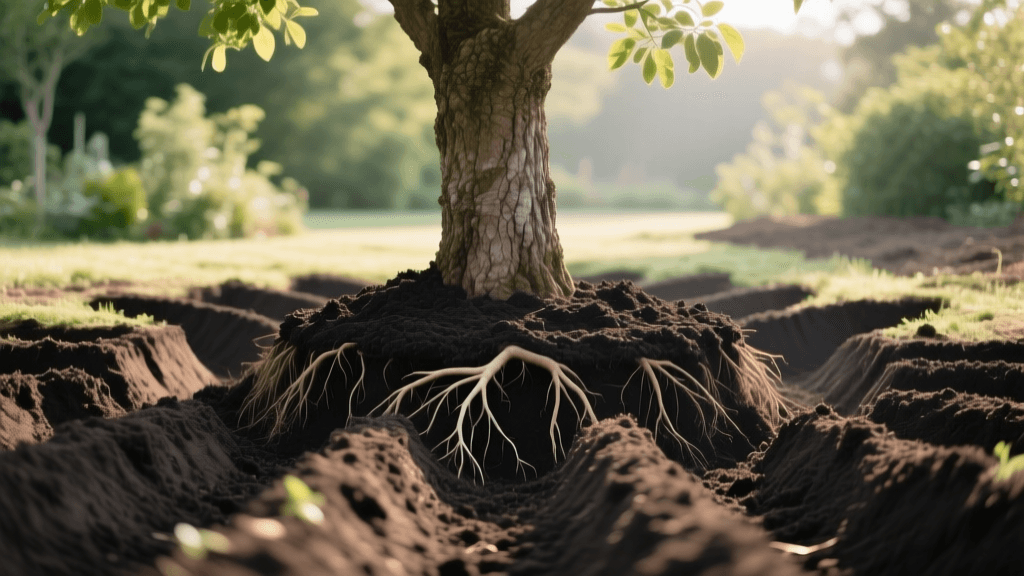
The root flare is the area where the trunk expands at the base and transitions into the structural roots. In many urban landscapes, trees are planted too deeply, or soil has washed over the flare over the years. Before applying compost, carefully excavate the soil around the base of the trunk using a hand trowel or an air-spade (a pneumatic tool used by professional arborists that removes soil without cutting roots). Ensure the root flare is fully exposed and completely free of soil, mulch, and compost. Applying organic matter directly against the trunk will lead to bark decay, girdling roots, and fungal infections.
Step 2: Radial Trenching or Vertical Mulching
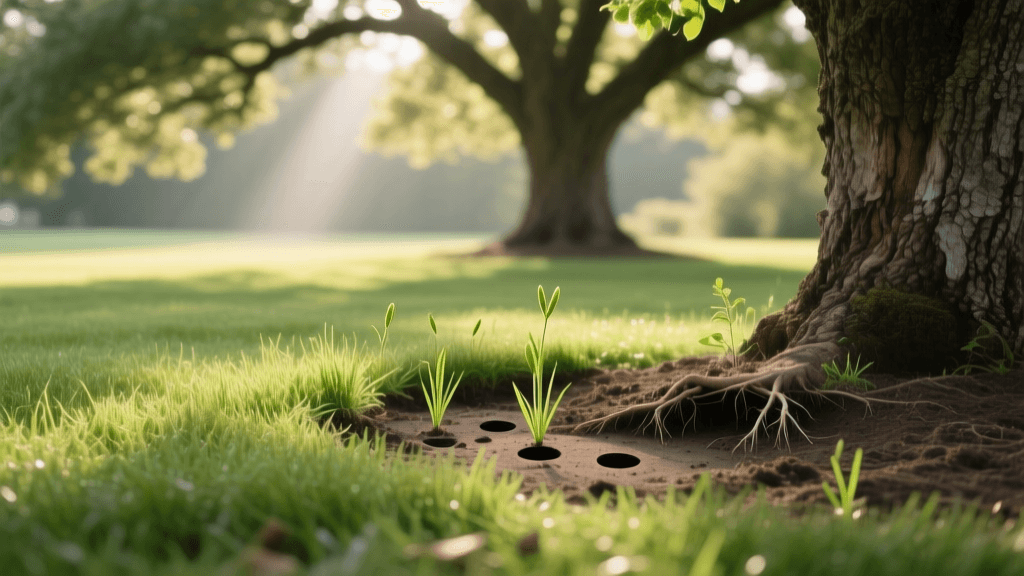
To help the compost penetrate compacted subsoil, create pathways for air and water. Using a 2-inch auger or a manual soil corer, drill holes 8 to 12 inches deep in a radial pattern starting 3 feet away from the trunk and extending out to the tree's drip line (the outer edge of the canopy). Space these holes about 12 to 18 inches apart. This process, known as vertical mulching, fractures the compacted soil layers and provides direct channels for the compost tea and organic matter to reach the deeper feeder roots.
Step 3: Apply the Compost Layer
Spread a uniform layer of high-quality, fully finished compost over the entire root zone, extending out to the drip line and slightly beyond. The ideal application rate for top-dressing is 1/4 inch to 1/2 inch thick. Do not exceed 1 inch, as thicker layers can impede gas exchange between the soil and the atmosphere. Use a stiff rake to gently work the compost into the aeration holes created in Step 2 and lightly scratch it into the top layer of the existing soil or turf.
Choosing the Right Compost and Soil Amendments
Not all compost is created equal. The source material dictates the nutrient profile, pH, and microbial diversity of the final product. Below is a comparison chart to help you select the best compost for your specific tree care needs.
| Compost Type | Nutrient Profile & Characteristics | Best Use Case | Potential Drawbacks |
|---|---|---|---|
| Leaf Mold | Low NPK, high carbon, excellent fungal dominance, slightly acidic. | Acid-loving trees (Oaks, Maples, Pines) and mimicking forest floors. | Can take 1-2 years to fully break down; low immediate nutrient value. |
| Municipal Biosolid | High nitrogen and phosphorus, heavily regulated for pathogens. | Severely depleted soils needing a rapid nutrient boost. | Can contain trace heavy metals; strong odor during application. |
| Manure-Based | High NPK, rich in bacteria, alkaline tendency. | Fruit trees and fast-growing shade trees needing vigorous growth. | Can burn roots if not fully cured; may introduce weed seeds. |
| Wood-Based / Arborist | Balanced C:N ratio, high microbial diversity, improves soil tilth. | General urban tree top-dressing and long-term soil conditioning. | Ties up nitrogen temporarily if mixed deeply into soil rather than top-dressed. |
Pro Tip: Always request a compost analysis from your supplier. Ensure the compost has a C:N (Carbon to Nitrogen) ratio between 15:1 and 25:1, and verify that it has been heated to at least 131°F for three consecutive days to eliminate plant pathogens and weed seeds.
Soil Testing: The Critical First Step
Before spending money on bulk compost and amendments, conduct a comprehensive soil test. Contact your local university cooperative extension office to obtain a soil testing kit. You need to know your soil's baseline pH and organic matter percentage. Most landscape trees prefer a slightly acidic to neutral pH (6.0 to 7.0). If your soil is highly alkaline (common in arid regions or near concrete foundations), applying a sulfur-amended compost or incorporating elemental sulfur alongside your top-dressing will help lower the pH and unlock bound micronutrients like iron and manganese, preventing chlorosis (yellowing of leaves).
The Synergy of Compost and Arborist Wood Chips
Compost top-dressing is highly effective, but it is volatile. Exposure to direct sunlight and wind can dry out the compost, killing the beneficial microbes you just introduced. To lock in moisture, regulate soil temperature, and provide a slow-release food source for soil fungi, you must cap the compost with a layer of coarse organic mulch.
The University of Minnesota Extension recommends applying a 2 to 3-inch layer of organic mulch, such as arborist wood chips or shredded bark, over the root zone. The wood chips act as a protective blanket. As they slowly decompose, they feed the fungal networks (mycorrhizae) that form symbiotic relationships with tree roots, extending the root system's absorptive capacity by hundreds of times. Remember to maintain the 'donut' shape: keep the mulch and compost at least 6 inches away from the trunk to prevent rodent damage and trunk rot.
Timing, Costs, and Maintenance Schedules
Timing: The optimal time for compost top-dressing is in the early fall, just as the tree is entering dormancy but the soil is still warm enough for microbial activity and root growth. Early spring, just before bud break, is the second-best window. Avoid heavy applications during the peak heat of summer or when the ground is frozen solid.
Cost Breakdown:
- Bulk Compost: $30 to $50 per cubic yard. One cubic yard covers approximately 650 square feet at a 1/2-inch depth.
- Arborist Wood Chips: Often free from local tree care companies, or $15 to $25 per cubic yard if delivered.
- Professional Air-Spading: If you hire a certified arborist to excavate the root flare and perform radial trenching, expect to pay $300 to $600 depending on the tree's size and accessibility.
- Mycorrhizal Inoculant: $40 to $80 for a commercial-grade powder to dust over the roots during aeration.
Maintenance: Soil building is not a one-time event. Plan to reapply a 1/4-inch layer of compost every two to three years, and refresh your wood chip mulch annually as it breaks down. Over a 5-year period, this consistent regimen will transform hard, compacted clay into a rich, loamy soil structure capable of supporting a massive, healthy tree canopy.
Common Mistakes to Avoid
When implementing a soil health regimen, well-meaning homeowners often make critical errors that harm the tree. Avoid 'volcano mulching,' which is the practice of piling mulch and compost high against the trunk. This traps moisture against the bark, inviting fungal pathogens and encouraging secondary roots to grow in a circle around the trunk (girdling roots), which will eventually strangle the tree. Additionally, never use 'hot' or unfinished compost, as the active decomposition process generates heat and organic acids that will severely burn the tree's delicate surface roots. Finally, avoid using synthetic, broadleaf weed-and-feed herbicides on the lawn surrounding the tree, as these chemicals can be absorbed by the tree's shallow roots and cause severe foliar damage or death.
Conclusion
Revitalizing compacted urban soil through compost top-dressing and proper mulching is one of the most impactful investments you can make in your landscape's longevity. By shifting your focus from merely feeding the tree with synthetic fertilizers to feeding and building the soil ecosystem, you create a resilient, self-sustaining environment. The result is a tree that requires less supplemental watering, withstands environmental stress, and provides beauty and shade for generations to come.