Lawn Care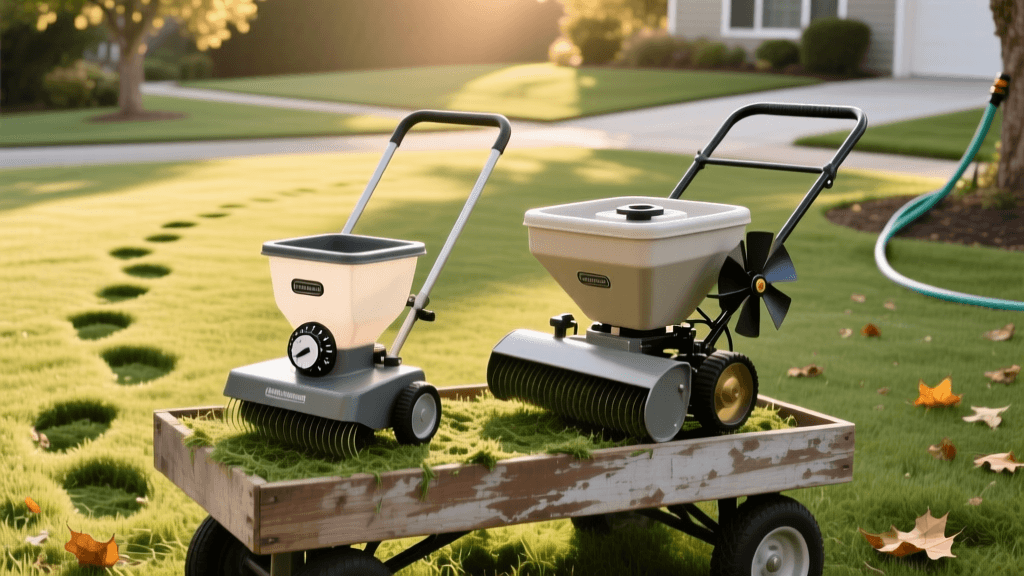
Drop vs. Broadcast Spreaders: Which Lawn Tool is Best?
The Importance of Precision in Lawn Care
Achieving a thick, vibrant, and weed-free lawn requires more than just buying the right fertilizer or grass seed; it requires applying those materials evenly and at the correct rate. Using the wrong application method can lead to striping, fertilizer burn, or wasted product. According to the University of Minnesota Extension, applying the correct amount of nitrogen and ensuring uniform coverage are critical steps in maintaining turfgrass health and preventing environmental runoff.
When it comes to lawn care tools, the spreader is the unsung hero of the equipment shed. Whether you are applying pre-emergent herbicides in the spring, overseeding in the fall, or laying down winterizer, choosing between a drop spreader and a broadcast (rotary) spreader will dictate the efficiency and accuracy of your lawn maintenance routine. This comprehensive guide breaks down the mechanics, pros, cons, and best use cases for both types of spreaders to help you make an informed equipment investment.
Understanding Drop Spreaders
A drop spreader operates on a simple gravity-fed mechanism. As you push the tool forward, a rotating agitator bar inside the hopper stirs the granular material, allowing it to fall through a series of precisely spaced holes along the bottom of the hopper. The material drops directly beneath the spreader in a neat, defined swath.
Pros of Drop Spreaders
- Pinpoint Accuracy: Because the material falls straight down, you have complete control over where the product lands. This makes drop spreaders ideal for lawns with narrow passages, intricate garden beds, or proximity to water features.
- Zero Overspread: You will not accidentally fling fertilizer or weed-and-feed onto your driveway, sidewalk, or neighbor's property, reducing the risk of staining concrete or harming non-target plants.
- Wind Resistance: Since the product drops directly to the soil surface from a height of only a few inches, windy conditions will not disrupt your application pattern.
Cons of Drop Spreaders
- Slower Coverage: Most residential drop spreaders, such as the popular Scotts Classic Drop Spreader, have a swath width of only 22 to 30 inches. Covering a large, open lawn takes significantly more time and physical effort.
- High Risk of Striping: If you do not overlap your wheel tracks perfectly, or if you walk at an inconsistent speed, you will likely see distinct stripes of dark green (over-application) and pale yellow (under-application) in your turf a few days later.
Understanding Broadcast (Rotary) Spreaders
Broadcast spreaders, often referred to as rotary spreaders, use a horizontal spinning disk located beneath the hopper. As the granular material drops from the hopper, it hits the spinning disk and is flung outward in a wide, circular pattern. High-end professional models, like those manufactured by Lesco, can cast materials up to 10 to 12 feet in diameter.
Pros of Broadcast Spreaders
- Rapid Coverage: With a spread pattern ranging from 5 to 12 feet wide, broadcast spreaders can cover large, open lawns in a fraction of the time it takes a drop spreader.
- Forgiving Overlap: The wide, fan-like distribution pattern naturally tapers off at the edges. By overlapping your previous pass by about 50%, you ensure a perfectly even application without the risk of harsh striping lines.
- Versatility: Broadcast spreaders handle a wider variety of granular sizes, from fine grass seed to large, irregularly shaped organic fertilizers and ice melt, without clogging as easily as drop spreader holes.
Cons of Broadcast Spreaders
- Overspread and Waste: Without an edge guard feature, rotary spreaders will fling product onto hardscapes, gardens, and streets. Sweeping up stray fertilizer is a necessary chore to prevent concrete staining and waterway pollution.
- Wind Sensitivity: Applying light materials like grass seed or fine herbicides on a breezy day will result in a highly skewed application pattern, as the wind catches the airborne particles.
Drop vs. Broadcast Spreader Comparison Chart
| Feature | Drop Spreader | Broadcast (Rotary) Spreader |
|---|---|---|
| Application Width | 22 to 30 inches | 5 to 12 feet |
| Best Lawn Size | Small to Medium (Under 5,000 sq ft) | Medium to Large (Over 5,000 sq ft) |
| Accuracy | Extremely High | Moderate to High (with overlap) |
| Wind Interference | None | High |
| Striping Risk | High (requires precise wheel tracking) | Low (forgiving overlap) |
| Ideal For | Complex yards, near water/gardens | Open, expansive, rectangular lawns |
How to Choose the Right Spreader for Your Yard
Your property layout should dictate your equipment purchase. If you live in a suburban neighborhood with a small, rectangular backyard bordered by flower beds, a fence, and a patio, a drop spreader is your safest bet. The precision will save you from having to sweep granular weed-killers off your patio stones, which can cause permanent rust-like stains.
Conversely, if you have a sprawling, half-acre property with wide-open spaces and minimal obstacles, a broadcast spreader is practically mandatory. Pushing a 22-inch drop spreader across 20,000 square feet of turf is an exhausting, time-consuming endeavor. Many homeowners with large properties opt for a tow-behind broadcast spreader that attaches to a riding mower or ATV to save time and physical strain.
Calibration and Application Best Practices
Regardless of the tool you choose, calibration is essential. The Wisconsin Horticulture Division of Extension emphasizes that relying solely on the dial settings printed on fertilizer bags can lead to inaccuracies due to variations in equipment wear and granular density. To ensure accuracy, follow these actionable steps:
1. The Catch-Pan Test
Before applying product to your lawn, place a shallow catch pan or a piece of cardboard on your driveway. Set your spreader dial to the manufacturer's recommended setting and walk over the pan at your normal mowing pace (roughly 3 mph). Weigh the collected granules to ensure the output matches the square-footage coverage rate listed on the product bag.
2. The Perimeter Pass
Always start by walking a continuous perimeter strip around the entire edge of your lawn. This gives you a defined turning area and ensures the borders are fully covered. When using a broadcast spreader, engage the edge-guard feature or shut off the flow while turning to prevent product from flying into garden beds.
3. Maintain a Steady Pace
Your walking speed directly impacts the application rate. Walking too slowly will dump excess product, risking fertilizer burn, while walking too fast will under-apply. Practice a steady, rhythmic walking pace, and always start walking before you open the hopper, and close the hopper before you come to a complete stop.
Environmental Considerations and Runoff Prevention
Proper spreader usage is not just about lawn aesthetics; it is an environmental responsibility. The Environmental Protection Agency (EPA) warns that excess fertilizers and pesticides swept from driveways and sidewalks into storm drains flow directly into local waterways, causing toxic algal blooms and harming aquatic ecosystems.
When using a broadcast spreader near hardscapes, always use a broom to sweep stray granules back onto the grass. Never use a leaf blower or a hose to clear your driveway, as this pushes the chemicals directly into the municipal stormwater system. Furthermore, never fill your spreader on the driveway or patio; always pour granular products over the grass or a tarp to catch accidental spills.
Spreader Maintenance and Storage
Lawn care tools represent a significant financial investment, and spreaders are highly susceptible to rust and corrosion if neglected. Fertilizers and herbicides are essentially salts and corrosive chemicals that will quickly eat through metal hopper frames and seize up axle bearings.
After every single use, empty the hopper completely. Take the spreader to your lawn or driveway and use a garden hose with a spray nozzle to thoroughly rinse the hopper, the agitator bar, and the spinning disk. Allow the spreader to dry completely in the sun. Once a season, apply a light coat of silicone lubricant or WD-40 to the axle wheels, the hopper gate hinge, and the spinning disk shaft to ensure smooth operation and prevent rust during winter storage. By maintaining your equipment, you ensure consistent application rates and extend the lifespan of your tools for years to come.