Tree Care
Choosing Drought-Tolerant Shade Trees for Urban Yards
Transforming Urban Landscapes with Water-Wise Canopies
Urban environments present a unique set of challenges for tree establishment. Between compacted soils, reflected heat from concrete and asphalt, restricted root zones, and increasingly strict municipal water restrictions, planting a traditional shade tree can feel like an uphill battle. However, selecting the right species is the single most important decision a homeowner can make for long-term landscape success. By prioritizing drought-tolerant shade trees, you not only conserve precious water resources but also create a resilient, cooling canopy that enhances property value and local biodiversity.
The Urban Heat Island Effect and the Power of Shade
Cities and densely populated suburbs often suffer from the 'Urban Heat Island' effect, where human-made surfaces absorb and re-emit the sun's heat more than natural landscapes. According to the United States Environmental Protection Agency (EPA), urban heat islands can increase daytime temperatures by up to 7°F compared to outlying rural areas. Strategically planting large, drought-resistant shade trees over driveways, patios, and the west-facing sides of your home can reduce local air temperatures, lower your summer cooling bills by up to 25%, and mitigate the stress on your local water infrastructure.
Top Drought-Tolerant Shade Trees for Urban Yards
When selecting a tree for a water-wise landscape, it is vital to look beyond the nursery tag and consider the tree's mature size, root architecture, and native adaptability. Below is a comparison chart of four exceptional shade trees that thrive in challenging, dry urban conditions once established.
| Species | Mature Height | Canopy Spread | USDA Hardiness Zones | Drought Tolerance |
|---|---|---|---|---|
| Bur Oak (Quercus macrocarpa) | 60-80 ft | 60-80 ft | 3-8 | Exceptional |
| Shumard Oak (Quercus shumardii) | 40-60 ft | 30-40 ft | 5-9 | High |
| Kentucky Coffeetree (Gymnocladus dioicus) | 60-75 ft | 40-50 ft | 3-8 | High |
| Thornless Honeylocust (Gleditsia triacanthos var. inermis) | 30-70 ft | 30-50 ft | 4-9 | High |
1. Bur Oak (Quercus macrocarpa)
The Bur Oak is a majestic, slow-growing giant that is practically bulletproof once its deep taproot is established. Native to the North American plains, it is adapted to survive extreme droughts, harsh winters, and heavy clay soils. Its massive, deeply lobed leaves provide dense, cooling shade. While it requires a large yard due to its expansive canopy, the Bur Oak is an unparalleled legacy tree for homeowners willing to invest in long-term resilience.
2. Shumard Oak (Quercus shumardii)
For those in slightly warmer hardiness zones (5 through 9), the Shumard Oak is a spectacular choice. It offers the classic, sturdy oak form but boasts one of the most brilliant red and orange fall color displays among drought-tolerant species. It adapts remarkably well to urban pollution and alkaline soils, making it a favorite among municipal arborists for street plantings and residential parkways.
3. Kentucky Coffeetree (Gymnocladus dioicus)
Often underutilized in residential landscapes, the Kentucky Coffeetree is a tough, medium-to-large shade tree with a unique, coarse winter silhouette and large, bipinnate compound leaves that create dappled summer shade. It is highly resistant to pests, diseases, and urban smog. Because it casts a lighter shade than oaks, it allows for easier cultivation of shade-tolerant groundcovers or turfgrass beneath its canopy.
4. Thornless Honeylocust (Gleditsia triacanthos var. inermis)
If you need a fast-growing shade tree that establishes quickly and tolerates severe urban stress, the Thornless Honeylocust is a top contender. Cultivars like 'Shademaster' provide an elegant, vase-shaped canopy. Its fine, fern-like foliage turns a beautiful golden yellow in autumn and drops so late and finely that it rarely requires raking, as the small leaflets simply blow away or decompose into the lawn.
Site Assessment and Soil Preparation
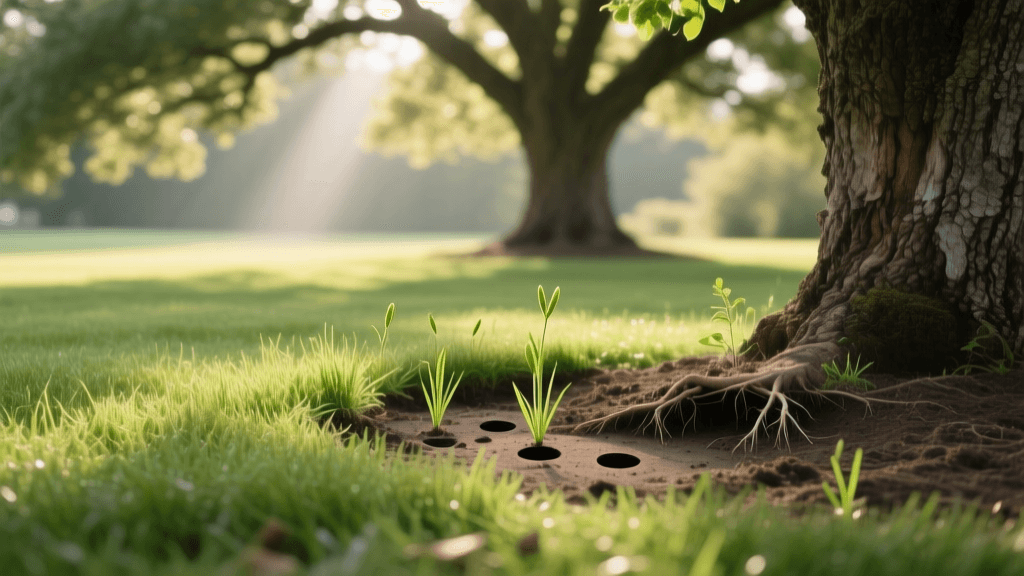
Before purchasing your tree, you must evaluate your site's drainage and soil composition. Urban yards are notorious for compacted subsoils left behind by construction equipment. To test your drainage, perform a simple percolation test: dig a hole 12 inches deep and 6 inches wide, fill it with water, and let it drain completely. Refill it and measure how long it takes to drain. An ideal rate is 1 to 2 inches per hour. If the water sits for more than four hours, you have heavy clay or severe compaction.
When amending heavy clay, avoid the temptation to create a 'bathtub effect' by filling the planting hole entirely with loose potting soil. Water will collect in the loose soil and drown the roots. Instead, use the native soil you dug out, mixing in no more than 20% organic compost by volume, and consider incorporating horticultural biochar to improve long-term moisture retention and microbial activity.
The Establishment Phase: Watering Math
A common misconception is that 'drought-tolerant' means a tree never needs water. In reality, drought tolerance is a trait exhibited by mature trees with expansive root systems. A newly planted tree, regardless of species, requires consistent moisture to survive the critical establishment phase, which typically lasts one to two years.
To ensure deep root growth, follow this actionable watering formula: apply 1 to 1.5 gallons of water per inch of trunk caliper (measured at knee height) per watering session. For a two-inch caliper tree, this means delivering 2 to 3 gallons of water directly to the root ball. The Morton Arboretum emphasizes that deep, infrequent watering is vastly superior to shallow, daily sprinkling. Use a slow-drip soaker hose or a tree watering bag to allow moisture to penetrate deeply into the soil profile. Always water in the early morning to minimize evaporative loss. For comprehensive visual guides on initial planting and watering techniques, the Arbor Day Foundation's Planting Guide is an invaluable resource for homeowners.
Proper Mulching Techniques for Moisture Retention
Mulch is the ultimate tool for water conservation in the urban landscape. A proper layer of organic mulch reduces soil surface evaporation by up to 70%, moderates soil temperature fluctuations, and suppresses water-stealing weeds. Follow the industry-standard '3-3-3 Rule' for mulching:
- 3 Inches Deep: Apply a layer of organic wood chips or shredded bark no deeper than 3 inches. Piling mulch too thick restricts oxygen flow to the shallow feeder roots.
- 3 Feet Wide: Create a mulch ring that extends at least 3 feet in diameter from the trunk. As the tree grows, expand this ring to the edge of the canopy's dripline to eliminate competition from turfgrass.
- 3 Inches Away: Keep the mulch at least 3 inches away from the actual trunk of the tree. Piling mulch against the bark (often called 'volcano mulching') traps moisture against the trunk, inviting fungal pathogens, rot, and girdling roots.
Root Zone Management and Hardscape Clearances
When planting large shade trees in urban settings, spatial awareness is critical. Tree roots require oxygen and physical space to expand. Planting a Bur Oak or Shumard Oak too close to a driveway, retaining wall, or home foundation will inevitably lead to hardscape damage as the structural roots thicken. As a general rule, plant large shade trees at least 15 to 20 feet away from permanent structures.
Before planting, inspect the root ball for circling or girdling roots—a common issue in container-grown nursery stock. Use a sharp hori-hori knife or pruning saw to shave off the outer 1-inch layer of the root ball. This aggressive technique, known as 'root shaving,' severs circling roots and stimulates the growth of new, outward-facing radial roots that will anchor the tree and seek out deep soil moisture.
Conclusion
Selecting a drought-tolerant shade tree is an investment in the future of your property and your local ecosystem. By carefully assessing your site, choosing resilient species like the Bur Oak or Kentucky Coffeetree, and following strict establishment watering and mulching protocols, you can cultivate a magnificent, water-wise canopy that will provide cooling shade and ecological benefits for generations to come.