
Landscaping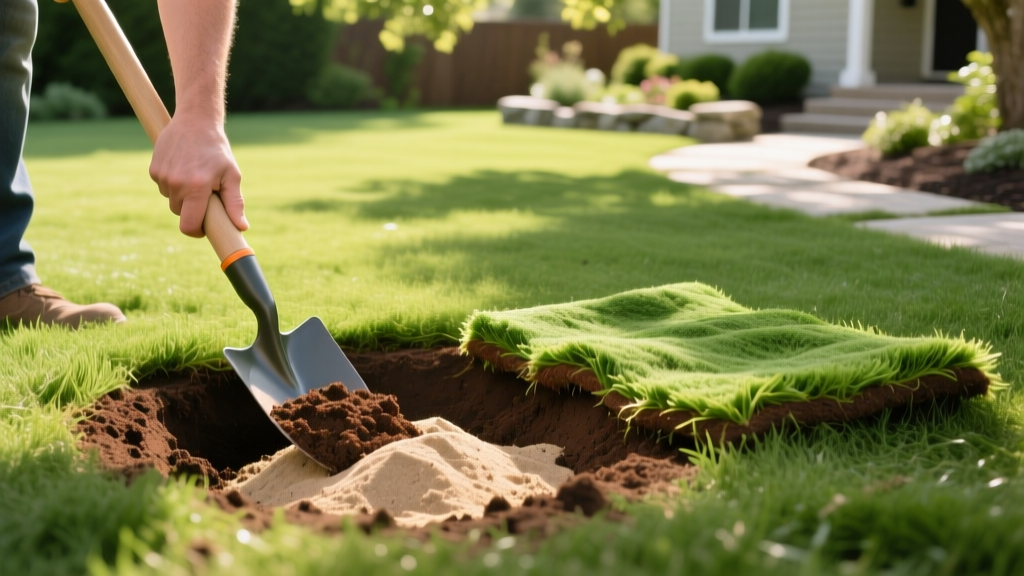
How to Fill Holes in Backyard Yards: Soil, Sand & Sod Fixes
Diagnosing the Hole: Why Your Yard is Sinking
Depressions, animal burrows, and settling soil compromise both the aesthetics and drainage of your landscape. Before buying materials, you must identify the root cause of the void. Filling a hole without addressing the underlying trigger guarantees the ground will resettle within a single season.
Common Backyard Voids
- Rotting Subsurface Wood: Old tree stumps, buried construction debris, or decaying roots leave massive caverns as they decompose. These require deep structural filling, not just surface topdressing.
- Animal Burrows: Voles, groundhogs, and chipmunks create extensive tunnel networks. Simply pouring soil into the entrance will collapse the tunnel and create a secondary sinkhole.
- Soil Settling & Erosion: New construction homes frequently experience soil settling 3 to 5 years post-build as the backfill around the foundation and utility trenches naturally compacts.
The Material Matrix: What to Use for Filling
Selecting the wrong fill material is the most common beginner mistake. Pure play sand drains too fast and leaches nutrients, while heavy clay topsoil compacts into a concrete-like barrier that suffocates turf roots. According to turfgrass specialists at University of Minnesota Extension, a balanced loam mixture is critical for long-term structural integrity and root health.
| Material | Best Use Case | Cost Estimate | Drainage & Notes |
|---|---|---|---|
| 70/30 Topsoil & Compost Mix | Lawn depressions, garden bed leveling, general yard grading. | $35-$45 per cubic yard (bulk) | Optimal. Retains moisture while allowing excess water to percolate. |
| Masonry Sand | Base layer for hardscapes, filling deep structural voids under patios. | $25-$35 per cubic yard (bulk) | Fast drainage. Lacks organic matter; will not support grass growth alone. |
| Pure Compost | Topdressing existing lawns (max 1/4 inch depth), enriching garden beds. | $40-$60 per cubic yard (bulk) | High water retention. Will shrink significantly as microbes break it down. |
| 3/4-Inch Clean Crushed Stone | Plugging animal burrows, French drain bases, deep erosion gullies. | $50-$70 per cubic yard (bulk) | Zero compaction. Deters re-digging by rodents due to sharp edges. |
The Volume Calculation Formula
Bagged soil from big-box stores costs roughly $3.00 to $5.00 per cubic foot (a standard 40lb bag yields about 0.75 cubic feet). If your hole requires more than 5 cubic feet of fill, switch to bulk delivery or pick up a truckload from a local landscape supply yard to cut costs by up to 60%. Use this formula to calculate your needs:
Cubic Yards Needed = (Length in feet × Width in feet × Depth in feet) ÷ 27
How to Fill Holes in Backyard Lawns (Step-by-Step)
Repairing a sunken area in a turfgrass lawn requires a specific layering technique to ensure the new grass integrates seamlessly with the existing root zone. Research from the UMass Amherst Turf Program emphasizes that proper soil-to-seed contact and compaction are the primary drivers of successful lawn patching.
- Cut and Peel the Sod: If the hole is in an active lawn, do not just dump soil over the existing grass. Use a half-moon edger or a sharp spade to cut a square around the depression. Peel back the living turf like a carpet and set it aside on a piece of cardboard.
- Loosen the Subgrade: Use a True Temper 4-Tine Spading Fork to pierce and loosen the hard-packed clay at the bottom of the exposed hole. This prevents a distinct barrier from forming between the old subsoil and your new fill.
- Add the Fill Mix: Shovel your 70/30 topsoil and compost mix into the void. Crucial Step: Overfill the hole by exactly 10% to 15%. Soil naturally settles by this amount after the first three heavy rain events.
- Tamp and Level: Do not use your foot to pack the soil; human weight only achieves roughly 40% compaction and leaves air pockets. Use an 8-inch steel hand tamper (such as the Bon Tool 8-Inch Steel Tamper, approx. $35) to compact the soil until it sits exactly flush with the surrounding subgrade.
- Replace and Topdress: Lay the peeled sod back over the patch. If the sod is dead or the hole was bare dirt, spread a high-quality grass seed (matched to your existing lawn) and cover with 1/8 inch of peat moss or straw mulch to retain moisture during germination.
⚠️ Warning: The Nitrogen Tie-Up Effect
Never fill backyard holes with raw wood chips, sawdust, or uncomposted mulch. As soil microbes break down these high-carbon materials, they consume massive amounts of nitrogen from the surrounding soil. This process, known as nitrogen tie-up, will starve the surrounding grass, creating a distinct yellow halo around the patched area that can persist for up to two years.
Fixing Animal Burrows and Hardscape Voids
Holes created by wildlife or erosion near retaining walls require a completely different structural approach than lawn depressions.
Plugging Rodent and Groundhog Tunnels
If you fill a groundhog burrow with soft topsoil, the animal will simply excavate it again the following night. To permanently seal an active tunnel:
- Clear loose debris from the tunnel entrance.
- Pour 3/4-inch clean crushed stone into the hole until it is filled to within 4 inches of the surface. The sharp, heavy stones deter digging and collapse the tunnel architecture.
- Cap the final 4 inches with your 70/30 topsoil mix and tamp it flush with the surrounding grade.
Settling Near Retaining Walls and Patios
When soil washes out from under pavers or retaining wall blocks, the structural integrity of the hardscape is compromised. Do not use organic topsoil here; organics decompose and shrink. Instead, use masonry sand or polymeric sand. Sweep the sand deep into the voids using a stiff push broom, then mist with a garden hose. The water activates the polymers (if using polymeric sand) or settles the masonry sand into a rigid, erosion-resistant lock.
Critical Mistakes That Cause Resettling
Even experienced DIYers make errors that lead to callback sinkholes. Avoid these common pitfalls to ensure your repair lasts:
- Filling During Heavy Rain: Working wet soil destroys its granular structure, turning loam into dense, impermeable clay clods that will eventually crack and sink. Always fill holes when the subgrade is moist but not saturated.
- Ignoring Utility Lines: Before digging out or tamping down any hole deeper than 12 inches, call 811 to have local utility lines marked. Tamping blindly over a shallow irrigation or gas line can cause catastrophic damage.
- Using Fill Dirt Instead of Topsoil: "Fill dirt" is often heavily clay-based subsoil scraped from construction sites. It is excellent for building structural mounds but terrible for the top 6 inches of a yard where grass roots need oxygen and organic matter.
Frequently Asked Questions
Can I use potting soil to fill holes in my yard?
No. Potting soil is engineered to be extremely lightweight and porous, containing high amounts of peat moss, perlite, and vermiculite. If used outdoors in a yard void, it will dry out rapidly, blow away in the wind, and fail to provide the structural density needed to support foot traffic or turfgrass roots.
How long does it take for grass to grow over a filled hole?
If you are planting seed over the patched area, cool-season grasses (like Kentucky Bluegrass or Fescue) typically germinate in 7 to 14 days, while warm-season grasses (like Bermuda or Zoysia) take 10 to 21 days. Keep the patched area consistently moist—but not muddy—during this window.
Should I add fertilizer to the fill soil?
According to guidelines from the Penn State Turfgrass Program, it is best to avoid heavy synthetic fertilizers directly in the fill mix, as they can burn delicate new seedling roots. Rely on the nutrients provided by the compost in your 70/30 mix, and apply a gentle starter fertilizer (like a 18-24-12 NPK ratio) only after the new grass has been mowed for the first time.

