Lawn Care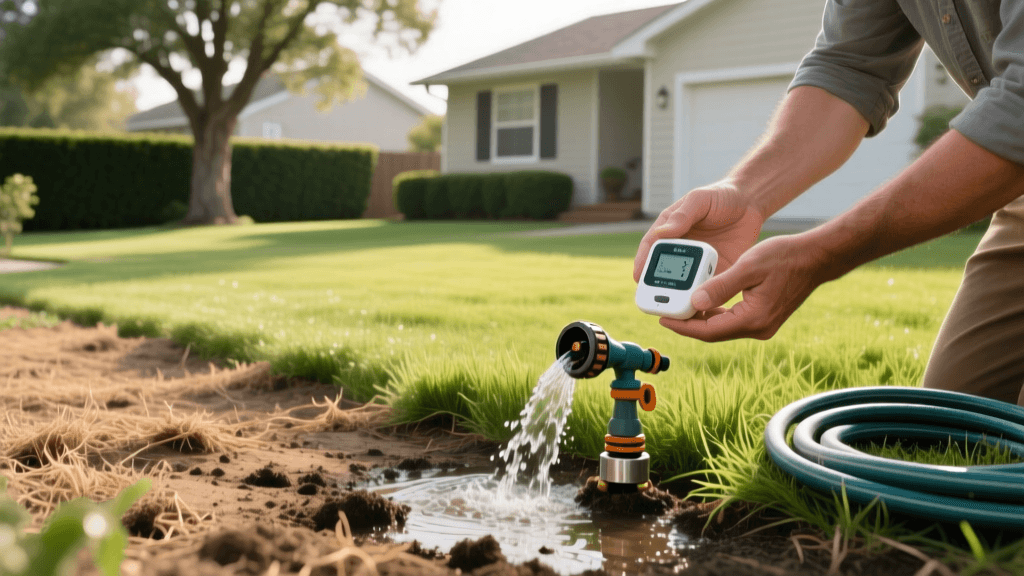
The 7 Biggest Lawn Watering Mistakes and Easy Fixes
Introduction: The High Cost of Irrigation Errors
Watering your lawn seems like a straightforward task: turn on the hose or set the sprinkler timer, and watch the grass grow. However, improper irrigation is the leading cause of turf stress, fungal disease, and wasted utility bills. According to EPA WaterSense, outdoor water use accounts for up to 60% of total household water consumption during the summer months. When you make irrigation errors, you are literally watching your money evaporate into thin air or run off into the storm drain.
Whether you are maintaining a cool-season Kentucky Bluegrass lawn in the North or a warm-season Bermudagrass lawn in the South, understanding the science of turf hydration is critical. Below, we break down the seven most common lawn watering mistakes and provide actionable, expert-backed fixes to help you achieve a lush, resilient landscape.
Mistake 1: Watering at the Wrong Time of Day
The Mistake: Many homeowners set their sprinklers to run in the middle of the afternoon or late at night. Watering at noon leads to massive water loss due to evaporation and wind drift. Conversely, watering late at night leaves the grass blades wet for extended periods, creating the perfect breeding ground for fungal diseases like Brown Patch and Dollar Spot.
The Fix: The optimal window for irrigation is between 4:00 AM and 8:00 AM. During this time, temperatures are at their lowest, wind speeds are minimal, and the water has time to soak deeply into the soil before the sun evaporates it. Furthermore, the grass blades will dry quickly once the sun rises, significantly reducing the risk of fungal pathogens taking hold.
Mistake 2: Watering Too Frequently and Too Shallowly
The Mistake: Running your sprinklers for 10 to 15 minutes every single day is one of the most detrimental habits for turf health. Frequent, shallow watering encourages grass roots to stay near the surface where moisture is readily available. This results in a shallow root system that is highly vulnerable to drought stress, heat damage, and weed invasion.
The Fix: Lawns require deep, infrequent watering to encourage roots to grow downward in search of moisture. According to the University of Minnesota Extension, most established lawns need about 1 to 1.5 inches of water per week, either from rainfall or irrigation. Water deeply two or three times a week rather than giving the lawn a light sprinkle every day.
Pro Tip: Use the screwdriver test to check soil moisture. If you can easily push a 6-inch screwdriver into the soil, your lawn has adequate deep moisture. If it meets resistance before the 4-inch mark, it is time to water.
Mistake 3: Ignoring Soil Infiltration Rates
The Mistake: Applying water faster than the soil can absorb it leads to puddling and runoff. This is especially common in lawns with heavy clay soils or compacted earth. If your sprinklers output 1.5 inches of water per hour, but your clay soil can only absorb 0.2 inches per hour, the excess water simply washes away, carrying expensive fertilizers with it.
The Fix: Implement the 'Cycle and Soak' method. Instead of running a zone for 30 continuous minutes, break it into three 10-minute cycles, allowing 30 minutes of soak time between each cycle. This gives heavy soils the necessary time to absorb the moisture without generating wasteful runoff.
Mistake 4: Mixing Sprinkler Head Types on One Zone
The Mistake: A common flaw in older or poorly designed irrigation systems is mixing rotor heads and spray heads on the same valve zone. Spray heads emit water at a much higher precipitation rate (approx. 1.5 inches per hour) compared to rotors (approx. 0.4 inches per hour). If they run simultaneously, the area near the spray heads will be flooded while the rotor areas remain dry.
The Fix: Practice proper 'hydro-zoning.' Ensure that each irrigation zone consists of only one type of sprinkler head with matched precipitation rates. If your system is mismatched, consult an irrigation professional to re-pipe the zones or swap the nozzles to matched-precipitation rotator nozzles (like the MP Rotator), which deliver water slowly and evenly.
Mistake 5: Forgetting to Adjust for Rainfall and Seasons
The Mistake: Leaving your sprinkler timer on the same 'set it and forget it' schedule from May through September guarantees you will overwater during rainy weeks and underwater during peak August heat. Overwatering not only wastes resources but also suffocates grassroots by displacing oxygen in the soil.
The Fix: Upgrade your irrigation controller. Installing a rain sensor (costing around $35 to $50) will automatically shut off your system during precipitation. For a more robust solution, invest in a Smart Wi-Fi Controller like the Rachio 3 or Orbit B-hyve (ranging from $150 to $250). These devices connect to local weather stations and automatically adjust your watering schedule based on real-time evapotranspiration (ET) rates, rainfall forecasts, and seasonal shifts.
Mistake 6: Failing to Perform an Irrigation Audit
The Mistake: Assuming your sprinkler system is distributing water evenly without ever checking. Clogged nozzles, sunken heads, and misaligned sprays can create massive dry spots and soggy puddles in the same yard.
The Fix: Perform a 'Catch Can Test' (often called the Tuna Can Test) at least once a season.
- Place 4 to 6 flat, straight-sided containers (like empty tuna cans) at various distances from the sprinkler heads in a single zone.
- Run the zone for exactly 15 minutes.
- Measure the water depth in each can with a ruler.
- Calculate the average depth and multiply by 4 to determine your system's hourly precipitation rate.
- Adjust run times or fix misaligned heads based on the variance between cans.
Mistake 7: Mismanaging Water for New Seed or Sod
The Mistake: Treating new seed or freshly laid sod like an established lawn. New seed will die if the top inch of soil dries out, while new sod will rot if it is kept constantly saturated without deeper root encouragement.
The Fix: Follow a phased watering schedule. For new seed, water lightly 3 to 4 times a day (5-10 minutes each) to keep the top inch of soil consistently moist until germination occurs. For new sod, water heavily immediately after installation to soak the sod and the top 2 inches of native soil. Over the next two weeks, gradually reduce the frequency of watering while increasing the duration to force the new roots to knit into the native soil below.
Cool-Season vs. Warm-Season Watering Guide
Understanding your specific turfgrass type is essential for dialing in your irrigation schedule. The experts at University of Nebraska-Lincoln Turfgrass Science emphasize that warm-season grasses generally require less water and possess higher drought tolerance than their cool-season counterparts.
| Grass Type | Classification | Weekly Water Needs | Drought Tolerance | Visual Wilt Signs |
|---|---|---|---|---|
| Kentucky Bluegrass | Cool-Season | 1.0 - 1.5 inches | Moderate | Bluish-gray hue, footprints remain |
| Tall Fescue | Cool-Season | 1.0 - 1.5 inches | High | Leaf rolling, dull color |
| Perennial Ryegrass | Cool-Season | 1.0 - 1.5 inches | Low | Rapid wilting, browning tips |
| Bermudagrass | Warm-Season | 0.5 - 1.0 inches | Very High | Grayish tint, folded leaves |
| Zoysiagrass | Warm-Season | 0.5 - 1.0 inches | High | Leaf rolling, slight yellowing |
| St. Augustinegrass | Warm-Season | 0.75 - 1.25 inches | Moderate | Bluish-gray fold, slow recovery |
Conclusion: Water Smarter, Not Harder
Correcting your lawn watering mistakes does not require a complete landscape overhaul. By shifting to deep, infrequent watering cycles, utilizing the cycle-and-soak method for clay soils, and upgrading to a smart weather-based controller, you can drastically reduce your water bill while cultivating a deeper, more resilient root system. Take the time to audit your sprinkler heads this weekend, adjust your timer to the early morning hours, and watch your lawn transform into a thick, vibrant carpet of green.