
Landscaping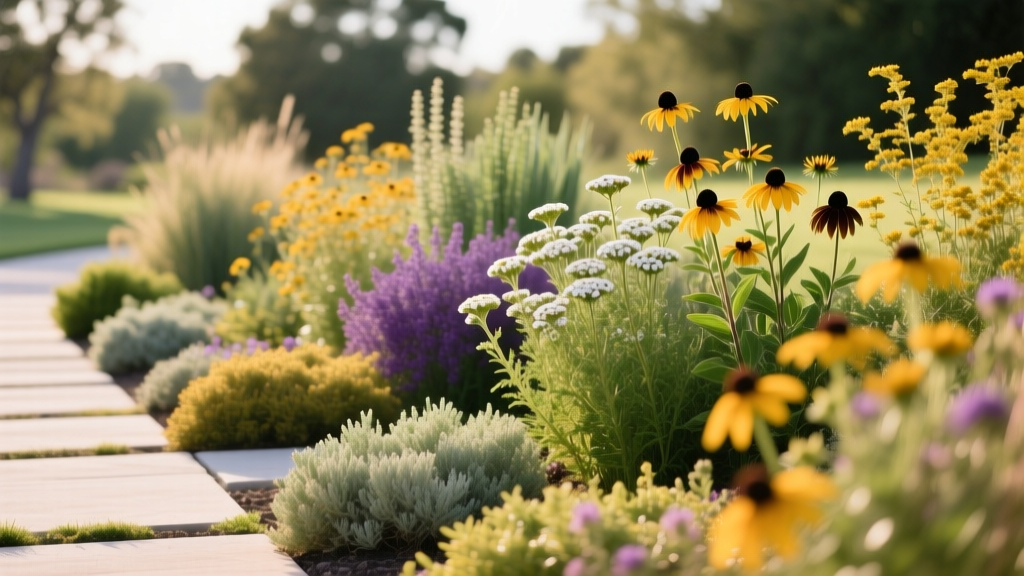
Low Maintenance Native Plant Borders For Sunny Areas
Designing for Resilience and Simplicity
Native plant borders in full sun offer a strategic response to increasing climate volatility, water scarcity, and labor constraints in residential and institutional landscapes. Rather than treating plant selection as an aesthetic afterthought, landscape architects integrate ecological function, spatial hierarchy, and long-term stewardship into the earliest design phases. The American Society of Landscape Architects (ASLA) emphasizes that “sustainable site design begins with understanding regional plant communities and soil hydrology” (ASLA, 2021). This principle is especially critical in sunny, well-drained microclimates—such as those found on south-facing slopes or paved perimeters—where evapotranspiration rates exceed 8 mm/day during peak summer months.
Low-maintenance native borders reduce annual upkeep by up to 70% compared to non-native perennial beds, according to a three-year comparative study conducted at the University of California, Davis Arboretum (UC Davis, 2022). These reductions stem from decreased irrigation needs, minimal pruning, no chemical fertilization, and natural resistance to local pests. Design success hinges not only on species choice but also on thoughtful spatial organization: layering height, bloom sequence, root architecture, and seasonal structure ensures visual continuity without intensive intervention.
Core Plant Palette for Full-Sun Sites
Selecting species requires alignment with USDA Hardiness Zones 5–9, soil pH (typically 5.5–7.2), and drought tolerance metrics. All recommended plants are documented in the Lady Bird Johnson Wildflower Center’s Native Plant Database and meet ASLA’s criteria for “regionally appropriate, non-invasive, and pollinator-supportive” (ASLA, 2021). Each has demonstrated survival without supplemental irrigation after establishment (defined as 12 consecutive weeks post-planting).
Structural Anchors (3–5 ft tall)
- Echinacea pallida — Pale purple coneflower; forms dense clumps, blooms June–September; mature width: 18–24 in; cost: $6.50–$9.25 per 1-gallon container
- Rudbeckia maxima — Giant coneflower; architectural foliage with tall flowering stalks; tolerates clay soils; cost: $8.75–$11.50 per 1-gallon container
Mid-Level Fillers (1.5–3 ft tall)
- Baptisia australis — Blue false indigo; nitrogen-fixing, deer-resistant, deep taproot; matures in 3–4 years; cost: $12.00–$15.50 per 1-gallon container
- Solidago rugosa ‘Fireworks’ — Upright goldenrod cultivar; blooms September–October; spreads slowly via rhizomes; cost: $7.25–$9.75 per 1-gallon container
Groundcover & Edging (under 18 in tall)
Coreopsis verticillata ‘Zagreb’ offers fine-textured foliage and lemon-yellow flowers from May through October. It tolerates poor soils and requires zero staking. At the Chicago Botanic Garden’s Regenstein Learning Campus, this cultivar achieved 92% ground coverage within 14 months across 1,200 sq ft of border, with only two hand-weedings required annually.
Schizachyrium scoparium (little bluestem) provides year-round structure, turning copper-red in fall and persisting upright through winter. Its fibrous root system stabilizes slopes up to 3:1 (horizontal:vertical) and reduces erosion by 40% compared to mulched bare soil (USDA Natural Resources Conservation Service, 2020).
Quantitative Design Framework
Effective installation balances density, spacing, and square footage economics. Overcrowding increases disease risk and competition; underplanting invites weed incursion. A standard 30-linear-foot border, 3 ft deep, covers 90 sq ft. For layered planting, use these spacing guidelines:
| Plant Type | Spacing (in) | Plants per 100 sq ft | Estimated Installed Cost (2024) |
|---|---|---|---|
| Structural anchors | 36–48 | 6–8 | $65–$110 |
| Mid-level fillers | 24–30 | 12–16 | $110–$180 |
| Groundcovers | 12–18 | 32–48 | $75–$125 |
Total material cost for a 90-sq-ft border ranges from $250 to $415, excluding labor. Professional installation adds $2.75–$4.20 per sq ft depending on site access and soil prep. At the Brooklyn Botanic Garden’s Native Flora Garden renovation (2023), 2,400 sq ft of new native border was installed at $3.80/sq ft, achieving 98% plant survival at 18 months.
Soil preparation is non-negotiable: remove turf to 2 in depth, incorporate 1.5 in of compost *only if soil organic matter is below 3%* (per ASLA soil health guidelines), and avoid tilling deeper than 4 in to preserve mycorrhizal networks. Mulch with 1.5 in of shredded hardwood—not bark nuggets—to suppress weeds while permitting seedling emergence.
Hardscape Integration Principles
Native borders perform best when framed by intentional hardscaping. Permeable pavers adjacent to borders reduce runoff velocity and allow root zone infiltration. At the University of Washington’s Ecological Landscape Lab, 24-in-wide decomposed granite edging reduced edge encroachment by Bromus inermis by 65% over five years compared to mulch-only edges.
Vertical transitions matter: raised beds exceeding 12 in in height create microclimates that increase soil temperature and decrease moisture retention—unsuitable for shallow-rooted natives like Asclepias tuberosa. Instead, use gentle berms no higher than 6 in, sloped at 3:1, to direct sheet flow toward bioswales or rain gardens. Curvilinear edges—following the “golden ratio” proportioning used in ASLA award-winning projects—enhance perceived spaciousness and reduce mowing frequency along lawn interfaces.
Maintenance Protocols Beyond Establishment
After the first growing season, maintenance drops to two scheduled interventions annually: late-winter cutback (mid-February to early March) and selective thinning (late July). Cut back all herbaceous stems to 4–6 in above crown level—this encourages basal branching and prevents lodging. Thinning removes 15–20% of oldest stems per species to improve air circulation and light penetration.
Monitor for invasive non-natives such as Polygonum cuspidatum (Japanese knotweed), which can colonize disturbed edges. At the Missouri Botanical Garden’s Shaw Nature Reserve, targeted hand-removal within 12 inches of border edges reduced knotweed incidence by 91% over four years.
Irrigation, if used at all, should be delivered via drip lines placed 3 in from plant crowns—not overhead sprinklers. Drip emitters should deliver 0.5–0.75 gallons per hour per plant, activated only when top 2 in of soil registers >15% volumetric water content (measured with calibrated TDR sensors). This protocol cuts water use by 85% versus conventional spray zones.
“Native borders are not ‘set-and-forget’—they’re ‘observe-and-refine.’ Their value emerges from responsive management aligned with phenology, not rigid schedules.” — Dr. Elena Torres, Senior Ecologist, Lady Bird Johnson Wildflower Center, 2023
Replanting is rare: Baptisia australis commonly survives 25+ years; Schizachyrium scoparium persists 15–20 years with no decline in vigor. When replacement is needed, source stock from local ecotypes—ideally within 100 miles of the planting site—to maintain genetic integrity and co-evolved pollinator relationships. The North Carolina Botanical Garden’s Seed Bank mandates that all restoration stock be collected within the same river basin as the planting location.
Annual observation logs—recording first bloom date, peak pollinator activity, and foliar health—provide empirical data for future design refinements. At UC Davis, such logs informed revisions to their campus-wide native planting standards, reducing failure rates from 12% to 3.4% between 2019 and 2023.
These borders also serve pedagogical functions: at the Brooklyn Botanic Garden, interpretive signage tied to each species’ role in carbon sequestration (e.g., Schizachyrium scoparium stores 0.87 kg C/m²/year) enhances public engagement while reinforcing ecological literacy.
Full-sun native borders exemplify how ecological fidelity and human-centered design converge—not as compromise, but as calibrated synergy. When rooted in measurement, regional knowledge, and iterative observation, they become enduring features rather than seasonal accents.

