Tree Care
Managing Tree Shade and Roots During Lawn Renovation
The Challenge of Trees in Lawn Renovation
Undertaking a complete lawn renovation is one of the most rewarding projects a homeowner can tackle. Whether you are recovering from drought damage, eliminating invasive weeds, or simply upgrading to a premium turf blend, the process requires meticulous soil preparation, precise seeding, and consistent watering. However, when your yard features mature trees, lawn recovery becomes a complex balancing act. Trees and turfgrass are natural competitors, fighting for the same essential resources: sunlight, water, and soil nutrients.
If you attempt to renovate a lawn beneath a dense canopy using standard full-sun techniques, your new grass will likely thin out, turn yellow, and fail within the first season. Conversely, aggressive lawn preparation methods can severely damage the trees you are trying to coexist with. To achieve a lush, recovered lawn that thrives alongside your landscape's arboreal giants, you must adopt specialized tree care and turf management strategies. This guide will walk you through the exact steps to manage tree shade, protect critical root zones, and select the right grass varieties for a successful lawn renovation.
The Hidden Conflict: Tree Roots vs. Turfgrass
Before you rent a rototiller or order topsoil, you must understand the subterranean battlefield beneath your yard. According to tree health experts at The Morton Arboretum, the vast majority of a tree's fine, water-absorbing feeder roots are located in the top 6 to 12 inches of soil. This is the exact same soil profile where turfgrass roots establish themselves.
Why Deep Tilling is a Tree Killer
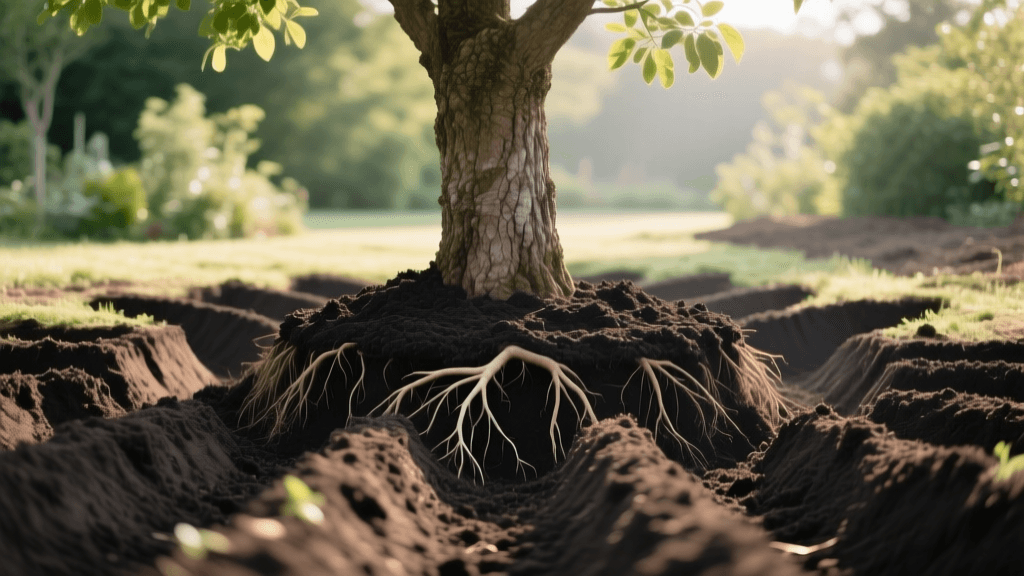
During a standard lawn renovation, contractors often recommend deep tilling to break up compacted soil and incorporate organic compost. While this is excellent for open, sunny areas, tilling within a tree's dripline (the area directly beneath the outermost branches) is catastrophic. Tilling severs the delicate feeder roots responsible for absorbing water and nutrients. A severed root system can lead to canopy dieback, increased susceptibility to borers and fungal diseases, and in severe cases, the structural failure of the entire tree.
Safe Soil Aeration Techniques
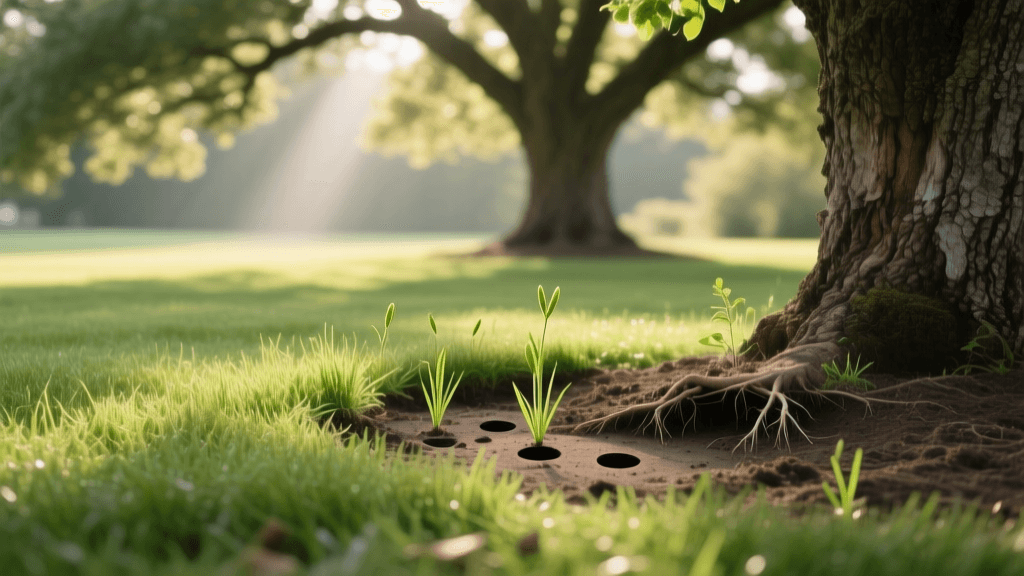
Instead of tilling, use a core aerator to relieve soil compaction around trees. Core aeration pulls small plugs of soil (typically 2 to 3 inches deep and 0.5 inches in diameter) from the ground, allowing oxygen, water, and fertilizer to reach both the grass and the tree roots without causing massive root trauma. For areas heavily dominated by surface roots, switch to a liquid aeration product containing humic and fulvic acids, which soften the soil chemically without mechanical disruption.
Canopy Management: Pruning for Light Penetration
Turfgrass generally requires a minimum of four to six hours of direct sunlight to survive, and ideally eight hours to thrive. If your lawn renovation is failing due to shade, you must modify the tree canopy to allow more photosynthetically active radiation (PAR) to reach the soil surface.
- Crown Thinning: This involves the selective removal of smaller, interior branches (typically 1 to 2 inches in diameter) throughout the canopy. The goal is to create small 'windows' that allow dappled sunlight to reach the grass below. Never remove more than 15% to 20% of the live canopy in a single season, as over-pruning stresses the tree and triggers a flush of weak, watersprout growth.
- Crown Raising: This technique involves removing the lowermost branches to elevate the bottom of the canopy. Raising the canopy to a height of 8 to 10 feet allows early morning and late afternoon sun to penetrate underneath the tree, significantly improving the light conditions for the turf below.
- Deadwood Removal: Clearing out dead, diseased, or crossing branches not only improves the health and safety of the tree but also incrementally increases light penetration to the recovering lawn.
Always hire an ISA-Certified Arborist for canopy modifications. Improper pruning cuts can introduce decay pathogens that will compromise the tree's long-term health, ultimately defeating the purpose of your landscape renovation.
Selecting Shade-Tolerant Grasses for Recovery
If you are overseeding or laying new sod in tree-dominated zones, you must abandon full-sun grasses like Kentucky Bluegrass or Bermudagrass. Research from the University of Minnesota Turfgrass Science program highlights that fine fescues are the undisputed champions of shaded environments. Below is a comparison chart to help you select the right seed blend for your specific renovation needs.
| Grass Type | Shade Tolerance | Drought Tolerance | Traffic Tolerance | Best Application |
|---|---|---|---|---|
| Fine Fescue Blend | Excellent | High | Low | Deep shade, low-traffic tree zones |
| Tall Fescue (Turf-type) | Good | Excellent | High | Dappled shade, active family yards |
| Rough Bluegrass | Good | Poor | Low | Moist, heavily shaded cool areas |
| St. Augustine | Good | Moderate | Moderate | Warm-season shaded lawns |
Actionable Tip: For cool-season lawns, look for a 'Shade Mix' that contains at least 60% Chewing Fescue, Creeping Red Fescue, or Hard Fescue. Brands like Jonathan Green Black Beauty Ultra or Scotts Turf Builder Dense Shade offer formulated blends that include endophytes—beneficial fungi that live inside the grass blade and naturally deter surface-feeding insects.
Watering and Fertilizing in Tree Zones
A common mistake during lawn recovery is applying a uniform watering and fertilizing schedule across the entire yard. Trees act as massive biological pumps, drawing gallons of water from the soil daily. Consequently, the soil beneath a tree canopy dries out much faster than soil in open, sunny areas.
Strategic Irrigation
During the seed germination phase, the top inch of soil must remain consistently moist. In tree zones, this may require watering three to four times a day for short durations, compared to twice a day in sunny zones. Once the grass is established, transition to deep, infrequent watering. Apply 1 to 1.5 inches of water per week, utilizing a rain gauge or empty tuna can to measure output. Deep watering encourages both the grass and the tree to send roots deeper into the soil profile, reducing surface competition.
Fertilizer Adjustments
Turfgrass in shaded areas grows more slowly and requires less nitrogen than grass in full sun. Applying high-nitrogen, quick-release fertilizers to shaded turf forces rapid, weak leaf growth that depletes the plant's carbohydrate reserves, making it highly susceptible to disease. Use a slow-release, organic fertilizer (such as Milorganite or Espoma Organic Lawn Food) at a reduced rate—about 50% of what you would apply to the sunny sections of your lawn.
When to Abandon Grass: Mulch and Groundcovers
Sometimes, the best tree care decision you can make during a lawn renovation is to stop trying to grow grass. If an area receives less than three hours of dappled sunlight per day, or if the ground is dominated by massive, exposed surface roots (common with species like Silver Maples, Willows, and Poplars), turfgrass will inevitably fail.
In these zones, transition from turf to mulch or shade-tolerant groundcovers. This eliminates the need for mowing near the trunk, which frequently causes 'mower blight'—mechanical damage to the tree's bark that invites fatal pathogens. The Arbor Day Foundation strongly advocates for proper mulching to protect tree health and conserve soil moisture.
The 3-3-3 Mulching Rule
When installing mulch around your trees during the landscape renovation, adhere strictly to the 3-3-3 rule to prevent trunk rot and girdling roots:
- 3 Inches Deep: Apply a layer of organic mulch (like shredded hardwood bark or pine straw) no deeper than 3 inches. Deeper mulch restricts oxygen flow to the roots.
- 3 Feet Wide (Minimum): Extend the mulch ring at least 3 feet from the trunk, though extending it to the dripline is ideal for reducing grass competition.
- 3 Inches Away from the Trunk: Never let mulch touch the bark of the tree. Keep a 3-inch gap around the base to prevent moisture buildup, which attracts rodents and encourages fungal collar rot.
Conclusion: A Balanced Landscape
Successful lawn renovation in a tree-dominated yard requires a shift in perspective. You are not just growing grass; you are managing a complex, shared ecosystem. By protecting the critical root zone from mechanical damage, selectively pruning the canopy to optimize light, choosing genetically shade-tolerant grass varieties, and knowing when to substitute turf with mulch, you can achieve a stunning, recovered landscape. Prioritizing the health of your trees during the renovation process ensures that both your turf and your canopy will thrive together for decades to come.