
Landscaping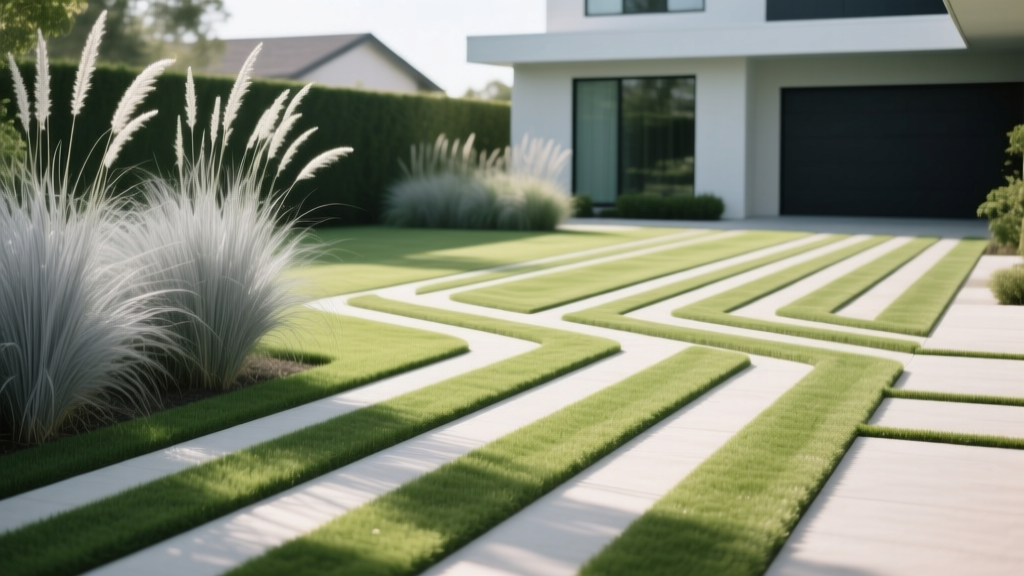
Modern Minimalist Front Yard Striping & Grass Patterns 2026
James MillerPublished
In 2026, the modern minimalist front yard has evolved beyond stark concrete and solitary agave plants. Today’s premier landscape designs emphasize a deliberate, high-contrast interplay between structured turf art and the soft, architectural movement of ornamental grasses. When you combine the crisp, light-reflecting geometry of lawn striping with the disciplined placement of minimalist ornamental grasses, you create a dynamic curb appeal that feels both manicured and effortlessly natural. This guide explores how to master this exact aesthetic, leveraging the latest 2026 turf cultivars, mowing technologies, and design principles.
The Philosophy of Minimalist Turf Art
Minimalism in landscaping relies on the principle that every element must serve a distinct visual or functional purpose. In a modern front yard, the lawn acts as a living canvas. According to landscape design principles, the human eye is naturally drawn to contrast. By employing precise lawn striping, you manipulate the direction of the grass blades to create alternating bands of light and dark. This geometric foundation provides a sense of order and calm.
To prevent the yard from feeling sterile or overly rigid, ornamental grasses are introduced as softscape focal points. Unlike traditional flowering shrubs that require heavy pruning and create visual clutter, ornamental grasses offer verticality, seasonal color shifts, and gentle movement in the wind. The juxtaposition of the rigid, linear mowing patterns against the feathery, chaotic plumes of grasses like Karl Foerster or Blue Fescue is the hallmark of 2026’s most sought-after minimalist landscapes.
Top Ornamental Grasses for Minimalist Front Yards
Selecting the right grass species is critical. You want plants that grow in tight, architectural clumps rather than spreading aggressively via rhizomes, which would ruin your clean lawn edges. The University of Minnesota Extension recommends clump-forming grasses for their low maintenance and structural integrity. Below is a comparison of the top varieties suited for modern minimalist designs:
| Variety | Botanical Name | Mature Height | Visual Texture | Striping Contrast |
|---|---|---|---|---|
| Karl Foerster Feather Reed | Calamagrostis x acutiflora | 3-5 feet | Strictly vertical, golden wheat-like plumes | High (Vertical vs. Horizontal lines) |
| Elijah Blue Fescue | Festuca glauca | 8-12 inches | Compact, silvery-blue mounds | Medium (Color contrast with green turf) |
| Regal Mist Muhly | Muhlenbergia capillaris | 2-3 feet | Cloud-like pink/purple fall plumes | High (Softens harsh geometric edges) |
| Adagio Miscanthus | Miscanthus sinensis 'Adagio' | 3-4 feet | Silver-green arching blades | Medium (Adds silver tones to palette) |
Selecting the Right Turf for Crisp 2026 Striping
Not all lawn grasses stripe equally well. The physics of striping relies on bending the grass blade so that the waxy, light-reflecting underside faces the viewer in one direction, while the darker, light-absorbing top faces the viewer in the other. Cool-season grasses with broader blades generally yield the most dramatic results.
For northern and transitional zones in 2026, elite Turf-Type Tall Fescue (TTTF) blends like 'Firewall' and 'Titan Ultra', alongside premium Kentucky Bluegrass (KBG) cultivars, are the gold standard. Look for modern cultivars that have been bred for deep green color and disease resistance, which ensures the dark stripes appear rich rather than washed out. For southern zones, TifTuf Bermuda and Zenith Zoysia offer improved blade flexibility and density, allowing for tighter, more defined stripes than older warm-season varieties. Maintaining a mowing height between 2.5 and 3.5 inches is essential; cutting the grass too short reduces the surface area available to bend, resulting in faint, unimpressive patterns.
Geometric Mowing Patterns for Minimalist Designs
While a traditional checkerboard is a classic staple of turf art, modern minimalist design demands a more restrained approach. Overly complex patterns, such as tight concentric circles or intricate waves, introduce visual noise that clashes with the clean lines of contemporary architecture. Instead, focus on these three minimalist striping patterns:
1. The Linear Corridor
This is the ultimate minimalist pattern. Stripes are mowed in straight lines that run either perfectly parallel or perfectly perpendicular to the primary architectural lines of your home or driveway. This technique elongates the yard and draws the eye directly toward the front entrance. It pairs beautifully with a straight concrete pathway flanked by alternating blocks of Elijah Blue Fescue.
2. The Oversized Diamond
If you desire a pattern that breaks up the monotony of a large, square front lawn without creating clutter, the oversized diamond is ideal. By mowing diagonals at 45-degree angles and overlapping them, you create large, sweeping diamond shapes. Keep the diamonds massive—at least 10 feet across—so the pattern registers as a subtle texture rather than a busy mosaic.
3. The Border-Framed Canvas
In this design, the perimeter of the lawn is mowed in a continuous, unstriped loop (or a single dark stripe) to act as a visual frame. The interior of the lawn is then striped in a single, uniform direction. This mimics the effect of a framed piece of art and provides a clean boundary where your ornamental grass beds begin.
Hardscape Edging: The Secret to Minimalist Perfection
The transition between your striped turf and your ornamental grass beds must be razor-sharp. In 2026, standard plastic landscape edging is entirely obsolete for high-end minimalist designs. The industry standard is now hidden Corten steel edging or poured-in-place concrete curbing.
Corten steel develops a beautiful, rust-colored patina that contrasts stunningly with both the vibrant green of a freshly striped lawn and the silvery-blue tones of fescue grasses. The steel is driven deep into the soil, leaving only a quarter-inch lip above ground. This allows you to use a string trimmer to maintain a flawless edge without the grass rhizomes invading your meticulously planned ornamental beds. According to sustainable landscaping guidelines from the EPA's WaterSense program, properly edged and mulched beds also retain moisture more effectively, reducing the irrigation needs of your ornamental grasses.
Soil Preparation and Planting Techniques for Minimalist Beds
Minimalism demands that every element looks intentional, including the soil surface. Traditional shredded bark mulch can look messy as it breaks down and blows onto your carefully striped lawn, disrupting the clean aesthetic. In 2026, the preferred top-dressing for minimalist ornamental grass beds is inorganic gravel or expanded shale. A one-inch layer of dark basalt gravel or light pea gravel provides a stark, architectural contrast to the green turf and the foliage of the grasses. Furthermore, inorganic mulch eliminates the need for annual replenishment and prevents weed seeds from germinating, drastically reducing maintenance time. When planting your ornamental grasses, ensure they are spaced with mathematical precision. Use a laser measure to guarantee that the distance between each Karl Foerster clump is identical, reinforcing the geometric theme established by your lawn stripes.
2026 Mowing Technology and Maintenance
Achieving these pristine patterns consistently requires the right equipment. While traditional push mowers with aftermarket roller kits remain popular, 2026 has seen a massive surge in robotic mowers equipped with integrated striping rollers. High-end models from manufacturers like Husqvarna and Segway now offer GPS-driven, perfectly straight mowing lines that can be programmed via smartphone apps to alternate directions weekly, preventing soil compaction and grass grain.
If you prefer manual mowing, a rear-engine reel mower or a rotary mower with a heavy, adjustable drag mat is essential. The weight of the roller is what permanently bends the cell structure of the grass blade for that week. Always remember to alternate your mowing pattern slightly every two weeks to prevent the grass from permanently leaning in one direction, which can lead to thatch buildup and uneven wear. For comprehensive mowing best practices, the University of Minnesota Extension provides excellent, up-to-date guidelines on maintaining turf health while pursuing aesthetic patterns.
Conclusion
A modern minimalist front yard is a masterclass in controlled contrast. By pairing the disciplined, light-manipulating art of lawn striping with the architectural elegance of clump-forming ornamental grasses, you create a landscape that is deeply engaging yet entirely uncluttered. Whether you are utilizing the latest 2026 robotic mowing technology to carve out linear corridors or planting stark vertical lines of Karl Foerster grass to frame an oversized diamond pattern, the key to success lies in precision, high-quality turf selection, and razor-sharp hardscape edging. Embrace the geometry, respect the natural movement of the grasses, and your front yard will stand as a premier example of contemporary landscape design.

