Pest Control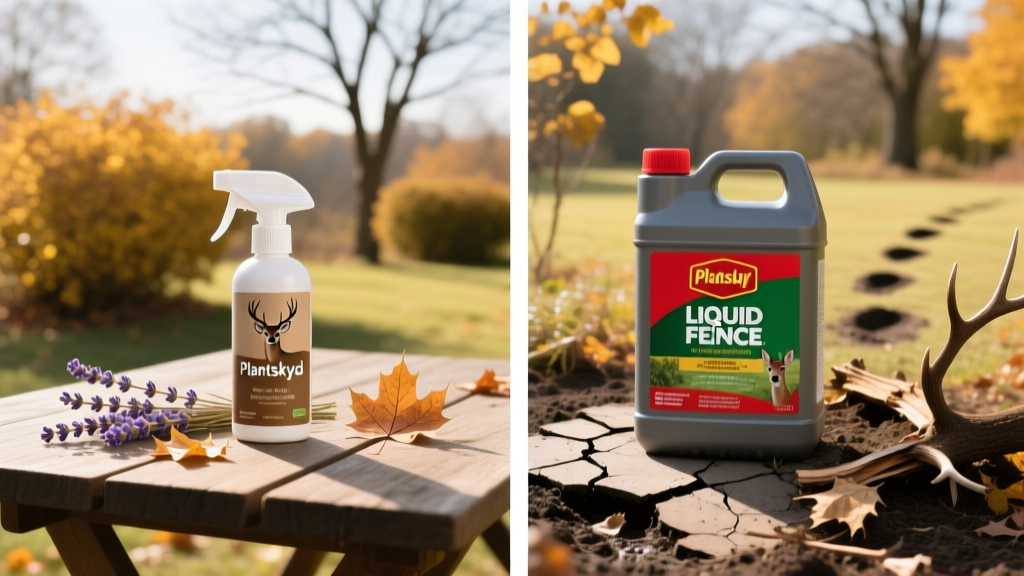
Plantskydd vs Liquid Fence: Best Fall Deer Repellent 2026
Lisa ThompsonPublished
The Autumn Threat: Why Deer Target Fall Landscapes
As the autumn air turns crisp and homeowners focus on essential fall lawn care tasks like aeration, overseeding, and leaf management, a hidden threat begins to mobilize at the edge of the property line. White-tailed deer are entering their most aggressive foraging period of the year. Driven by the biological need to build fat reserves for the harsh winter months and the frantic energy of the autumn rut (mating season), deer become relentless browsing machines. According to the Penn State Extension, deer damage peaks in the late fall and winter when natural food sources dwindle, forcing them to turn to your prized landscape ornamentals, fall-planted bulbs, and evergreen shrubs.
Protecting your investment in arborvitae, yews, winter pansies, and newly planted spring bulbs requires a robust integrated pest management strategy. For organic gardeners and homeowners seeking non-lethal deterrents, two commercial giants dominate the market: Plantskydd and Liquid Fence. But when the temperature drops and the first frost approaches, which formula actually holds up? In this comprehensive 2026 guide, we break down the science, application strategies, and real-world effectiveness of Plantskydd versus Liquid Fence for fall deer control.
Understanding the Contenders: The Science of Avoidance
Deer possess an incredibly acute sense of smell, which they rely on to detect predators and locate high-calorie forage. Both Plantskydd and Liquid Fence exploit this sensory advantage, but they trigger entirely different psychological responses in the animal.
Plantskydd: The Fear-Based Blood Formula
Plantskydd is fundamentally a fear-based repellent. Its primary active ingredient is dried animal blood (typically porcine or bovine), combined with vegetable oils and water. When a deer catches the scent of dried blood, its instinctual fight-or-flight response is triggered. The deer associates the smell with a predator's kill site and avoids the area entirely. Because it relies on a predator response rather than taste, the deer learns to avoid the property before it even takes a bite of your expensive autumn shrubs. Furthermore, the vegetable oil base acts as a natural sticker and provides a degree of winter desiccation protection for evergreen foliage.
Liquid Fence: The Disgust-Based Egg and Garlic Blend
Liquid Fence operates on a disgust and irritation mechanism. Its active ingredients include putrescent whole egg solids, garlic, and capsaicin (the chemical that makes hot peppers spicy). When a deer approaches a treated plant, the foul odor of rotting eggs and pungent garlic offends its highly sensitive olfactory system. If the deer ignores the smell and attempts to browse, the capsaicin irritates its mouth and nasal passages, creating a strong negative reinforcement loop. The University of Minnesota Extension notes that putrescent egg-based repellents are highly effective during the growing season, but their efficacy can fluctuate based on environmental conditions and deer hunger levels.
Head-to-Head Fall Comparison Chart
To help you decide which product to add to your 2026 fall lawn care arsenal, we have compiled a direct comparison of their core specifications.
| Feature | Plantskydd Liquid Concentrate | Liquid Fence Deer & Rabbit |
|---|---|---|
| Primary Active Ingredient | Dried Blood (Predator Scent) | Putrescent Egg Solids, Garlic, Capsaicin |
| Mechanism of Action | Fear / Predator Avoidance | Disgust / Taste Irritation |
| Rainfast Time | 24 Hours | 5 to 6 Hours |
| Minimum Application Temp | Above Freezing (32°F / 0°C) | Above 35°F (Ideally above 45°F) |
| Odor to Humans | Strong sulfur/rotten egg odor, lingers for days | |
| OMRI Listed (Organic) | Yes | Yes |
| Fall Reapplication Rate | Every 3 to 4 months (or after heavy snow) | Every 3 to 4 weeks in fall/winter |
Weather Resistance and Late-Season Durability
Fall weather is notoriously unpredictable. You may experience a warm, sunny afternoon followed by a freezing rainstorm the next morning. How these two repellents handle moisture and cold is the deciding factor for late-season applications.
Liquid Fence boasts a faster rainfast time, usually drying and adhering to the foliage within 5 to 6 hours. This makes it an excellent choice for early autumn when rain showers are frequent and temperatures are still comfortably warm. However, as late November approaches and temperatures hover near freezing, Liquid Fence struggles to dry properly. Applying putrescent egg formulas to frost-covered or damp leaves can lead to poor adhesion, causing the repellent to wash off during the first heavy winter rain or snowmelt.
Plantskydd, on the other hand, requires a full 24 hours of dry weather to become completely rainfast. While this requires checking your long-range weather forecast before spraying, its vegetable oil-based carrier gives it a distinct advantage once cured. The oil binds the dried blood to the plant cuticle and provides a waterproof barrier that withstands freezing, thawing, and heavy snow loads. For deep winter protection spanning from December through early spring, Plantskydd's longevity is vastly superior, requiring far fewer reapplications in cold climates.
Step-by-Step Fall Application Guide
Maximizing the effectiveness of your deer repellent requires proper timing and technique. Follow these steps for your autumn application:
- Timing is Everything: Apply your chosen repellent in early to mid-autumn, well before the first hard frost and before deer establish their winter browsing patterns. Once a deer learns that your yew bushes are a reliable food source, it is much harder to break the habit.
- Prep the Foliage: Ensure plants are completely dry before spraying. Never apply Liquid Fence or Plantskydd to frost-covered, wet, or dew-heavy leaves, as this dilutes the active ingredients and prevents proper bonding.
- Target the New Growth: Deer prefer tender, new growth. In the fall, this includes the tips of evergreens and the emerging shoots of fall-planted bulbs. Ensure thorough coverage of the top and bottom of the leaves, as well as the stems.
- Create a Scent Perimeter: For Plantskydd, consider spraying not just the target plants, but also the perimeter of your property. Creating a 'fear fence' of predator scent can stop deer before they even enter your lawn.
- Rotate Formulas: Deer are highly adaptable. If you used Liquid Fence all summer, switching to Plantskydd in the fall prevents the local herd from becoming habituated to the garlic and egg scent.
2026 Pricing and Value Breakdown
When budgeting for your 2026 fall lawn care regimen, it is important to look beyond the initial bottle price and consider the cost per square foot of coverage and the frequency of reapplication. As of 2026, a 32-ounce ready-to-use bottle of Liquid Fence averages around $25 to $30, while a 33-ounce bottle of Plantskydd liquid concentrate (which must be mixed with water) retails for approximately $45 to $55.
While Plantskydd has a higher upfront cost for the concentrate, its dilution ratio and extended winter longevity make it the more cost-effective choice for large properties and deep-winter protection. A single late-fall application of Plantskydd can protect evergreens through the worst of the winter snows, whereas Liquid Fence may require a mid-winter reapplication during a January thaw to maintain its efficacy, increasing your annual chemical costs and labor.
Expert Verdict: Which Should You Choose This Autumn?
The choice between Plantskydd and Liquid Fence for fall lawn and garden care ultimately depends on your local climate, the size of your property, and the specific plants you are trying to protect.
Choose Liquid Fence if: You live in a region with mild winters, you are protecting small garden beds of fall-planted bulbs and pansies, and you need a fast-drying repellent to beat frequent autumn rainstorms. It is also highly effective for early fall applications when temperatures are still above 50°F.
Choose Plantskydd if: You are preparing for a harsh, snowy winter, you need to protect large evergreen shrubs and trees from severe winter browsing, and you want a long-lasting, fear-based deterrent that requires minimal reapplication. Its ability to withstand freezing temperatures and snow cover makes it the undisputed champion of late-fall and winter deer control.
For the ultimate integrated pest management strategy in 2026, many professional landscapers recommend a hybrid approach: use Liquid Fence during the early autumn growing season to protect tender new shoots, and then switch to a heavy application of Plantskydd in late November to lock in winter-long protection. By understanding the biological triggers of these products, you can keep your landscape pristine while the local deer herd looks elsewhere for their winter meals.