Tree Care
How To Renovate Lawns Under Trees Without Harming Roots
Homeowners embarking on a comprehensive lawn renovation project often face their greatest challenge not in the sun-baked expanse of the front yard, but in the cool, stubbornly bare, or heavily compacted patches beneath mature trees. Recovering a lawn that sits within the drip line of an oak, maple, or pine requires a fundamental shift in standard turf management practices. Traditional lawn renovation techniques—such as aggressive rototilling, deep core aeration, and heavy topsoil application—can cause catastrophic, irreversible damage to a tree's vital root system. To successfully recover and renovate turf in shaded areas, you must balance the biological needs of the grass with the structural and nutritional requirements of the tree.
The Hidden Battle: Turfgrass vs. Tree Roots
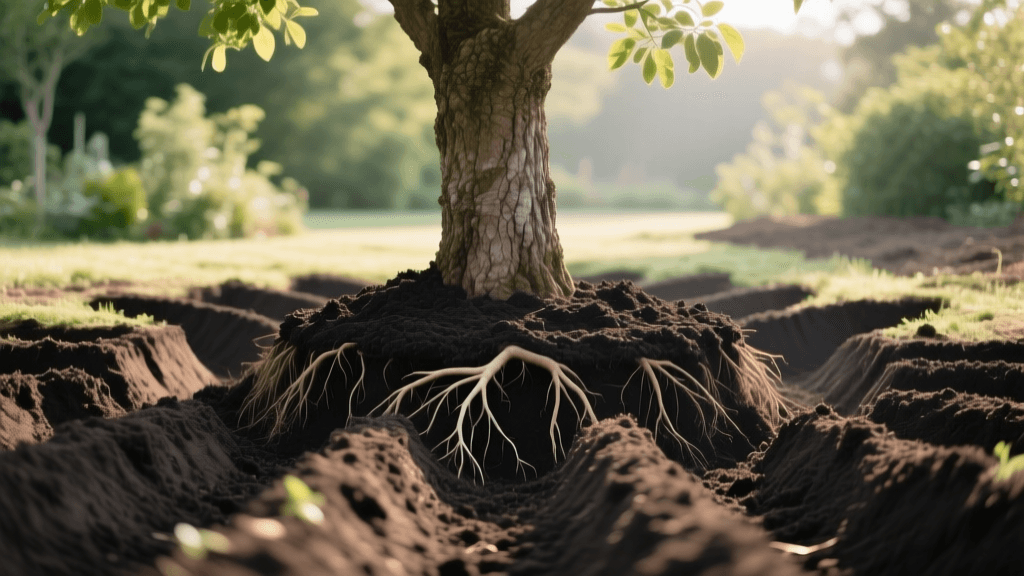
The primary reason lawn recovery fails under trees is a misunderstanding of the Critical Root Zone (CRZ). Many homeowners mistakenly believe that a tree's structural roots are deep underground, while the grass occupies the surface. In reality, the vast majority of a tree's fine, water-and-nutrient-absorbing feeder roots reside in the top 2 to 8 inches of the soil profile. This is the exact same soil horizon where turfgrass roots establish themselves. When you introduce heavy machinery, deep tilling, or thick layers of imported topsoil, you are either severing these vital feeder roots or suffocating them by cutting off oxygen exchange. According to the Arbor Day Foundation, a tree's root system can extend well beyond its drip line, meaning that lawn renovation efforts must be carefully calibrated to avoid soil compaction and oxygen deprivation in the upper soil horizons.
Step 1: Canopy Management and Light Penetration
Before touching the soil, you must address the canopy. Turfgrass requires a minimum amount of photosynthetically active radiation (PAR) to survive, let alone recover from renovation stress. Dense tree canopies block sunlight and intercept rainfall, creating a hydrophobic environment below. Careful crown thinning and raising the lower branches (crown lifting) can increase light penetration and air circulation without compromising the tree's health or structural integrity. Aim to remove no more than 15% to 20% of the live canopy in a single season. By selectively pruning lower limbs, you allow dappled sunlight to reach the soil surface, which is crucial for the germination and establishment of shade-tolerant grass seed.
Step 2: Root-Safe Soil De-compaction
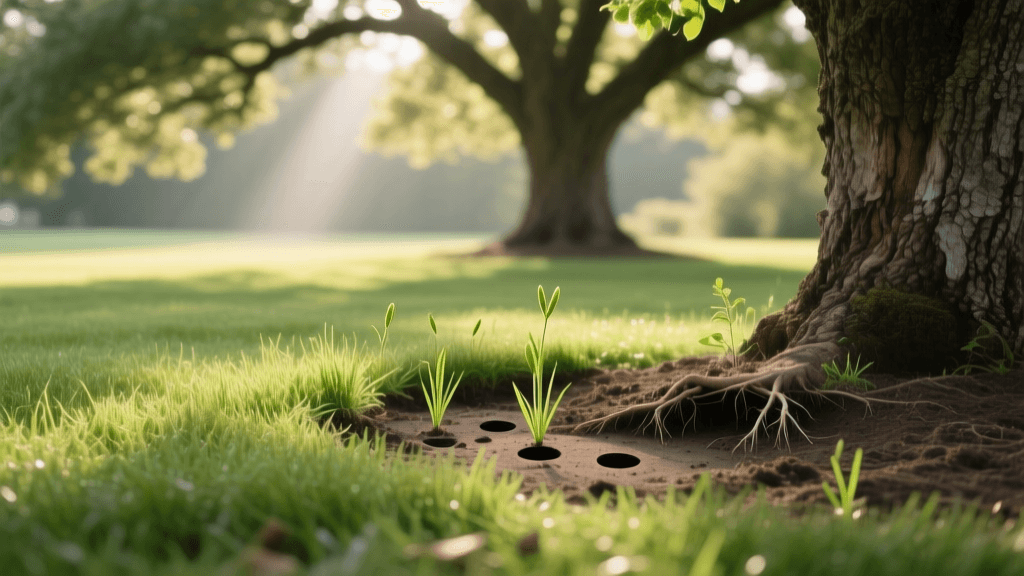
Soil under trees is notoriously compacted due to years of foot traffic, rainfall impact, and the natural binding of soil particles by root exudates. However, using a standard mechanical core aerator with deep tines (3 to 4 inches) can sever critical structural roots and invite pathogenic fungi into the tree's vascular system. Instead of mechanical core aeration, opt for root-safe de-compaction methods during your lawn recovery phase.
- Liquid Aeration: Products containing humic acid, fulvic acid, and organic surfactants (like saponins) help break up soil tension and improve water infiltration without physically tearing through the root mat.
- AirSpade Technology: For severely compacted soils under high-value trees, hiring an arborist to use an AirSpade (which uses compressed air to excavate soil) can safely de-compact the zone and incorporate organic matter without slicing a single root.
- Shallow Core Aeration: If you must use a mechanical aerator, adjust the tines to a maximum depth of 1.5 inches and use solid tines rather than hollow cores to minimize root disruption.
Step 3: Topdressing Without Suffocation
A common mistake during lawn renovation is adding a thick layer of topsoil to level the ground and provide a seedbed. Adding more than a half-inch of soil over a tree's root zone can drastically reduce oxygen availability, leading to root decline and eventual tree death. When topdressing under trees, use a highly screened, organic compost and apply it at a rate no thicker than 1/8 to 1/4 of an inch. This thin layer provides a hospitable environment for grass seed germination and introduces beneficial soil microbes, while still allowing oxygen to diffuse down to the tree's feeder roots.
Step 4: Selecting the Right Shade-Tolerant Seed
Standard Kentucky Bluegrass or Perennial Ryegrass blends will quickly thin out and die under the stress of shade and root competition. For a successful lawn recovery under trees, you must select species adapted to low-light, low-nutrient environments. Penn State Extension recommends fine fescues as the premier choice for heavily shaded turf areas. Fine fescues require less water, less nitrogen, and can thrive in the acidic soil conditions often found beneath oak and pine trees.
- Creeping Red Fescue: Excellent for dry shade and spreads via rhizomes to fill in bare patches.
- Chewings Fescue: Bunch-type growth habit with superior shade tolerance and a fine, attractive texture.
- Hard Fescue: Highly drought-tolerant and requires very minimal mowing or fertilization.
When overseeding, apply the seed at a rate of 4 to 5 pounds per 1,000 square feet. Rake the seed gently into the compost topdressing to ensure seed-to-soil contact, which is vital for moisture retention during germination.
Root-Safe Renovation vs. Traditional Methods
| Renovation Practice | Traditional Open-Lawn Method | Root-Safe Tree-Zone Method |
|---|---|---|
| Soil Preparation | Deep rototilling (6-8 inches) | Liquid aeration or shallow raking |
| Aeration | Deep core aeration (3-4 inches) | Solid tine (max 1.5 inches) or AirSpade |
| Topdressing | 1/2 to 1 inch of topsoil/compost | 1/8 to 1/4 inch of fine compost |
| Seed Selection | Kentucky Bluegrass / Tall Fescue | Fine Fescue blends (Creeping, Chewings) |
| Fertilization | High nitrogen synthetic blends | Low-nitrogen, slow-release organic |
Step 5: Hydrology and Nutrient Management
Watering a newly renovated lawn under a tree requires a strategic approach. The tree's canopy acts as an umbrella, often leaving the soil directly beneath it bone dry even after heavy rain. Furthermore, the mature tree will aggressively outcompete young grass seedlings for moisture. You must water the renovated area lightly and frequently (2 to 3 times a day for 5-10 minutes) during the first three weeks of seed germination. Once established, transition to deep, infrequent watering to encourage the grass roots to grow deeper, though they will always be restricted by the tree's root mat.
Fertilizing turf under trees also requires restraint. High-nitrogen synthetic fertilizers can burn shallow tree roots and promote excessive, weak top-growth in the grass that is susceptible to disease. Instead, use a slow-release, organic fertilizer with a lower nitrogen ratio, applying it in early fall when the tree's root uptake is slowing down and the cool-season grass is actively storing energy for winter.
When to Surrender: Embracing the Mulch Ring
Finally, part of successful lawn recovery is knowing when to surrender. If an area receives less than three hours of filtered sunlight per day, or if the soil is heavily dominated by surface roots, turfgrass will simply not survive long-term. In these cases, the University of Missouri Extension advises transitioning the area from turf to a mulched tree ring. Removing the competing grass and applying 2 to 3 inches of organic wood mulch (keeping it away from the tree trunk) eliminates the competition for water and nutrients, protects the tree's bark from string-trimmer damage, and creates a much healthier, more aesthetically pleasing landscape design.