Tree Care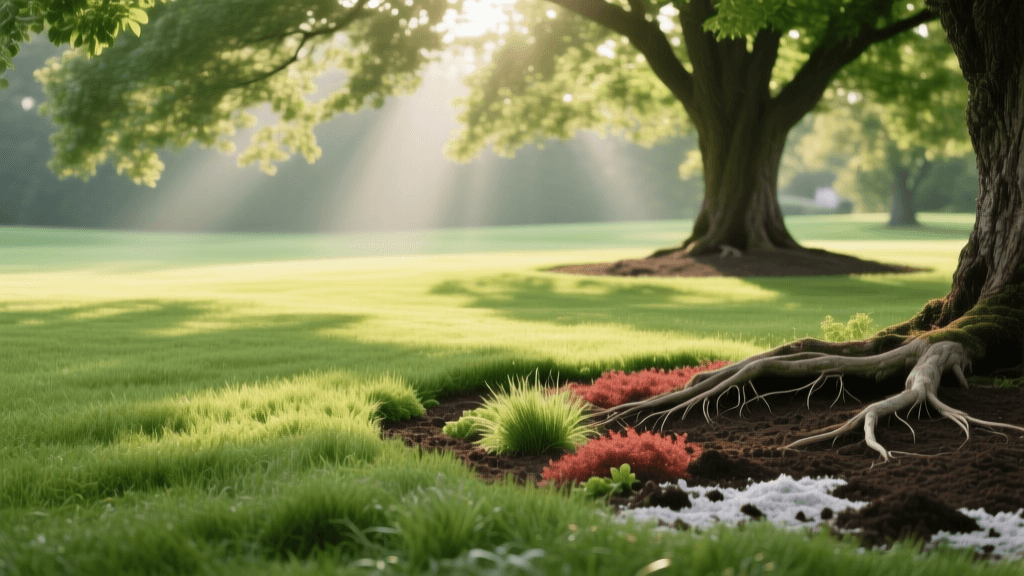
How to Renovate Lawns Under Trees: Shade and Root Recovery
The Biological Conflict: Turfgrass vs. Tree Roots
Renovating a lawn that sits beneath the sprawling canopy of a mature tree is one of the most frustrating challenges in landscape recovery. In nature, trees and dense turfgrass rarely coexist in the same immediate space. Forest floors are typically covered in decomposing leaves, moss, and shade-tolerant groundcovers, not the sun-loving, high-water-demanding turfgrasses we attempt to grow in our yards. When you attempt a lawn renovation under a mature oak, maple, or pine, you are essentially entering a biological tug-of-war.
The tree holds all the cards: it monopolizes sunlight, hoards soil moisture, and dominates the nutrient profile with its aggressive, shallow feeder roots. Furthermore, the soil beneath mature trees is often heavily compacted from years of foot traffic, mower wheels, and the natural settling of the earth. According to the University of Minnesota Extension, turfgrass grown in heavy shade requires a completely different maintenance regimen than grass grown in full sun, primarily because the grass is constantly stressed and stretching for limited photons.
However, with the right strategy, careful soil preparation, and realistic expectations, you can successfully renovate and recover the turf beneath your trees. This guide will walk you through the precise steps of canopy management, root-safe soil preparation, shade-tolerant seed selection, and long-term recovery maintenance.
Step 1: Canopy Management and Pruning for Light
Before you touch the soil or buy a single bag of grass seed, you must address the primary limiting factor: light. Most turfgrasses require a minimum of four to six hours of direct sunlight or a full day of bright, filtered dappled light to photosynthesize effectively and build the root mass necessary for recovery.
Crown Thinning vs. Crown Raising
To increase light penetration without compromising the tree's health, you need to employ specific pruning techniques. The goal is to filter the light, not obliterate the canopy.
- Crown Thinning: This involves the selective removal of smaller, inner branches (typically 1 to 3 inches in diameter) throughout the canopy. This allows dappled sunlight to reach the soil surface. Never remove more than 15% to 20% of the live foliage in a single season, as this can trigger stress responses and epicormic growth (water sprouts).
- Crown Raising: This is the removal of the lower limbs to elevate the base of the canopy. Raising the lowest branches to 8 or 10 feet above the ground allows low-angle morning and evening sunlight to sweep under the tree, which is highly beneficial for turf recovery.
Cost Expectation: Hiring an ISA-Certified Arborist to perform a structural prune and crown thinning on a large mature tree typically costs between $400 and $900, depending on the species, size, and proximity to structures. The International Society of Arboriculture (Trees Are Good) strongly recommends using certified professionals, as improper pruning cuts can introduce decay pathogens that will ultimately kill the tree you are trying to landscape around.
Step 2: Soil Preparation Without Damaging Roots
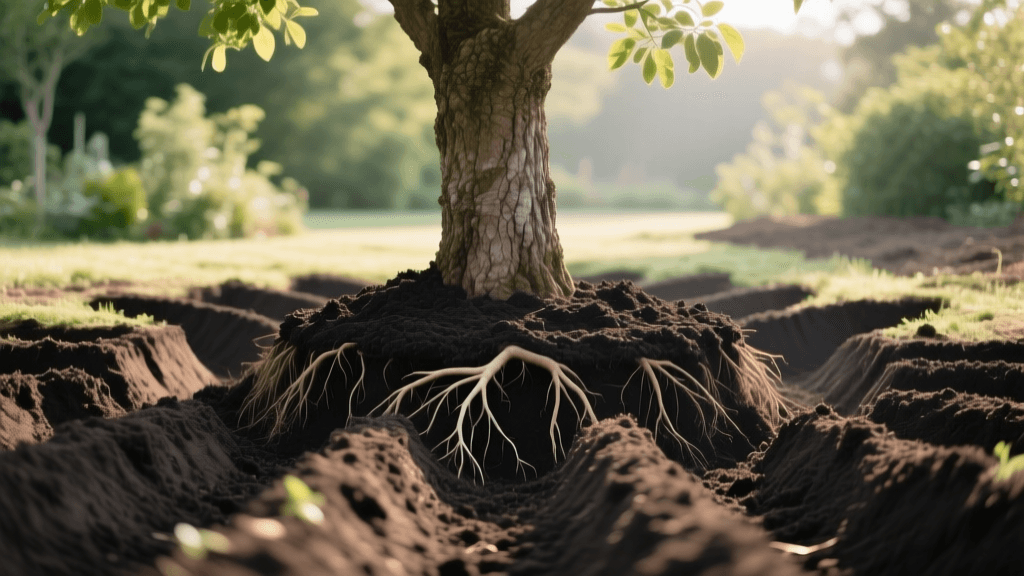
The most common and fatal mistake homeowners make during lawn renovation under trees is using a mechanical rototiller. The vast majority of a tree's absorbing feeder roots are located in the top 2 to 6 inches of the soil profile. Tilling this area will sever these critical roots, effectively girdling the tree and causing severe canopy dieback or total tree failure within two to three years.
Core Aeration and Compost Topdressing
Instead of tilling, you must use low-impact soil amendment techniques to relieve compaction and introduce organic matter.
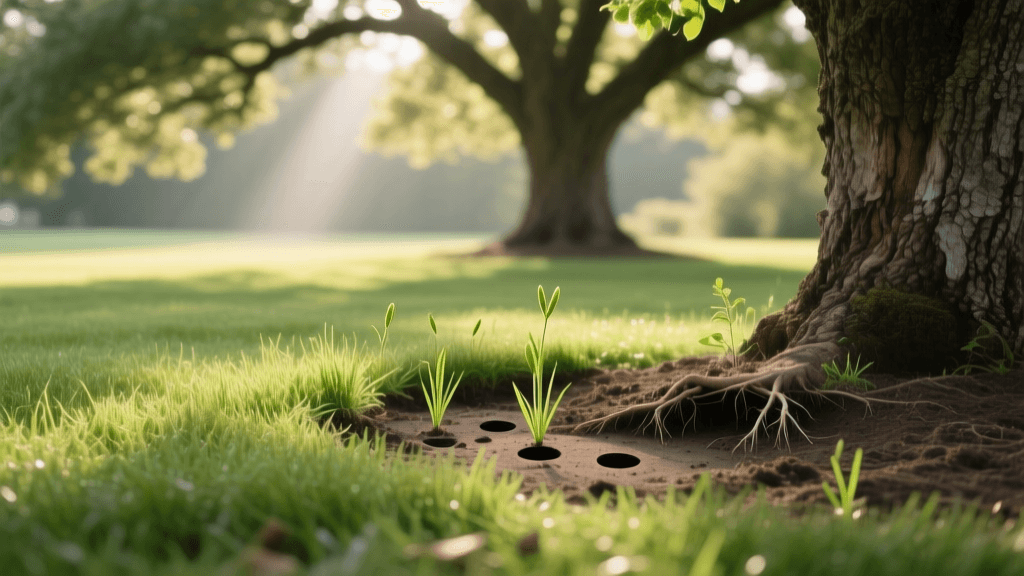
- Liquid Aeration or Manual Coring: Use a liquid aeration product containing humic and fulvic acids to help loosen tight clay soils chemically. Alternatively, use a manual core aerator or an aerator machine with shallow tines (set to a maximum depth of 2 inches) to pull plugs. Avoid aggressive, deep-tine aeration directly over the major structural roots near the trunk.
- Compost Topdressing: Apply a very thin layer of high-quality, screened compost (no more than 1/4 inch thick). This provides a sterile, nutrient-rich seedbed for your new grass without suffocating the tree roots beneath. Use a push broom to sweep the compost into the aeration holes and the existing turf canopy.
- Mycorrhizal Inoculants: When overseeding, apply a granular mycorrhizal fungi inoculant. These beneficial fungi form symbiotic relationships with both the tree roots and the new grass roots, helping them share water and nutrients more efficiently in the cramped soil environment.
Step 3: Selecting the Right Shade-Tolerant Grass Seed
You cannot plant standard Kentucky Bluegrass or Bermuda grass under a dense canopy and expect it to survive the summer. You must select cool-season fine fescues, which are biologically adapted to low-light, low-nitrogen environments.
| Grass Species | Shade Tolerance | Drought Resistance | Best Planting Time | Overseeding Rate |
|---|---|---|---|---|
| Creeping Red Fescue | Excellent | Good | Early Fall | 5 lbs / 1,000 sq ft |
| Chewings Fescue | Excellent | Moderate | Early Fall | 5 lbs / 1,000 sq ft |
| Hard Fescue | Very Good | Excellent | Early Fall | 5 lbs / 1,000 sq ft |
| Tall Fescue (Shade Blends) | Moderate | Excellent | Early Fall | 8 lbs / 1,000 sq ft |
Pro Tip: Look for commercial seed blends specifically labeled as 'Dense Shade' or 'Deep Shade.' These blends are typically composed of 70% to 80% fine fescues mixed with a small percentage of shade-adapted perennial ryegrass for quick germination and erosion control. Always buy seed with a germination rate of 90% or higher and less than 0.5% weed seed content.
Step 4: Managing Water and Nutrient Competition
A mature shade tree can transpire upwards of 40,000 gallons of water in a single growing season. When you plant grass beneath it, the grass is fighting a giant for every drop of rain and every granule of fertilizer.
Watering Strategies
Newly seeded shade lawns require consistent moisture to germinate, but the lack of sunlight and wind under the canopy means the soil stays wet much longer than in open areas. Water lightly 2 to 3 times a day for the first 14 days to keep the top inch of soil moist. Once the grass establishes, transition to deep, infrequent watering. Because the tree roots will intercept surface water, use a pulsating sprinkler or a soaker hose to apply 1 inch of water slowly, allowing it to penetrate deep into the soil profile where both the tree and turf can access it.
Fertilizer Adjustments
Shade-grown grass requires significantly less nitrogen than sun-grown grass. Excess nitrogen forces the grass to produce lush, weak top growth at the expense of deep roots, making it highly susceptible to fungal diseases like powdery mildew and brown patch. Apply a slow-release, organic nitrogen fertilizer in the late fall when the tree has dropped its leaves and the grass can photosynthesize without canopy competition. Reduce standard fertilizer application rates by 30% to 50% in shaded zones.
Step 5: Knowing When to Quit and Mulch Instead
Sometimes, despite your best efforts, the shade is simply too dense, or the surface roots are too aggressive to support a healthy turfgrass stand. If you have tried fine fescues, canopy thinning, and soil amendment, and the grass still thins out every August, it is time to embrace alternative landscaping.
'The healthiest environment for a mature tree is not a manicured lawn, but a wide, undisturbed mulch ring that mimics the natural forest floor. Forcing turfgrass to grow over major surface roots leads to mower damage, soil compaction, and tree decline.'
The Morton Arboretum champions the 3-3-3 rule for tree mulching to protect roots and improve soil biology:
- 3 Inches Deep: Apply a layer of organic wood chips or shredded bark no deeper than 3 inches to prevent oxygen deprivation to the roots.
- 3-Foot Radius (Minimum): Extend the mulch ring at least 3 feet from the trunk, though extending it to the tree's drip line is vastly superior for tree health and eliminates the need to mow near surface roots.
- 3 Inches Away from the Trunk: Keep the mulch entirely away from the root flare and bark of the trunk to prevent rot, rodent damage, and girdling roots. Never create a 'mulch volcano.'
By converting the most heavily shaded, root-dense areas into mulched planting beds featuring shade-tolerant groundcovers like hostas, pachysandra, or creeping jenny, you save hundreds of dollars in annual lawn renovation costs while vastly improving the long-term health and structural stability of your tree.
Conclusion: Patience and Realistic Expectations
Lawn renovation under trees is not a one-and-done weekend project; it is an ongoing process of ecological balance. By respecting the tree's biological dominance, carefully managing the canopy for light, protecting the shallow root zone from mechanical damage, and selecting the correct fine fescue seed blends, you can recover a beautiful, functional green space. Remember that a slightly thinner, more naturalized turf under a mature tree is a sign of a healthy, coexisting landscape, rather than a failure of your lawn care regimen.