Tree Care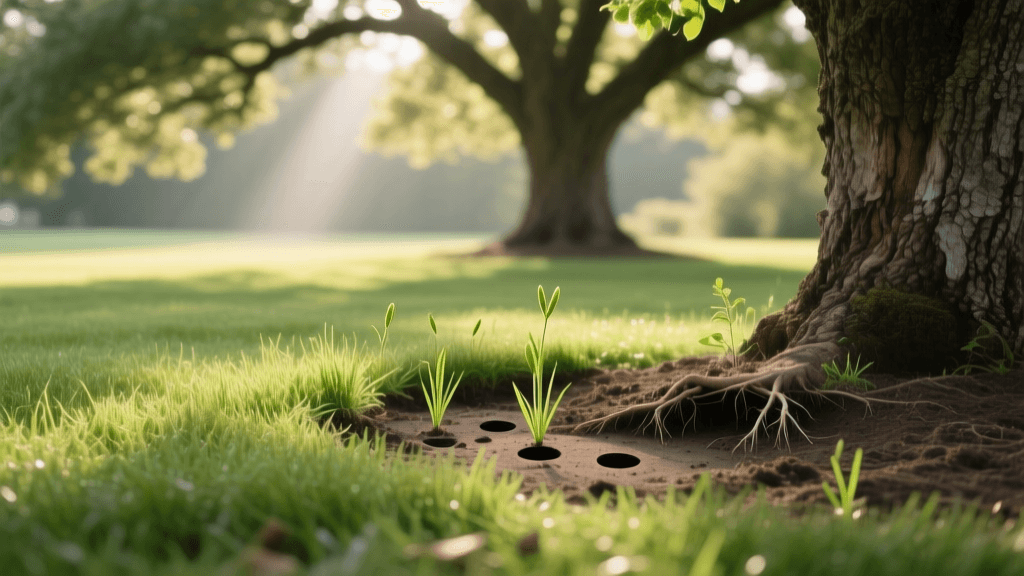
Reviving Lawns Under Trees: Root Protection and Canopy Care
The Hidden Conflict Between Turf and Trees
When homeowners embark on a major lawn renovation or recovery project, the focus is almost entirely on the turf. We aerate, topdress, seed, and fertilize with the singular goal of achieving a thick, emerald carpet. However, if your landscape features mature trees, this aggressive lawn recovery approach can inadvertently trigger a slow decline in your most valuable landscape assets. Trees and turfgrass are natural competitors. In nature, trees dominate forest floors characterized by deep shade, fungal-rich soils, and thick layers of decaying organic matter. Turfgrass, conversely, thrives in open prairies with full sun, bacterial-dominated soils, and frequent, shallow moisture.
Successfully renovating a lawn that grows beneath or adjacent to mature trees requires a delicate balancing act. You must provide the light, nutrients, and soil structure your grass needs to recover, while fiercely protecting the critical root systems and vascular health of your trees. This guide outlines the precise steps to recover your shaded lawn without compromising the giants that anchor your yard.
Mapping the Critical Root Zone (CRZ)
Before you rent a core aerator, bring in a skid steer for grading, or apply heavy soil amendments, you must identify the Critical Root Zone (CRZ) of your trees. The CRZ is the area where the majority of a tree's fine, water-and-nutrient-absorbing roots are located. Damaging this zone during lawn renovation is the leading cause of post-construction tree decline.
To calculate the CRZ, measure the diameter of the tree trunk at 4.5 feet above the ground (Diameter at Breast Height, or DBH). For every one inch of trunk diameter, the CRZ extends one foot outward from the trunk in all directions. For example, a mature oak with a 20-inch trunk diameter has a critical root zone that extends 20 feet outward from the base. Within this circle, heavy machinery, deep tilling, and aggressive core aeration are strictly prohibited.
Safe Lawn Aeration and Dethatching Near Trees
Compacted soil is the enemy of both grass and trees. Standard lawn renovation relies heavily on core aeration to relieve compaction and allow water, air, and nutrients to penetrate the soil profile. However, standard plug aerators pull 3-inch to 4-inch cores of soil. Because the vast majority of a tree's absorbing roots reside in the top 2 to 6 inches of soil, mechanical core aeration within the dripline (the area directly beneath the tree's canopy) will sever thousands of vital feeder roots.
The Liquid Aeration Alternative
For lawn recovery within the tree's dripline, abandon mechanical core aeration in favor of liquid aeration. Liquid aerators utilize active ingredients like humic acid, fulvic acid, and ammonium laureth sulfate to break down soil bonds at a molecular level, creating microscopic channels for water and air without physically slicing through tree roots. Apply liquid aeration at a rate of 2 to 3 ounces per 1,000 square feet in early fall, followed immediately by your shade-tolerant seed mix.
Canopy Management: Thinning for Sunlight
Shade is the primary reason grass fails to recover under trees. Most turfgrasses require a minimum of four to six hours of direct sunlight to sustain healthy growth and recover from environmental stress. If your lawn is thinning out due to heavy canopy shade, selective pruning is necessary.
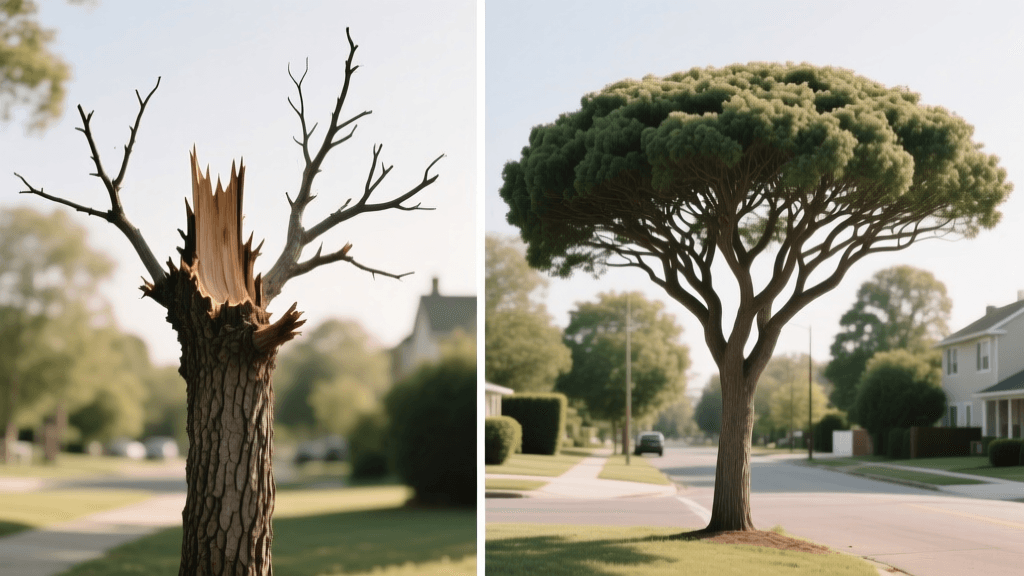
According to pruning guidelines established by the University of Minnesota Extension, crown thinning is the most effective method for increasing light penetration to the lawn below. Crown thinning involves the selective removal of smaller, interior branches (typically 1 to 2 inches in diameter) throughout the tree's canopy. The goal is to remove 15% to 20% of the live foliage to allow dappled sunlight to reach the turf. Never 'top' a tree or strip the lower limbs entirely (a practice known as 'lion's tailing'), as this stresses the tree, promotes weak water-sprout growth, and ruins the tree's natural wind resistance. Hiring an ISA Certified Arborist for professional crown thinning typically costs between $400 and $900, depending on the tree's size and accessibility.
Soil Grading and the Danger of Burying the Root Flare
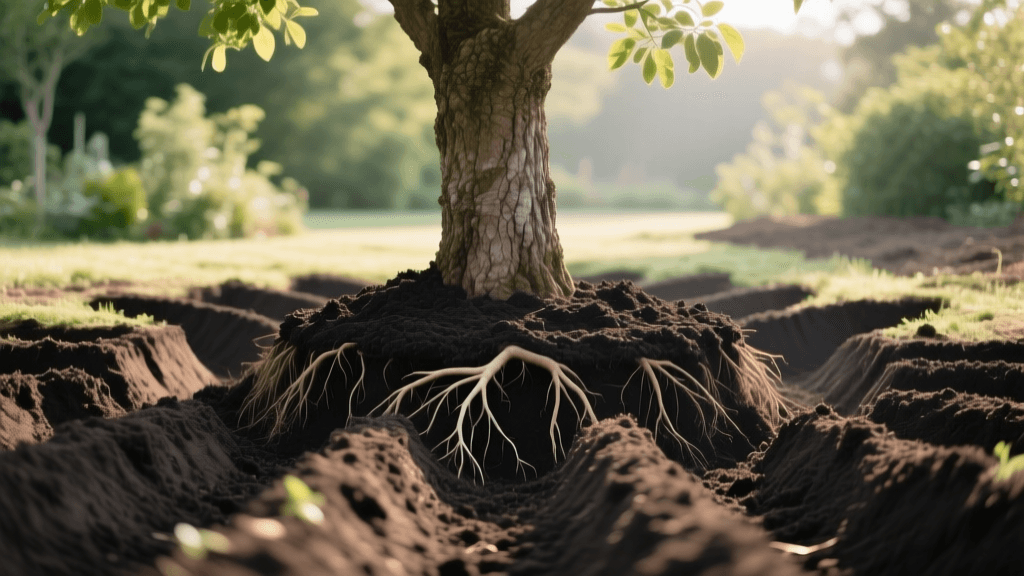
Lawn recovery often involves topdressing with compost or regrading low spots to improve drainage. Adding even two inches of soil over a tree's root flare (the area where the trunk widens and transitions into the root system) can be fatal. Burying the root flare cuts off oxygen to the basal roots, traps moisture against the bark (leading to fatal fungal rot), and encourages the development of girdling roots that eventually strangle the tree's main vascular system.
When topdressing your lawn during renovation, carefully taper the soil away from the tree trunk. The root flare should always remain visible and exposed to the air. If previous landscaping mistakes have buried the root flare, use an air spade (a specialized pneumatic tool used by arborists) to safely excavate the excess soil without damaging the delicate bark and roots.
Mulch vs. Turf: Making the Right Choice
Sometimes, the most effective lawn recovery strategy is admitting defeat in the deepest shade. Grass simply cannot survive under the dense canopy of certain species like Norway Maples, Blue Spruces, or mature Beech trees. In these areas, attempting to force turfgrass recovery leads to a muddy, barren mess.
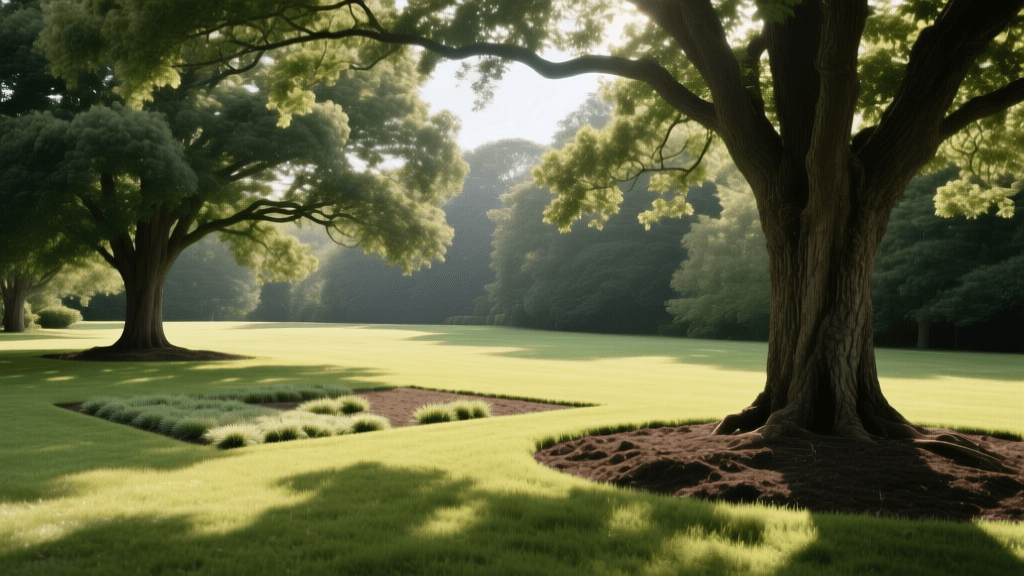
Instead, transition the innermost area of the dripline into a mulch ring. As recommended by The Morton Arboretum, a proper mulch ring mimics the natural forest floor, retaining soil moisture, regulating soil temperature, and eliminating the need for mowing near the trunk (which frequently causes devastating mower blight). Apply a 2-inch to 4-inch layer of organic hardwood mulch in a wide donut shape, ensuring the mulch is pulled at least 3 inches away from the actual trunk of the tree to prevent rot.
Fertilizer and Herbicide Hazards
The chemicals used to accelerate lawn recovery can be highly toxic to mature trees. 'Weed-and-feed' products containing broadleaf herbicides like dicamba, 2,4-D, and MCPP are easily absorbed by tree roots. Because tree roots extend far beyond the dripline, applying these herbicides to the lawn can result in severe leaf cupping, chlorosis, and long-term vascular decline in sensitive species like oaks, maples, and redbuds.
Furthermore, trees and grass have different nutritional needs. Turfgrass requires high levels of nitrogen to push blade growth, while trees require a more balanced, slow-release nutrient profile to support structural wood and root development. Over-fertilizing the lawn with high-nitrogen synthetic fertilizers can force a tree to produce rapid, weak, and succulent top growth that is highly susceptible to wind breakage and pest infestations. Opt for organic, slow-release fertilizers (like milorganite or compost-based blends) that feed the soil biology and benefit both the turf and the tree safely.
Tree and Turf Care Comparison Chart
Understanding the differing needs of your trees and your grass is vital for long-term landscape health. Use this comparison chart to guide your maintenance decisions during and after lawn renovation.
| Maintenance Factor | Turfgrass Needs | Mature Tree Needs | Compromise Strategy |
|---|---|---|---|
| Watering | Frequent, shallow watering (1 inch per week) | Infrequent, deep watering (soaking the top 12 inches) | Water deeply 1-2 times a week to encourage deep grass roots and hydrate tree roots. |
| Soil pH | Slightly acidic to neutral (6.0 - 7.0) | Varies, but generally adaptable (5.5 - 7.5) | Test soil annually; aim for a neutral 6.5 to accommodate both. |
| Aeration | Annual mechanical core aeration | No soil disturbance in the top 6 inches | Core aerate open lawn; use liquid aeration under the tree canopy. |
| Weed Control | Broadleaf herbicides (dicamba, 2,4-D) | Highly sensitive to root-absorbed herbicides | Use organic pre-emergents (corn gluten) and hand-pull weeds near trees. |
| Groundcover | Full sun to partial shade turf mixes | Organic mulch over the root flare | Grow fine fescues in dappled shade; use mulch in deep shade. |
Selecting the Right Shade-Tolerant Seed
If you are overseeding to recover thin grass under trees, standard Kentucky Bluegrass will fail. You must select a seed mix specifically bred for low-light environments. Fine fescues—including Creeping Red Fescue, Chewings Fescue, and Hard Fescue—are the gold standard for shaded lawn recovery. They require less nitrogen, tolerate drought better than other cool-season grasses, and can thrive in areas receiving only three to four hours of filtered sunlight.
When seeding, apply the fine fescue mix at a rate of 5 to 6 pounds per 1,000 square feet. Keep the seed consistently moist for the first 21 days, but be mindful that the tree's canopy will intercept a significant amount of rainfall and irrigation. You may need to water the shaded areas more frequently than the open lawn to ensure proper germination.
Step-by-Step Lawn Recovery Plan Under Trees
Follow this actionable timeline for a safe, effective lawn renovation around mature trees:
- Early Spring: Conduct a soil test. Apply lime or sulfur only if necessary to reach a 6.5 pH. Rake out winter debris gently to avoid tearing shallow tree roots.
- Mid-Spring: Hire an ISA Certified Arborist to perform a 15% crown thinning to increase light penetration to the struggling turf below.
- Late Summer: Apply liquid aeration (humic acid blend) to the soil beneath the tree's dripline to relieve compaction without severing roots.
- Early Fall: Overseed the shaded areas with a Fine Fescue blend. Topdress open lawn areas with 1/4 inch of compost, tapering to zero near the tree's root flare.
- Ongoing: Avoid weed-and-feed products. Hand-pull broadleaf weeds within the dripline. Maintain a 3-inch mulch ring around the trunk, keeping it clear of the bark.
Conclusion
Lawn renovation and tree preservation do not have to be mutually exclusive. By respecting the Critical Root Zone, adapting your aeration and chemical practices, and selecting the right shade-tolerant seed, you can recover a beautiful, functional lawn that coexists harmoniously with your mature trees. For more foundational guidance on establishing healthy landscapes, refer to the planting and care resources provided by the Arbor Day Foundation. Remember, a healthy tree adds exponentially more value to your property than a perfect patch of grass; protect your roots, thin your canopy wisely, and let nature find its balance.