Tree Care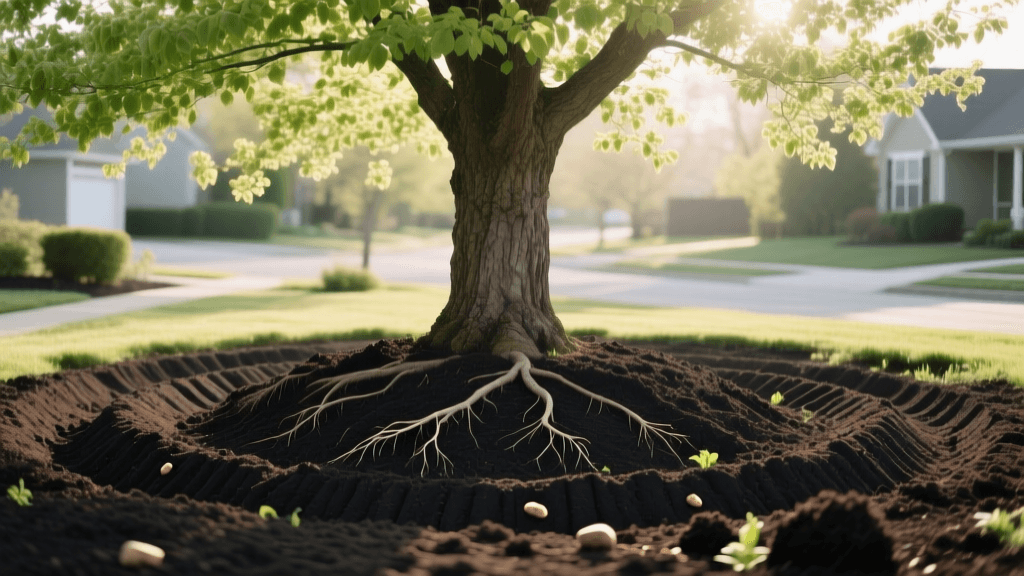
Reviving Mature Trees: Compost & Soil Health Guide
The Hidden Crisis Beneath Your Trees: Compacted Urban Soil
When homeowners notice a mature tree declining, exhibiting sparse canopies, premature fall coloration, or dieback at the branch tips, they often look up for the problem. However, the true culprit usually lies hidden beneath the surface. In urban and suburban environments, the soil surrounding established trees is frequently subjected to severe compaction from foot traffic, construction equipment, and the natural settling of clay-heavy soils over time. This compaction destroys soil structure, collapsing the vital pore spaces that roots need for oxygen exchange and water infiltration.
Tree roots require a delicate balance of moisture and oxygen to survive and uptake nutrients. When soil becomes compacted, it creates anaerobic conditions that suffocate fine feeder roots and invite opportunistic soil-borne pathogens like Phytophthora. Furthermore, compacted soils are typically depleted of organic matter, stripping the root zone of the beneficial microbial life necessary for nutrient cycling. To reverse this decline, arborists and soil scientists increasingly turn to targeted composting and organic soil amendment strategies to rebuild the soil food web from the ground up.
Why Compost is the Ultimate Tree Medicine
Compost is often mistakenly viewed merely as a slow-release fertilizer. In reality, its primary value in tree care lies in its ability to act as a powerful soil conditioner. According to the Environmental Protection Agency (EPA), adding organic compost to degraded soils significantly improves soil structure, increases water retention in sandy soils, and enhances drainage in heavy clays.
More importantly, high-quality compost introduces billions of beneficial microorganisms, including bacteria and mycorrhizal fungi, into the tree's critical root zone. Mycorrhizal fungi form symbiotic relationships with tree roots, effectively extending the root system's reach by hundreds of times. These fungal networks break down complex organic compounds and mine minerals from the soil, trading them to the tree in exchange for sugars produced during photosynthesis. By incorporating compost, you are not just feeding the tree; you are inoculating the soil with a living ecosystem that sustains long-term tree health and improves the soil's cation exchange capacity (CEC), allowing it to hold onto vital nutrients like calcium, magnesium, and potassium.
Step-by-Step Guide to Radial Trenching with Compost
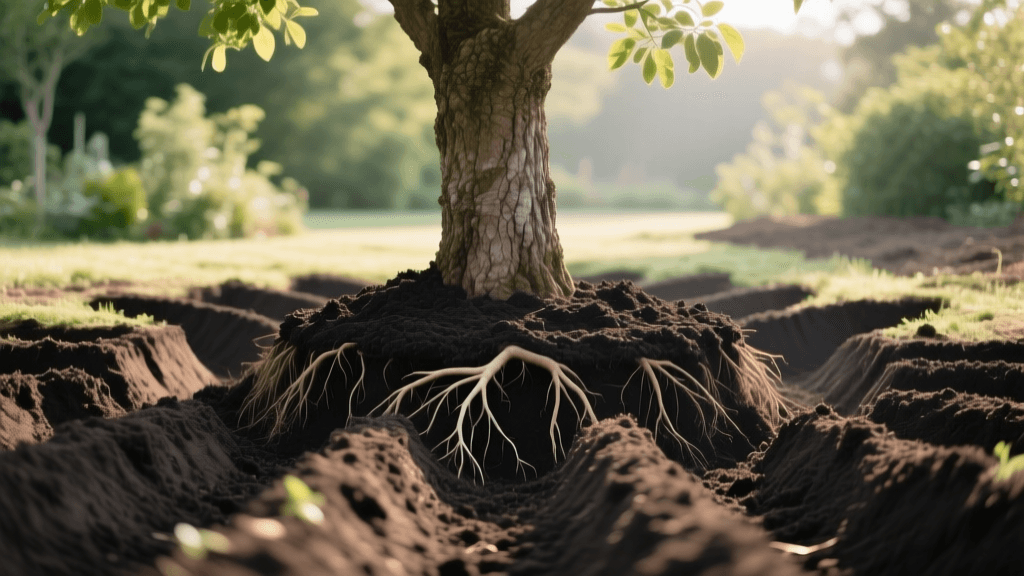
For severely compacted soils where surface applications cannot penetrate, radial trenching is a highly effective, minimally invasive technique to deliver compost directly to the absorptive root zone. This method involves digging narrow trenches in a spoke-like pattern radiating outward from the trunk, which are then backfilled with a nutrient-rich compost mix.
Tools Required: Hand trowel, narrow trenching shovel, air spade (for professional use to avoid root damage), wheelbarrow, and high-quality coarse compost.
The Process:
- Locate the Root Flare: Before digging, ensure the tree's root flare (where the trunk expands into the roots) is fully exposed. Never trench within 3 to 5 feet of the trunk base to avoid severing major structural roots.
- Dig the Trenches: Dig trenches radiating outward toward the drip line (the outer edge of the tree's canopy). Space the trenches 2 to 3 feet apart.
- Backfill with Compost: Fill the trenches with a mixture of 70% coarse woody compost and 30% native soil. The coarse texture prevents the compost from breaking down too quickly, maintaining soil aeration for years.
| Parameter | Specification | Arborist Notes |
|---|---|---|
| Trench Distance | 3 to 5 feet from trunk | Always start outside the critical root flare zone. |
| Trench Depth | 8 to 12 inches | Target the upper soil horizon where 90% of feeder roots live. |
| Trench Width | 2 to 4 inches | Narrow enough to minimize root severing, wide enough to pack compost. |
| Spacing | Every 2 to 3 feet | Create a radial pattern extending out to the drip line and beyond. |
| Fill Material | Coarse woody compost | Avoid fine, muddy composts which can re-compact and block oxygen. |
Top Dressing the Critical Root Zone
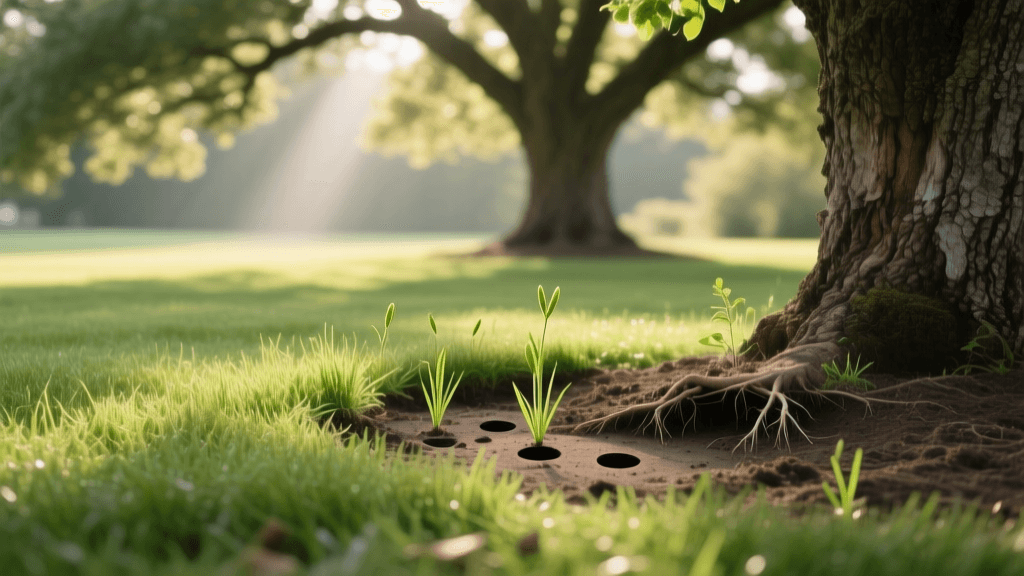
If your soil is only mildly compacted, or if you are performing annual maintenance, top dressing with compost is an excellent, low-impact strategy. Top dressing involves spreading a thin layer of compost over the soil surface beneath the tree's canopy. Over time, earthworms, rainfall, and freezing/thawing cycles will naturally incorporate this organic matter into the topsoil.
The Morton Arboretum emphasizes the importance of keeping organic matter away from the trunk itself to prevent rot and rodent damage. When top dressing, apply a layer of compost no thicker than 1/2 inch to 1 inch. If applied too thickly, you risk smothering the shallow feeder roots and altering the soil grade, which can lead to oxygen deprivation. Always leave a 6-to-12-inch mulch-free and compost-free ring immediately surrounding the trunk base. Follow the compost application with a 2-to-3-inch layer of coarse wood chip mulch to retain moisture and regulate soil temperature.
Brewing and Applying Aerated Compost Tea
For trees suffering from acute stress, disease pressure, or recent transplant shock, liquid applications of aerated compost tea (ACT) can provide an immediate influx of beneficial biology to the root zone. Compost tea extracts the soluble nutrients and microorganisms from solid compost, allowing them to percolate deep into the soil profile through existing macropores.
Basic ACT Recipe for Trees:
- Fill a 5-gallon bucket with non-chlorinated water (if using tap water, let it sit for 24 hours to allow chlorine to off-gas).
- Place 2 cups of high-quality, fungal-dominant compost into a mesh brew bag and submerge it in the water.
- Add 1 tablespoon of unsulfured blackstrap molasses to feed the multiplying bacteria and fungi.
- Attach an aquarium air pump with an air stone to the bottom of the bucket to keep the mixture highly oxygenated.
- Brew for 24 to 48 hours. The tea should smell earthy and sweet; if it smells sour or rotten, discard it.
- Dilute the finished tea at a 1:5 ratio with water and apply it as a soil drench across the entire critical root zone using a watering can or pump sprayer.
Choosing the Right Compost and Soil Amendments
Not all composts are created equal. Trees, unlike annual vegetables or turfgrass, thrive in soils dominated by fungal networks rather than bacterial networks. Therefore, selecting the right type of compost is crucial for long-term arboreal health.
- Leaf Mold Compost: Created primarily from decomposed deciduous leaves, this is the gold standard for trees. It is naturally fungal-dominant, slightly acidic, and very low in soluble salts, eliminating the risk of root burn.
- Arborist Wood Chip Compost: Aged wood chips break down slowly, providing excellent soil structure and long-term carbon. Ensure it has been composted for at least 12 to 18 months to avoid nitrogen tie-up in the soil.
- Manure-Based Compost: While rich in nitrogen, manure composts are highly bacterial and can be too 'hot' for mature trees. Excessive nitrogen forces trees to produce rapid, weak vegetative growth that is highly susceptible to sucking insects like aphids and borers. Use sparingly, if at all.
- Biochar-Enriched Compost: Biochar is a highly porous form of charcoal that acts like a coral reef for soil microbes. Mixing compost with biochar creates a permanent soil amendment that improves moisture retention in sandy soils and prevents nutrient leaching.
- Municipal Yard Waste Compost: Often inexpensive or free, but carries a high risk of contamination. Always test municipal compost for persistent broadleaf herbicides (like aminopyralid or clopyralid) which can survive the composting process and severely damage tree roots.
Seasonal Timing and Application Schedules
Timing your soil amendments correctly maximizes their effectiveness and minimizes stress on the tree. The optimal windows for radial trenching and heavy compost applications are early spring (just before bud break) and late fall (after leaf drop but before the ground freezes). During these periods, the tree is either mobilizing energy for new root growth or storing carbohydrates for the winter. Avoid major soil disturbances during the heat of summer or during severe drought conditions, as the tree is already under environmental stress and relies heavily on its existing root network for survival.
Common Soil and Mulching Mistakes to Avoid
Even with the best intentions, improper composting and mulching techniques can accelerate a tree's decline. The Arbor Day Foundation frequently warns against the practice of 'volcano mulching'—piling compost and mulch high against the tree trunk. This traps moisture against the bark, leading to stem girdling roots, fungal cankers, and providing a warm, hidden habitat for bark-gnawing rodents during winter.
Another critical mistake is using unfinished or 'hot' compost. Compost that has not fully cured will continue to decompose actively, consuming soil oxygen and generating heat and organic acids that will literally cook and chemically burn the tree's delicate feeder roots. Always source compost that is dark, crumbly, and smells like a rich forest floor. Finally, never use a rototiller to incorporate compost near an established tree; the rotating blades will indiscriminately shred the vital upper canopy of the root system, causing massive, sometimes irreversible, trauma to the tree. By respecting the biology of the soil and the architecture of the root system, you can successfully use compost to add decades of vibrant life to your landscape's most valuable assets.