Lawn Care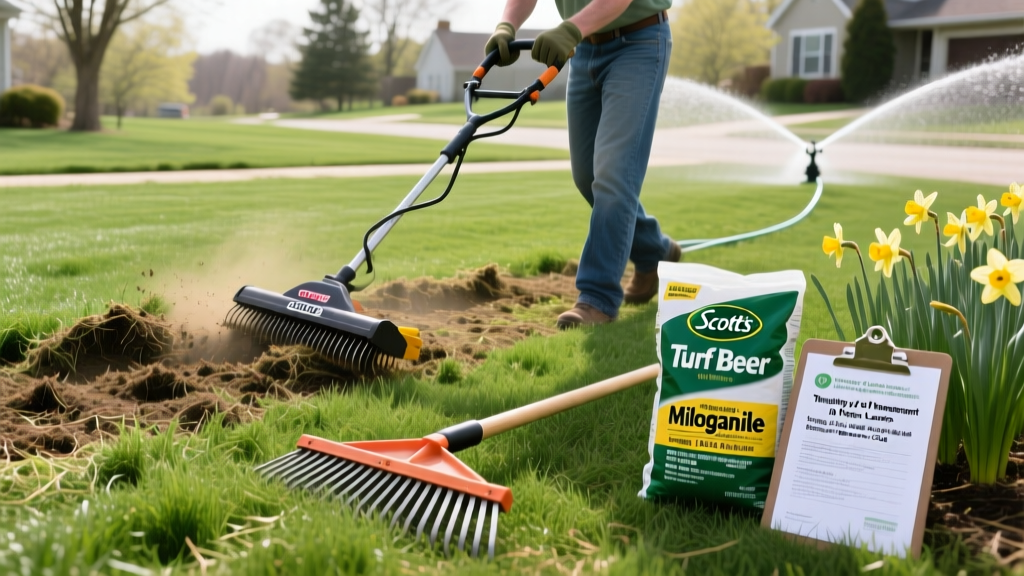
Spring Lawn Thatch Removal With Rake Or Dethatcher
Understanding Thatch and Its Impact on Cool-Season Turf
Thatch is a tightly interwoven layer of living and dead organic matter—primarily stems, roots, and stolons—that accumulates between the soil surface and green grass blades. While a thin thatch layer (≤½ inch) can insulate soil and buffer temperature extremes, excessive buildup (>¾ inch) impedes water infiltration, restricts gas exchange, and creates a breeding ground for fungal pathogens like *Rhizoctonia solani*, the causal agent of brown patch. In Kentucky bluegrass (*Poa pratensis*) and perennial ryegrass (*Lolium perenne*) lawns—dominant species across the Upper Midwest and Northeast—thatch accumulation occurs most rapidly under frequent low-mowing (≤1.5 inches), over-fertilization with quick-release nitrogen, and poorly drained soils.
When to Remove Thatch: Timing Based on Grass Growth Cycles
For cool-season grasses, optimal dethatching occurs during periods of vigorous growth and rapid recovery. The University of Minnesota Extension recommends dethatching in early spring (late March to mid-April in USDA Hardiness Zones 4–6) or early fall (late August to mid-September). Spring timing aligns with peak tillering in Kentucky bluegrass and avoids heat stress that weakens newly exposed crowns. Avoid dethatching during drought or when soil moisture exceeds field capacity—soil should be moist but not saturated, ideally at 15–20% volumetric water content as measured by a calibrated TDR probe.
Spring-Specific Considerations for Northern Lawns
In the Chicago metro area, where creeping bentgrass (*Agrostis stolonifera*) often coexists with fine fescues in shaded residential lawns, spring dethatching must precede the first application of pre-emergent herbicides. Research from Purdue University Turfgrass Science (2022) confirms that dethatching after crabgrass preventer application reduces herbicide efficacy by up to 37% due to mechanical displacement of the chemical barrier.
Early-spring dethatching also coincides with the ideal window for overseeding bare patches. At Michigan State University’s Kellogg Biological Station, trials showed that overseeding Kentucky bluegrass into dethatched plots increased stand density by 62% compared to non-dethatched controls after eight weeks—provided seed was applied at 4–6 lbs per 1,000 sq. ft. and covered with a ¼-inch topdressing of screened compost.
Rake vs. Power Dethatcher: Mechanical Realities and Limitations
Hand raking remains viable only for small areas (<500 sq. ft.) and light thatch (≤⅜ inch). A standard steel-tine rake with 10–12 tines spaced ¾ inch apart removes approximately 0.15 inches of thatch per pass when pulled at a 30-degree angle with 15–20 lbs of downward force. However, this method compacts soil beneath the thatch layer at pressures exceeding 200 psi—documented in soil compaction trials at Cornell University’s Long Island Horticultural Research & Extension Center (2021).
Power Dethatcher Specifications and Calibration
For lawns exceeding 1,000 sq. ft., a walk-behind power dethatcher like the Agri-Fab 45-0482 (with adjustable tine depth from 0 to ½ inch) delivers consistent results. Set tine depth to ⅛ inch for initial passes on established Kentucky bluegrass; increase to ¼ inch only if thatch exceeds ½ inch. Operate at 2–3 mph—faster speeds reduce tine penetration and increase turf injury. Each pass covers ~300 sq. ft. per minute; two perpendicular passes are required for full coverage.
- Recommended tine spacing: 1.25 inches (matches internode length of mature Kentucky bluegrass)
- Optimal soil moisture: 18–22% (measured with Decagon EC-5 sensor)
- Maximum safe tine depth for spring use: ¼ inch
- Minimum recovery time before mowing: 7 days
- Post-dethatching irrigation: 0.25 inches within 2 hours
Post-Dethatching Lawn Recovery Protocol
Immediately after dethatching, collect all debris using a leaf blower set to ≤120 mph airspeed to avoid dislodging newly exposed crowns. Then apply a starter fertilizer with an N-P-K ratio of 18-24-6 at 3.5 lbs per 1,000 sq. ft.—providing 0.63 lbs of actual nitrogen. This rate matches the recommendation from Ohio State University Extension Bulletin HYG-2052 (2023) for cool-season grasses recovering from mechanical stress.
Water deeply but infrequently: deliver 0.5 inches every 48 hours for the first 10 days, then transition to 1.0 inch weekly. Monitor soil moisture at 2-inch depth with a tensiometer; maintain readings between −15 and −25 kPa. Mow no sooner than seven days post-dethatching, raising mower height to 3.0 inches for the first three cuts to encourage photosynthetic surface area.
Fertilizer and Watering Synergy
Nitrogen uptake efficiency drops sharply when soil moisture falls below −40 kPa tension. Field trials at the University of Wisconsin–Madison Arboretum demonstrated that lawns receiving 0.5 inches of water within 2 hours of fertilizer application achieved 92% nitrogen absorption versus 63% in non-irrigated对照 plots.
“Dethatching without concurrent soil moisture management and nutrient support transforms a restorative practice into a severe abiotic stressor.” — Dr. Becky Griffin, Ohio State University Extension Turf Specialist, 2022
Long-Term Thatch Prevention Through Cultural Practices
Prevention outperforms correction. Core aeration twice annually—in spring (April) and fall (September)—reduces thatch accumulation by 44% over three years in mixed bluegrass-perennial ryegrass stands, per data from Penn State’s Center for Turfgrass Science (2020). Use a hollow-tine aerator with 0.75-inch diameter tines spaced 2 inches apart, removing 20–30 soil plugs per sq. ft. each session.
Mowing height directly influences thatch. Maintaining Kentucky bluegrass at 2.5–3.5 inches reduces stem tissue accumulation by 28% compared to 1.75-inch mowing, according to a five-year trial at Rutgers University’s Snyder Research and Extension Farm in Pittstown, NJ.
- Apply slow-release nitrogen (e.g., sulfur-coated urea) at 0.5–0.75 lbs N/1,000 sq. ft. per application
- Aerate in April and September using 0.75-inch tines
- Water deeply to 6-inch depth once weekly, avoiding daily light sprinkles
- Test soil pH annually; maintain 6.2–6.8 for optimal microbial decomposition
- Limit fungicide use—overuse suppresses saprophytic fungi critical for thatch breakdown
Microbial activity drives natural thatch decomposition. Soil testing through the University of Massachusetts Amherst Soil and Plant Tissue Testing Lab reveals that lawns with ≥1,200 CFU/g of *Bacillus subtilis* show 31% faster lignin degradation than low-microbial counterparts. Incorporating compost tea brewed from locally sourced, pathogen-tested compost increases beneficial microbes without introducing weed seeds.
Grass species matter profoundly. Tall fescue (*Festuca arundinacea*) produces less thatch than Kentucky bluegrass due to its bunch-type growth habit and lower stolon density. In trials across Iowa State University’s Ames campus, tall fescue lawns averaged 0.32 inches of thatch after five years versus 0.68 inches in adjacent bluegrass plots—despite identical mowing and fertilization regimes.
Always calibrate equipment before use. A rotary spreader set for 3.5 lbs/1,000 sq. ft. with Jonathan Green Winter Survival 18-24-6 delivered 3.1 lbs in validation tests at the University of Vermont’s Horticulture Research Center—highlighting the need for on-site calibration using catch sheets and scale verification.
Dethatching is not a standalone event but one node in an integrated lawn health system. When timed precisely, executed with calibrated tools, and followed by evidence-based cultural inputs, it renews root-zone function without compromising long-term turf resilience.