Lawn Care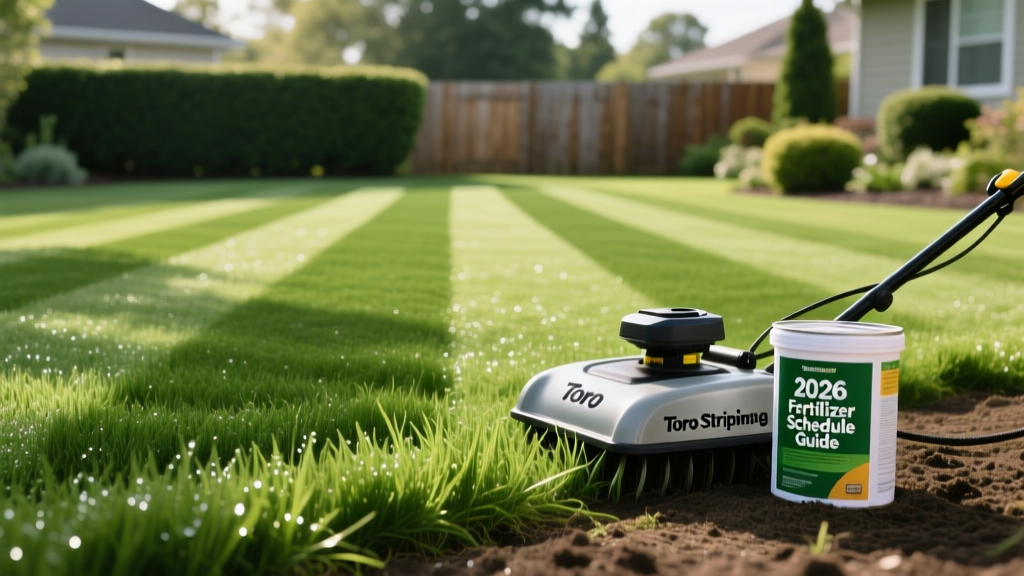
Best Fertilizer Schedule For Toro Striping Kit 2026
Lisa ThompsonPublished
The Secret to Professional Lawn Stripes: It Starts in the Soil
When homeowners picture the perfect lawn in 2026, they envision deep, contrasting stripes that rival professional baseball diamonds. While investing in a high-quality attachment like the Toro Lawn Striping Kit is the first step toward achieving that manicured look, the true secret to crisp, long-lasting stripes lies beneath the surface. Striping is not just about mowing; it is an optical illusion created by light reflecting off bent grass blades. If your turf lacks the cellular strength, turgor pressure, and vertical height required to bend and hold its shape, even the best Toro Striping Kit will simply mash weak grass into the dirt, resulting in brown, damaged streaks rather than beautiful patterns.
To achieve the perfect canvas for your Toro Striping Kit, you must implement a precise fertilizer schedule tailored to promote structural integrity and deep green coloration. In this comprehensive 2026 guide, we will explore the exact fertilizer types, NPK ratios, and seasonal schedules required to cultivate turf that responds beautifully to lawn striping patterns.
The Physics of Striping and Turfgrass Nutrition
Lawn stripes are created when grass blades are bent in opposite directions. When you push the grass away from you with the Toro Striping Kit's weighted roller, the light reflects off the glossy, waxy cuticle of the blade, creating a light stripe. When you pull the grass toward you, you see the shaded underside of the blade, creating a dark stripe.
For this optical illusion to work, the grass must possess high turgor pressure—the internal water pressure that keeps plant cells rigid. If the grass is dehydrated or deficient in key macronutrients, the cell walls will collapse under the weight of the Toro roller. According to turfgrass research highlighted by the University of Minnesota Extension, maintaining optimal nutrient levels is critical for cell wall development and stomatal regulation, both of which dictate how well a grass blade bends and recovers.
The Role of NPK in Stripe Quality
- Nitrogen (N): Drives vertical growth and chlorophyll production. You need long blades (at least 3.5 inches) to create a visible stripe. However, too much quick-release nitrogen causes rapid, weak, and watery growth that will tear under the Toro roller.
- Phosphorus (P): Essential for deep root development. A robust root system anchors the turf so the striping kit can bend the blades without uprooting the plant.
- Potassium (K): The ultimate "striping mineral." Potassium regulates water retention and fortifies cell walls. High potassium levels ensure the grass has the elasticity to bend in complex patterns (like checkerboards) without snapping or bruising.
The 2026 Toro Striping Kit Fertilizer Schedule
To prepare your cool-season or transitional-zone turf for the 2026 mowing season, you must transition away from heavy, quick-release synthetic feeds and move toward polymer-coated urea (PCU) and potassium-rich formulations. Below is the optimal 2026 fertilization schedule designed specifically to maximize the performance of your Toro Striping Kit.
| Season | Target NPK Ratio | Purpose for Striping | Application Rate |
|---|---|---|---|
| Early Spring (April) | 3-1-2 (Slow Release) | Initiate vertical blade growth and deep rooting | 0.75 lbs N / 1000 sq ft |
| Late Spring (May) | 4-0-1 (High Potassium) | Fortify cell walls for early-season mowing | 0.50 lbs N / 1000 sq ft |
| Early Fall (September) | 3-1-3 (Balanced K) | Maximize turgor pressure for crisp autumn stripes | 1.00 lbs N / 1000 sq ft |
| Late Fall (November) | 0-0-3 (Potassium Only) | Winterize and protect cellular structure | 1.50 lbs K / 1000 sq ft |
By utilizing a slow-release nitrogen source in the spring, you ensure a steady, manageable growth rate. This allows you to maintain the 3.5 to 4.0-inch mowing height required for the Toro Striping Kit to grip the blades effectively, without forcing you to mow every single day.
Mastering Lawn Striping Patterns with the Toro Kit
Once your fertilizer schedule has produced a thick, turgid, and healthy turf canopy, it is time to attach the Toro Striping Kit to your mower. The Toro kit typically features a durable, weighted poly roller that mounts to the rear axle, applying gentle, even pressure to lay the grass down. Here is how to execute professional patterns using your nutritionally optimized turf.
1. The Classic Checkerboard
The checkerboard is the hallmark of a pristine lawn, but it is also the most stressful pattern for your grass. It requires mowing the lawn in parallel lines North-to-South, and then immediately mowing perpendicular lines East-to-West.
The Fertilizer Connection: If your lawn is deficient in Potassium, the second pass of the Toro roller will crush the grass blades against the soil, causing cellular rupture and leaving brown, bruised tracks. By following the high-potassium Late Spring and Early Fall schedule outlined above, your grass will possess the elasticity to bend in two different directions and reflect light beautifully.
2. Diagonal Diamonds
Diagonal stripes create a dynamic, elongating effect that makes smaller yards appear larger. Mow at a 45-degree angle to your property line. Overlap each pass by exactly 2 inches to ensure the Toro roller catches the edge of the previous stripe, creating a sharp, defined line. The deep green coloration achieved through adequate Nitrogen levels will make the light and dark contrasts of the diagonal pattern pop brilliantly in the 2026 summer sun.
3. Straight Banding
For a traditional, manicured look, mow parallel to your driveway or sidewalk. Always keep your eyes fixed on a distant focal point rather than looking down at the mower deck. This ensures perfectly straight lines. The Toro Striping Kit's weight distribution is designed to glide over minor imperfections, but a dense turf canopy—built through consistent Phosphorus and Nitrogen feeding—will hide soil undulations and provide a uniform bending surface.
Irrigation, Turgor Pressure, and Cell Wall Strength
Fertilizer alone cannot create turgor pressure; it requires water. As noted by the UC Statewide IPM Program, proper irrigation is inextricably linked to nutrient uptake and turfgrass rigidity. In 2026, with shifting climate patterns and more frequent late-summer heat domes, deep and infrequent watering is non-negotiable for lawn striping enthusiasts.
Water your lawn deeply (providing 1 to 1.5 inches of water per week) in the early morning. This allows the grass blades to fully hydrate and stand upright before you mow. Never stripe a dry lawn. Dry grass is brittle; the Toro roller will snap the blades rather than bend them, resulting in a ragged, white-tipped appearance that ruins the optical illusion. Conversely, do not stripe immediately after a heavy rain or irrigation cycle, as the soil will be too soft, and the mower wheels may rut the yard while the grass blades are too heavy with surface water to hold a crisp bend.
Toro Striping Kit Setup and Mowing Best Practices
To maximize the results of your fertilizer program, ensure your equipment is calibrated correctly for the 2026 season:
- Mower Deck Height: Raise your Toro mower deck to the highest or second-highest setting (typically 3.5 to 4.0 inches). Striping requires length. If you cut the grass to 2.5 inches, there is not enough blade surface area for the Toro roller to bend, and the stripe will be virtually invisible.
- Blade Sharpness: A dull mower blade shreds the grass tip, causing it to turn white and fray. This destroys the reflective cuticle needed for light stripes. Sharpen your Toro blades every 20 hours of use.
- Pattern Rotation: While the Toro Striping Kit is gentle, bending grass in the exact same direction every week can cause it to "train" and lay flat permanently, leading to thatch buildup and fungal issues. Alternate your striping patterns (e.g., Checkerboard one week, Diagonals the next, Straight lines the following week) to encourage upright, resilient growth.
Conclusion
Achieving professional-grade lawn stripes is a holistic endeavor that bridges mechanical precision with turfgrass biology. Your Toro Striping Kit is an exceptional tool, but it is only as effective as the grass it bends. By adopting the 2026 fertilizer schedule—prioritizing slow-release nitrogen for blade length and heavy potassium for cellular elasticity—you will cultivate a resilient, vibrant turf canopy. When paired with proper irrigation and precise mowing techniques, your lawn will reflect light beautifully, turning your backyard into a masterpiece of landscape design.