Tree Care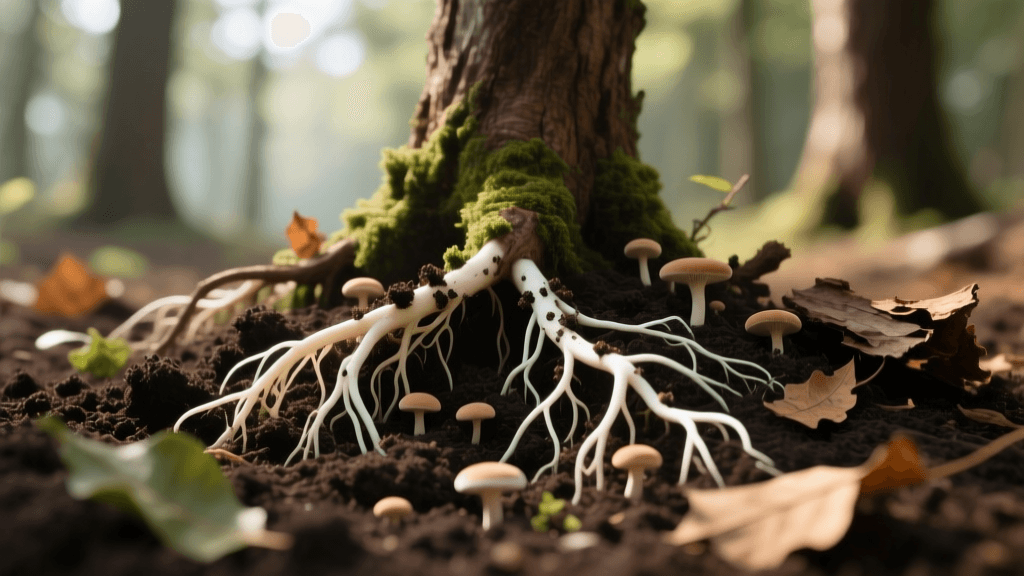
Tree Composting Guide: Boosting Root Zone Soil Health
When we think of tree care, our minds often jump to canopy pruning, pest management, or seasonal watering schedules. However, the true foundation of a thriving, long-lived tree lies hidden beneath the surface. In urban and suburban environments, trees face severe soil degradation, compaction, and a lack of organic matter. Applying compost to the tree root zone is one of the most effective, scientifically backed methods to restore soil health, improve water retention, and foster a robust immune system for your trees.
The Hidden Ecosystem: The Rhizosphere and Soil Food Web
Trees do not grow in isolation; they are part of a complex underground ecosystem known as the rhizosphere. This micro-environment is teeming with bacteria, fungi, nematodes, and earthworms that break down organic matter into bioavailable nutrients. According to the USDA Natural Resources Conservation Service (NRCS), soil health is fundamentally driven by the presence of organic matter and a diverse soil food web. When soils are stripped of their topsoil during construction or compacted by heavy foot traffic, this biological network collapses. Compost acts as a biological inoculant, reintroducing beneficial microbes and providing the carbon-rich food source necessary to rebuild the soil food web from the ground up.
Selecting the Best Compost for Tree Root Zones
Not all compost is created equal. While vegetable gardens often require high-nitrogen, fast-acting composts, trees generally prefer a more fungal-dominated, slow-release organic matter that mimics the natural forest floor. Below is a comparison of common compost types and their specific applications in tree care.
| Compost Type | NPK Ratio (Approx.) | pH Level | Best Use Case for Trees |
|---|---|---|---|
| Leaf Mold | Low (1-1-1) | 6.0 - 7.0 | Mimics the forest floor; excellent for moisture retention and promoting beneficial mycorrhizal fungi. |
| Yard Waste Compost | Medium (2-1-2) | 6.5 - 7.5 | General top-dressing for established urban and suburban shade trees. |
| Mushroom Compost | High (3-1-2) | 7.5 - 8.5 | Alkaline soils; use sparingly to avoid salt buildup and pH spikes around acid-loving trees like oaks. |
| Worm Castings | Variable | 7.0 | Seedling establishment, transplant shock recovery, and brewing aerated compost teas. |
Step-by-Step Guide to Compost Application
Applying compost incorrectly can do more harm than good, potentially leading to trunk rot or suffocated roots. Follow these actionable steps to properly amend your tree's soil.
1. Site Preparation and Grass Removal
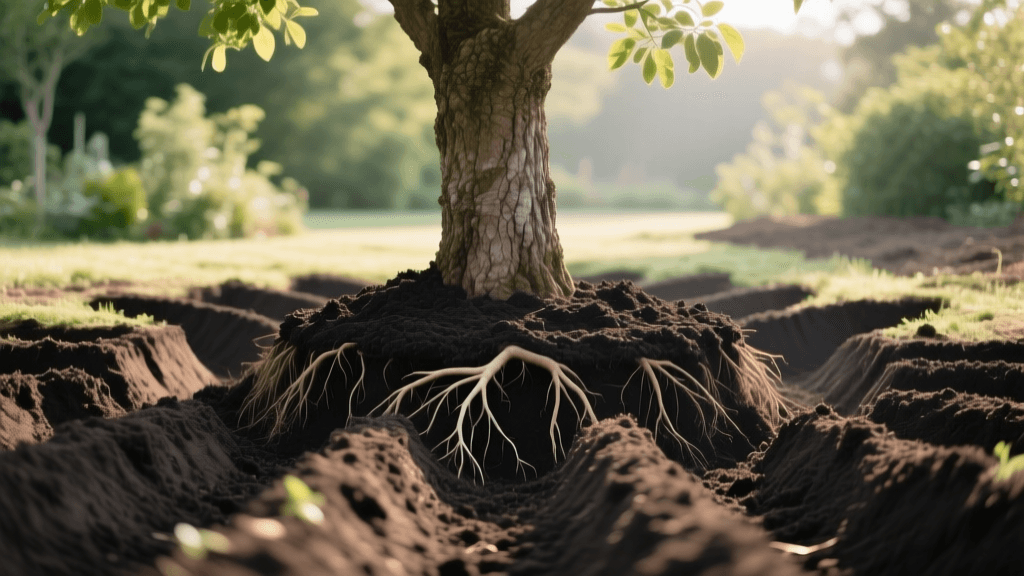
Before applying any amendments, you must remove competing turfgrass. Grass roots form a dense mat that intercepts water and nutrients before they can reach the deeper tree roots. Using a spade or a sod cutter, carefully remove the grass in a circle around the tree. Ideally, this circle should extend to the tree's dripline (the outer edge of the canopy), but a minimum radius of 3 to 4 feet from the trunk is sufficient for younger trees. Be careful not to sever major structural roots near the surface during this process.
2. The 'Donut' Top-Dressing Technique
Once the soil is exposed, apply a 2 to 3-inch layer of your chosen compost over the root zone. It is absolutely critical to keep the compost at least 6 inches away from the tree trunk flare. The trunk flare is the area where the trunk widens at the base and meets the roots. Burying the trunk flare under compost or mulch traps moisture against the bark, inviting fungal pathogens, root girdling, and eventual tree death. Think of the application shape as a donut, with the tree trunk in the empty center hole.
3. Vertical Mulching for Compacted Soils
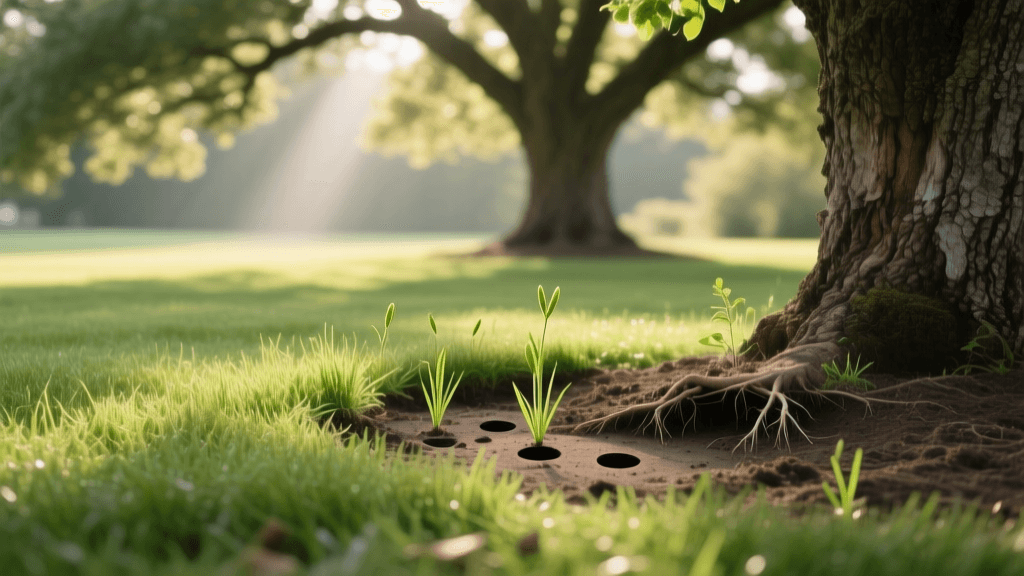
If your soil is heavily compacted from construction or heavy clay content, surface top-dressing alone will not penetrate deeply enough. In these cases, use vertical mulching. Using a 2-inch auger bit on a power drill, bore holes 8 to 12 inches deep into the soil, spacing them about 2 feet apart in concentric circles starting 3 feet away from the trunk and moving outward to the dripline. Fill these holes with a mixture of premium compost and coarse sand. This technique creates permanent channels for oxygen, water, and biological activity to reach the deeper feeder roots.
Advanced Biological Amendments
For trees suffering from severe stress, transplant shock, or decline, combining compost with targeted biological inoculants can accelerate recovery.
Mycorrhizal Fungi Inoculants
Mycorrhizal fungi form a symbiotic relationship with tree roots, effectively extending the root system's reach by up to 100 times. These fungal hyphae mine the soil for phosphorus, zinc, and water, trading them to the tree in exchange for sugars. When planting new trees or treating declining ones, apply a granular endo/ectomycorrhizal inoculant directly to the root ball or mix it into your compost top-dressing. Ectomycorrhizae are particularly vital for hardwoods like oaks, beeches, and birches.
Actively Aerated Compost Tea (AACT)
AACT is a liquid extract brewed from high-quality compost, water, and a microbial food source (like unsulfured molasses), oxygenated via an air pump for 24 to 36 hours. This process multiplies beneficial bacteria and fungi exponentially. Drenching the root zone with AACT once a month during the growing season introduces billions of beneficial microbes directly into the soil matrix, outcompeting pathogenic organisms that cause root rot.
Cost Considerations and Sourcing
Investing in soil health is cost-effective compared to the price of removing a dead tree. Bulk yard waste compost typically costs between $30 and $50 per cubic yard at local landscape supply centers, which is enough to top-dress roughly 100 square feet at a 3-inch depth. For smaller properties or specific applications like vertical mulching, bagged premium composts or leaf mold can be purchased at garden centers for $5 to $8 per cubic foot. Always source compost from reputable facilities that test for herbicides and heavy metals, as persistent herbicides (like aminopyralid) can survive the composting process and severely damage tree roots.
Critical Mistakes to Avoid
Even well-intentioned gardeners can harm trees through improper soil amendment practices. The International Society of Arboriculture (ISA) frequently warns against 'volcano mulching'—the practice of piling compost and mulch high against the tree trunk. This not only causes bark decay but also encourages secondary roots to grow into the compost pile, which eventually girdle and strangle the main trunk.
Additionally, avoid over-fertilizing. The University of Minnesota Extension notes that adding high-nitrogen synthetic fertilizers alongside compost can disrupt the delicate mycorrhizal networks, making trees dependent on artificial inputs and more susceptible to drought. Compost provides a slow, steady release of nutrients that aligns perfectly with a tree's natural uptake cycles.
Conclusion
Improving tree root zone soil health through composting is a long-term investment in the structural integrity and biological resilience of your landscape. By selecting the right organic matter, applying it using the donut method, and avoiding common pitfalls like trunk burial, you create a thriving subterranean ecosystem. A healthy soil food web translates directly to a vigorous, disease-resistant canopy that will provide shade, beauty, and ecological benefits for generations to come.