
Gardening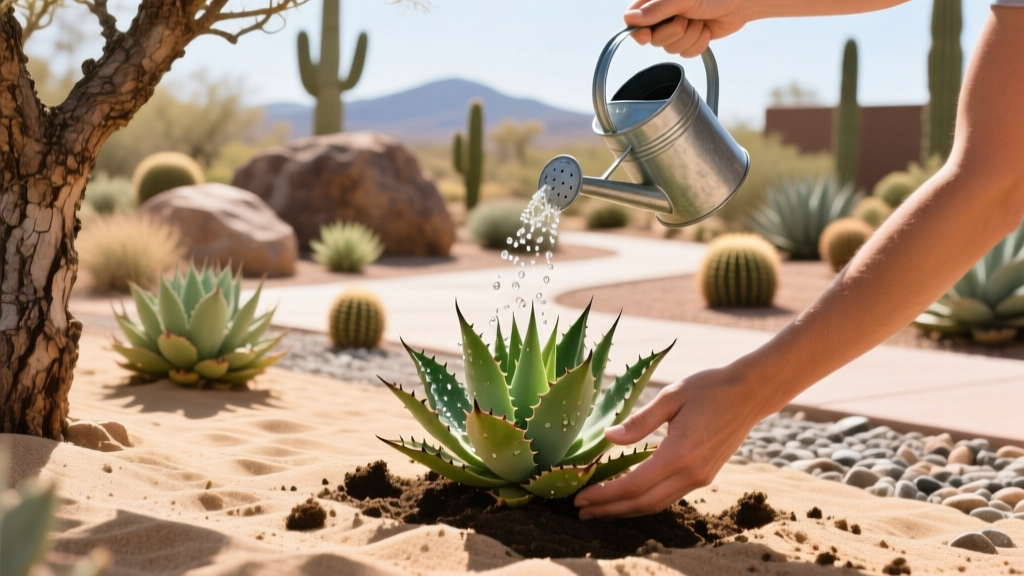
How to Plant and Water AZ Desert Plants for Drought-Resistant Yards
The Caliche Challenge: Preparing Alkaline Desert Soil
Successfully establishing AZ desert plants requires abandoning traditional eastern and coastal gardening paradigms. The primary obstacle in Arizona's low-desert regions (Zones 8a through 10a) is caliche—a concrete-like layer of calcium carbonate that restricts drainage and root penetration. Furthermore, desert soils typically boast an alkaline pH between 8.0 and 8.5, which locks up essential micronutrients like iron and zinc.
Before purchasing any plants, conduct a percolation test. Dig a 12-inch deep, 12-inch wide hole and fill it with water. If the water does not drain completely within four hours, you have a caliche hardpan. To resolve this, you must physically fracture the hardpan using a pickaxe or a motorized auger. If the caliche layer is too thick to break, pivot to constructing raised planter beds using a mix of 60% native sandy loam, 20% pumice, and 20% compost to ensure rapid drainage.
Warning: The "No-Amendment" Rule for Natives
When planting true native AZ desert plants like Creosote (Larrea tridentata) or Brittlebush (Encelia farinosa), do not amend the backfill soil with compost or peat moss. Native roots are adapted to low-organic, high-mineral soils. Adding organic matter creates a "bathtub effect" where the amended soil holds water while the surrounding native soil remains dry, leading to rapid root rot. Only amend the soil (with 10-15% compost) for non-native desert-adapted species like Lantana or Bougainvillea.
When planting true native AZ desert plants like Creosote (Larrea tridentata) or Brittlebush (Encelia farinosa), do not amend the backfill soil with compost or peat moss. Native roots are adapted to low-organic, high-mineral soils. Adding organic matter creates a "bathtub effect" where the amended soil holds water while the surrounding native soil remains dry, leading to rapid root rot. Only amend the soil (with 10-15% compost) for non-native desert-adapted species like Lantana or Bougainvillea.
Selecting the Right AZ Desert Plants for Your Microclimate
Arizona's microclimates vary drastically from the frost-prone high desert of Prescott (Zone 7b) to the sweltering low desert of Phoenix and Tucson (Zones 9b-10a). Selecting the correct species prevents costly winter die-offs and summer scorching. Below is a decision matrix for high-performing, low-water species available at most local nurseries.
| Botanical Name | Common Name | Mature Dimensions | USDA Zone | Est. 5-Gal Cost |
|---|---|---|---|---|
| Agave parryi | Parry's Agave | 2' H x 3' W | 7b - 10a | $45 - $65 |
| Chilopsis linearis | Desert Willow | 20' H x 15' W | 7b - 10a | $60 - $85 |
| Leucophyllum frutescenum | Texas Ranger | 6' H x 6' W | 8a - 10a | $45 - $75 |
| Eysenhardtia orthocarpa | Kidneywood | 15' H x 8' W | 8b - 10a | $55 - $80 |
| Sphaeralcea ambigua | Desert Mallow | 3' H x 3' W | 8a - 10a | $25 - $40 |
Step-by-Step Planting Technique to Prevent Crown Rot
The most common cause of death for newly installed AZ desert plants is crown rot, triggered by planting too deeply. Desert shrubs and succulents must be planted "high" to keep the root flare exposed to air circulation. Follow this precise installation protocol:
- Dig Wide, Not Deep: Excavate a hole three times as wide as the nursery container, but exactly the same depth. Do not loosen the soil at the bottom of the hole; this prevents the plant from settling lower after watering.
- Elevate the Root Flare: Place the plant in the hole so that the top of the root ball sits 1.5 to 2 inches above the surrounding native grade. This accounts for inevitable soil settling and keeps the stem base dry.
- Backfill and Tamp: Shovel the native soil back into the hole. Tamp it down gently with your boots to eliminate large air pockets, but avoid heavy compaction.
- Construct a Drip-Line Berm: Use the excess soil to build a 3-inch high, 4-inch wide circular berm exactly at the plant's drip line (the outer edge of the canopy). This captures rainfall and directs irrigation water to the active root zone.
Engineering the Drip Irrigation Layout
Overhead sprinklers are catastrophic for desert landscaping, promoting fungal diseases and wasting water to evaporation. A properly engineered drip system is non-negotiable. According to the Arizona Municipal Water Users Association (AMWUA), drip irrigation delivers water directly to the root zone with up to 90% efficiency.
For a standard residential xeriscape, utilize 1/2-inch polyethylene tubing with punch-in button emitters rather than pre-installed emitter lines, as desert plants require highly customized emitter spacing. Use pressure-compensating (PC) emitters to ensure uniform flow rates across sloped yards.
Emitter Sizing and Placement Framework
- Small Shrubs & Succulents (Under 3 ft): Use one 1.0 Gallon Per Hour (GPH) emitter placed 12 inches from the base.
- Medium Shrubs (3 ft to 6 ft): Use two 2.0 GPH emitters placed 18 inches apart at the drip line.
- Small Trees (Desert Willow, Palo Verde): Use three to four 2.0 GPH emitters spaced evenly in a circle 2 to 3 feet from the trunk.
The 1-2-3 Watering Rule for Long-Term Survival
Determining how long to run your drip system is a frequent point of confusion. The University of Arizona Cooperative Extension promotes the "1-2-3 Rule" based on the required depth of water penetration, rather than a fixed time duration, which varies based on soil composition and emitter flow rates.
- 1 Foot Deep: For groundcovers, annuals, and small succulents (e.g., Agave, Aloe).
- 2 Feet Deep: For medium shrubs and bushes (e.g., Texas Ranger, Lantana).
- 3 Feet Deep: For large trees and deep-rooted native shrubs (e.g., Mesquite, Desert Willow).
To verify penetration depth, purchase a 36-inch steel soil probe. Push the probe into the soil near the root zone two hours after an irrigation cycle. The probe will slide easily through wet soil and stop abruptly when it hits dry earth. If the probe does not reach the required depth for your plant category, increase the run time on your irrigation controller. During peak summer months (June through August), established desert shrubs typically require deep watering every 7 to 10 days, while native trees may only need water every 14 to 21 days. Consult the Arizona Extension Drought and Water-Wise Landscaping resources for seasonal scheduling matrices.
Troubleshooting Common Desert Plant Failures
Even with meticulous installation, environmental stressors can trigger specific failure modes. Recognizing these symptoms early prevents total plant loss.
Chlorosis (Yellowing Leaves with Green Veins)
This is a classic sign of iron deficiency induced by high soil pH, commonly seen in Texas Ranger and Desert Willow. Do not attempt to lower the soil pH with sulfur; it is largely ineffective in highly buffered desert soils. Instead, apply a chelated iron fertilizer (specifically Fe-EDDHA, which remains stable at pH 8.0+) as a soil drench in early spring. Expect to pay around $25 to $35 for a pound of Fe-EDDHA chelate.
Agave Snout Weevil Infestation
If your large Agaves suddenly appear wilted, with the central leaves collapsing and a foul odor emanating from the base, the Agave Snout Weevil (Scyphophorus acupunctatus) has likely bored into the core. Once the core is compromised, the plant cannot be saved and must be destroyed immediately to prevent the beetles from spreading. To protect healthy Agaves, apply a systemic imidacloprid drench to the soil around the base of the plant in early April before the beetles become active.
Root Rot in Succulents
Mushy, blackened stems at the soil line indicate root rot from overwatering or poor drainage. If caught early, you can attempt to save the plant by digging it up, cutting away all necrotic tissue with sterilized pruners, letting the plant callus over in the shade for five days, and replanting it in a heavily pumice-amended berm well above grade.

