
Gardening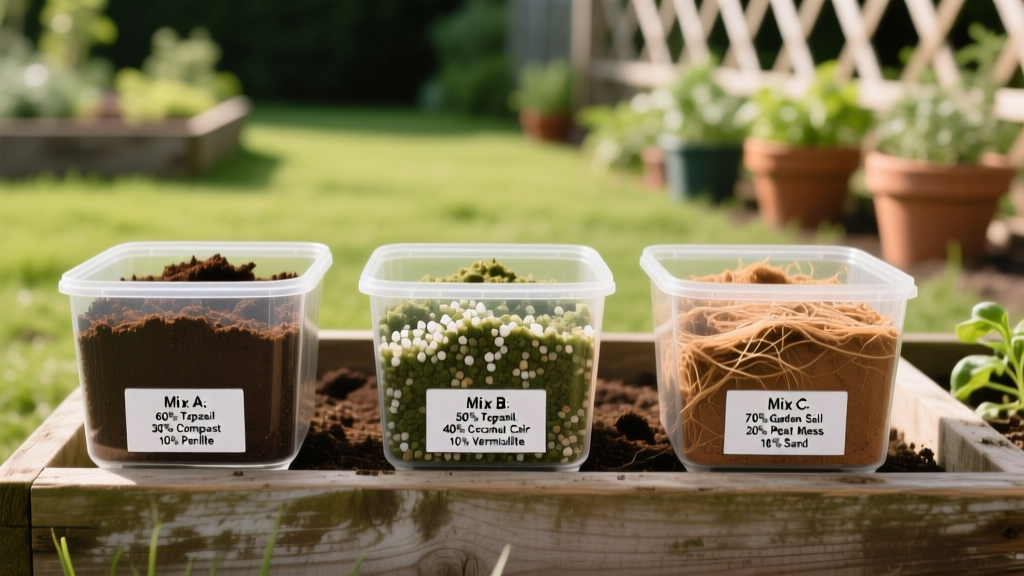
Beginner Gardening Soil Mixes: Exact Ratios for Raised Beds
The most common point of failure in beginner gardening is soil selection. Novices frequently fill their newly built raised beds with heavy, inexpensive topsoil or generic bagged garden dirt, only to watch their plants stall, yellow, and succumb to root rot. Raised beds require a fundamentally different soil architecture than in-ground planting. They demand a lightweight, highly aerated, and moisture-retentive medium that allows delicate feeder roots to expand without mechanical resistance.
This guide bypasses vague advice and provides the exact volumetric ratios, specific ingredient costs, and physical mixing protocols required to build a high-yield soil matrix for standard 4x4 raised beds.
The Core Beginner Gardening Soil Formula
The gold standard for raised bed cultivation is a variation of the classic equal-part mix, updated with modern, sustainable amendments. For a standard raised bed, you need a blend that provides structure, moisture retention, and slow-release nutrition. The optimal ratio by volume is 33% coarse vermiculite, 33% expanded coco coir, and 34% blended organic compost.
| Ingredient | Primary Function | Avg. Cost (2026) | Purchasing Specification |
|---|---|---|---|
| Coarse Vermiculite | Aeration, drainage, and capillary water retention | $35 per 4 cu. ft. bag | Must be 'coarse' or 'horticultural' grade, not fine seed-starting grade. |
| Coco Coir | Moisture retention and root penetration structure | $18 per 5kg compressed block | Look for low-EC (electrical conductivity) washed coir to avoid salt toxicity. |
| Blended Compost | Microbial life, macro/micronutrients, and cation exchange | $6 - $8 per cu. ft. | Use a blend of at least 3 sources (e.g., mushroom, cow manure, leaf mold). |
According to soil management guidelines from Penn State Extension, avoiding native soil in raised beds is critical because the confined space prevents the deep percolation required to flush salts and prevent compaction. The vermiculite-coir-compost triad mimics the physical properties of a premium greenhouse potting mix but at a fraction of the bulk cost.
Why Bagged 'Garden Soil' Fails in Confined Spaces
Hardware stores sell bags explicitly labeled 'Raised Bed Soil' or 'Garden Soil.' These are marketing terms, not scientific classifications. Bagged garden soil is typically a heavy blend of peat, sand, and forest products designed to be tilled into existing native dirt. When placed directly into a wooden or metal raised bed, it lacks the structural integrity to drain properly. Within six weeks, gravity and watering compress the particles, reducing pore space and suffocating root zones.
Critical Warning: Never use pure peat moss as a 1:1 substitute for coco coir without adjusting your hydration protocol. Peat moss becomes highly hydrophobic (water-repellent) once it dries out, whereas coco coir readily re-wets. If you must use peat, add 1 cup of agricultural lime per cubic foot to buffer its naturally low pH (3.5 - 4.5).
Step-by-Step Hydration and Mixing Protocol
The most frequent mistake beginners make is mixing dry ingredients directly in the bed. Dry vermiculite creates hazardous airborne dust, and dry coco coir will not integrate evenly. Follow this exact sequence:
- Expand the Coir: Place a 5kg compressed coir block in a heavy-duty mortar tub. Add 4.5 gallons of warm water. Allow it to sit for 45 minutes until fully expanded, yielding approximately 3 cubic feet of loose material.
- Pre-wet the Vermiculite: In a separate container, lightly mist the vermiculite with a hose sprayer until it is damp but not dripping. This suppresses silica dust and primes its capillary action.
- Layering: Add the expanded coir, damp vermiculite, and compost to a large wheelbarrow or a tarp spread on the lawn in alternating layers.
- The Tarp Roll: If using a tarp, grab two opposite corners and pull them over the pile to roll the soil onto itself. Repeat from all four sides until the color and texture are perfectly uniform. This method prevents the crushing of compost aggregates that occurs when using a metal shovel.
Calculating Total Volume and First-Year Costs
To fill a standard 4-foot by 4-foot raised bed that is 12 inches deep, you need exactly 16 cubic feet of soil. Because soil settles by roughly 10% after the first heavy watering, always mix 10% extra (aim for 17.5 cubic feet).
Exact Material Breakdown for One 4x4 Bed:
- Coco Coir: 2 blocks (yields 6 cu. ft.) = $36.00
- Coarse Vermiculite: 1.5 bags (yields 6 cu. ft.) = $52.50
- Blended Compost: 6 cu. ft. (bulk or bagged) = $42.00
- Total Initial Investment: $130.50 per bed
While this initial outlay is higher than buying $3 bags of topsoil, the Royal Horticultural Society notes that high-porosity organic matrices maintain their physical structure for 4 to 5 years. In subsequent years, you will only need to top-dress with 2 inches of fresh compost, dropping your annual maintenance cost to under $20 per bed.
Plant Spacing Matrix for High-Density Yields
Once your soil is mixed and settled, proper spatial arrangement dictates your harvest volume. Beginner gardening guides often rely on row-spacing meant for tractors. In a 4x4 raised bed, utilize intensive grid spacing to maximize the soil's nutrient density and shade out weeds.
| Crop Type | Grid Spacing | Plants per 4x4 Bed | Companion / Understory Notes |
|---|---|---|---|
| Bush Tomatoes (Determinate) | 2x2 foot squares | 4 plants | Interplant with fast-growing radishes in the corner gaps. |
| Bell Peppers | 1x1 foot squares | 16 plants | Requires heavy calcium supplementation to prevent blossom end rot. |
| Leaf Lettuce / Spinach | 4x4 inch grid | 144 plants | Sow successively every 14 days for continuous harvest. |
| Zucchini / Summer Squash | 3x3 foot squares | 1 to 2 plants | Plant in the center; allow leaves to spill over the bed edges. |
Frequently Asked Questions
Do I need to add fertilizer to this mix in the first year?
Yes, but sparingly. While the compost provides a baseline of nutrients, heavy feeders like tomatoes and brassicas will deplete available nitrogen by week six. Apply an organic granular fertilizer with an N-P-K ratio of 3-4-4 (such as Espoma Garden-tone) at a rate of 3 tablespoons per square foot at planting, and side-dress with another 2 tablespoons when the first flowers appear.
Can I use perlite instead of vermiculite?
You can, but it alters the water dynamics. Perlite is excellent for drainage but holds virtually no internal water. Vermiculite acts like a microscopic sponge, holding water and nutrients inside its layered structure and releasing them to roots via capillary action. If you live in an arid climate or struggle with daily watering, vermiculite is vastly superior for raised beds. If you live in a high-rainfall zone with poor natural drainage, a 50/50 split of perlite and vermiculite is optimal.
How do I refresh the soil in year two?
Do not replace the soil. The vermiculite and coir do not break down rapidly. In early spring, use a broadfork or a hand cultivator to gently loosen the top 6 inches. Add 2 inches of fresh blended compost across the surface, along with 1 cup of worm castings per square foot, and gently fold it into the existing matrix. This replenishes the microbial food web without disturbing the deep root channels established in year one.

