
Gardening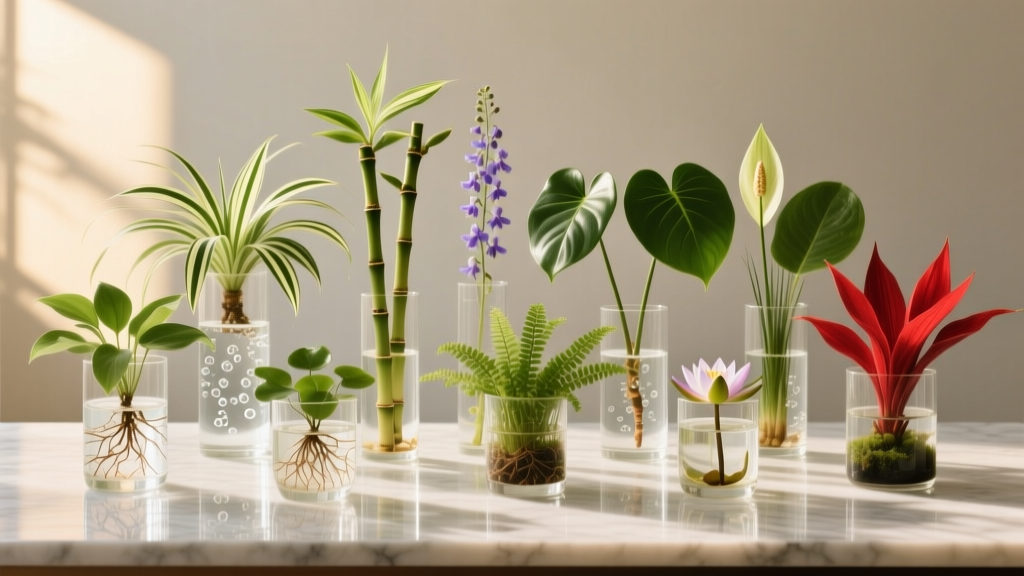
12 Best Plants That Grow in Water for Indoor Hydroculture
Growing plants that grow in water—often referred to as hydroculture or semi-hydroponics—bypasses soil-borne pests like fungus gnats and eliminates the guesswork of traditional watering schedules. However, transitioning from a soil medium to a 100% aqueous environment requires precise oxygenation, specific nutrient dosing, and strict light management. Water lacks the cation exchange capacity (CEC) of potting soil, meaning it cannot buffer nutrient spikes or hold onto essential minerals for the roots to absorb over time.
Hydroculture vs. Standard Water Propagation
While water propagation is a temporary method used to generate roots before potting in soil, true hydroculture is a permanent establishment technique. Plants cultivated permanently in water develop specialized 'water roots' that are structurally different from soil roots. They are thicker, whiter, and highly efficient at extracting dissolved oxygen. If you attempt to leave a standard soil-rooted plant in water without proper aeration, it will succumb to Pythium root rot within 14 to 21 days.
Expert Insight: To force the growth of water roots, you must maintain a dissolved oxygen (DO) level of at least 5-8 ppm. In a passive glass vase, this requires 100% water changes every 7 days. For a low-maintenance setup, drop a micro USB air stone into the vessel to provide continuous aeration.
The Water Quality and Nutrient Matrix
Tap water is generally hostile to long-term hydroculture due to chlorine, chloramines, and heavy minerals that cause tip burn and root necrosis. Use the matrix below to select your baseline water and nutrient strategy.
| Water Source | TDS (ppm) | Chlorine/Chloramine | Suitability for Hydroculture | Required Prep |
|---|---|---|---|---|
| Reverse Osmosis (RO) | 0-10 | None | Excellent (Ideal) | Add 1/4 tsp hydroponic fertilizer per gallon |
| Distilled | 0-5 | None | Excellent | Add 1/4 tsp hydroponic fertilizer per gallon |
| Filtered (Brita/PUR) | 50-150 | Chlorine removed | Good (Monitor for algae) | Use 1/8 tsp fertilizer; change every 10 days |
| Municipal Tap | 150-400+ | Present | Poor (High failure rate) | Must dechlorinate with sodium thiosulfate (1 drop/gal) |
For nutrient dosing, avoid standard liquid houseplant fertilizers (like Miracle-Gro), which rely on soil bacteria to break down urea. Instead, use a synthetic hydroponic formula like Dyna-Gro Foliage-Pro (9-3-6) or FloraGro. These contain immediately bioavailable nitrogen in the nitrate form, along with essential micronutrients like calcium and magnesium that are absent in pure water.
12 Elite Plants That Grow in Water
Not all species adapt to aqueous environments. The following 12 species possess the genetic resilience to thrive indefinitely in water when provided with appropriate lighting and nutrients.
Low Light Tolerant (50-150 Foot-Candles)
- Pothos (Epipremnum aureum): Specifically the 'Jade' or 'Neon' cultivars. Roots establish in 7-14 days. Highly forgiving of missed nutrient doses.
- ZZ Plant (Zamioculcas zamiifolia): Must be kept in an opaque or dark amber vase. Light exposure to the rhizomes and roots will trigger rot.
- Peace Lily (Spathiphyllum wallisii): Requires frequent water top-offs. Keep the crown strictly above the water line to prevent stem collapse.
- Lucky Bamboo (Dracaena sanderiana): Actually a Dracaena, not a bamboo. Thrives in 2-3 inches of water with LECA pebbles for structural support.
Medium Indirect Light (150-300 Foot-Candles)
- Philodendron (Philodendron hederaceum): The 'Brasil' and 'Heartleaf' varieties produce dense, fibrous water roots rapidly. Prune aerial roots before submerging.
- Swiss Cheese Plant (Monstera adansonii): Vines beautifully when grown in water. Requires a moss pole or trellis anchored in the vase for mature leaf fenestration.
- Arrowhead Vine (Syngonium podophyllum): Fast grower. Pinch back the apical meristem every 4 weeks to prevent the plant from becoming leggy and top-heavy in a glass vessel.
- Spider Plant (Chlorophytum comosum): Only submerge the base of the plantlets (spiderettes). Submerging the main crown of a mature plant will cause immediate rot.
Bright Indirect Light (300+ Foot-Candles)
- Wandering Dude (Tradescantia zebrina): Extremely aggressive rooter. Change water every 5 days, as the rapid growth depletes dissolved oxygen quickly.
- Coleus (Plectranthus scutellarioides): Demands high light to maintain leaf variegation. Use an air stone, as Coleus is highly susceptible to anaerobic bacterial blooms.
- Polka Dot Begonia (Begonia maculata): Keep the stem submerged, but ensure zero water splashes onto the silver-spotted leaves to prevent powdery mildew.
- English Ivy (Hedera helix): Prone to spider mites even indoors. The water environment allows for easy weekly rinsing of the foliage to deter pests.
Step-by-Step Establishment Protocol
Follow this exact procedure to transition cuttings into a permanent hydroculture setup with a 95%+ success rate.
- Node Identification and Cutting: Locate a healthy node (the brown bump or leaf joint). Using sterilized bypass pruners, make a clean 45-degree cut exactly 1/4 inch below the node. A 90-degree cut rests flat against the bottom of the glass, blocking vascular uptake.
- Foliage Stripping: Remove all leaves that will sit below the water line. Submerged leaves will decay within 48 hours, spiking ammonia levels and triggering bacterial rot.
- Vessel Selection: Choose a vessel with a narrow neck to support the stem. For light-sensitive plants (like ZZ or Philodendron), use amber glass or wrap clear glass in a neoprene sleeve to block UV rays and prevent algae photosynthesis.
- Water Conditioning: Fill the vessel with RO or distilled water. Add 1/4 teaspoon of Dyna-Gro Foliage-Pro per gallon of water. Stir gently to dissolve.
- Submersion and Placement: Submerge the cutting so that at least one node is underwater, but keep the lowest remaining leaf at least 1 inch above the water surface. Place in bright, indirect light.
Pro-Tip: If you are transitioning an entire plant from soil to water (rather than a fresh cutting), you must wash 100% of the soil from the root ball using a gentle hose spray. Any remaining organic soil matter will decompose in the water, causing an anaerobic environment and fatal root rot. According to the University of Minnesota Extension, bare-rooting requires trimming away any damaged or excessively long soil roots to encourage new water root flushes.
Troubleshooting: Algae, Rot, and Stagnation
Even with perfect technique, hydroculture setups can encounter environmental hiccups. Use this decision tree to diagnose and fix common issues.
Symptom: Slimy, Brown, Foul-Smelling Roots
Cause: Pythium or Phytophthora root rot due to anaerobic conditions (lack of oxygen).
The Fix: Remove the plant immediately. Trim all brown/mushy roots with sterilized scissors. Submerge the remaining healthy white roots in a solution of 1 part 3% hydrogen peroxide to 4 parts water for 10 minutes to kill the pathogens. Rinse, place in fresh RO water, and introduce an air stone. The Royal Horticultural Society (RHS) notes that improving drainage and aeration is the only effective cure for waterborne root pathogens.
Symptom: Green Film or Cloudy Water
Cause: Algae bloom. This occurs when three factors align: water, nutrients, and direct UV/sunlight hitting the glass.
The Fix: Algae is not directly harmful to the plant, but it competes for nutrients and oxygen. Scrub the vase with a bottle brush and a 10% bleach solution (rinse thoroughly). Move the plant out of direct sun, or switch to an opaque ceramic vase. Reduce nutrient dosing by 50% until the water remains clear for two consecutive weeks.
Symptom: Yellowing Leaves and Stunted Growth
Cause: Nutrient lockout or nitrogen deficiency. Water has no CEC to buffer pH swings; if the water pH drops below 5.5 or rises above 7.0, the plant cannot absorb iron or magnesium.
The Fix: Test the water pH using a digital meter or drops. If out of the 5.8-6.5 range, perform a 100% water change. Ensure you are using a complete hydroponic fertilizer that includes chelated micronutrients, not a standard NPK-only liquid feed.
Mastering the cultivation of plants that grow in water transforms indoor gardening into a clean, modern, and highly controlled practice. By strictly managing water quality, light exposure, and nutrient PPM, you can maintain lush, soil-free specimens that thrive for years.

