
Gardening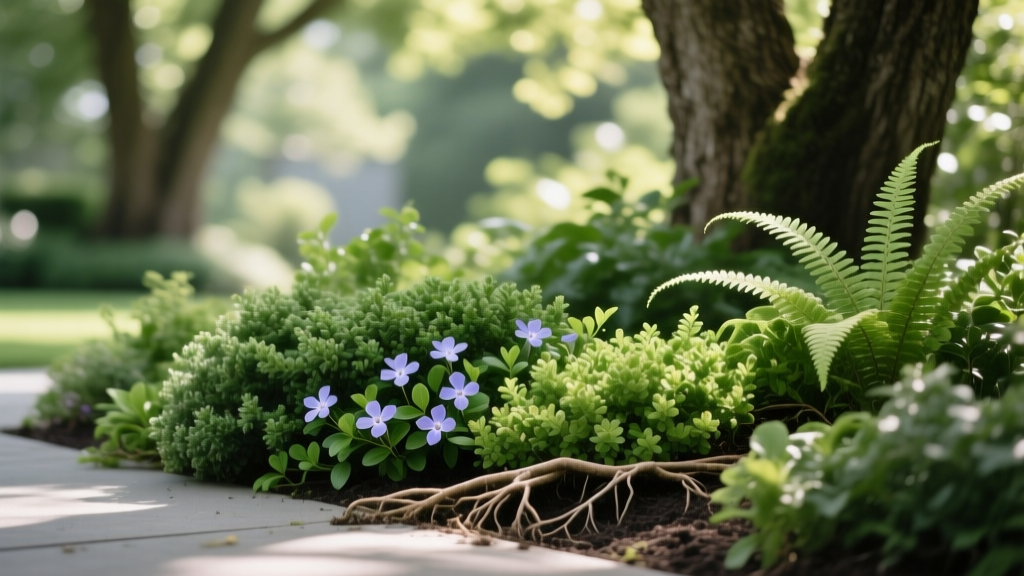
Best Creeping Plants for Shade to Fix Bare Soil Under Trees
Diagnosing Your Shade Microclimate
Bare, compacted soil under mature trees or along north-facing foundations is a notorious landscaping dead zone. Turfgrass starves in these areas due to a lack of photosynthetically active radiation (PAR) and intense moisture competition from tree roots. Selecting the right creeping plants for shade requires moving beyond generic 'shade-tolerant' labels and diagnosing the specific microclimate of your problem area.
Pro Tip: The Canopy Test
Look up at the tree canopy at noon. If less than 15% of direct sunlight penetrates to the ground, you are dealing with 'heavy shade.' If the soil is also hydrophobic (repels water) due to dense surface roots, you have 'dry shade'—the most challenging condition in horticulture.
Look up at the tree canopy at noon. If less than 15% of direct sunlight penetrates to the ground, you are dealing with 'heavy shade.' If the soil is also hydrophobic (repels water) due to dense surface roots, you have 'dry shade'—the most challenging condition in horticulture.
Before purchasing plants, categorize your site into one of two distinct environments:
- Dry Shade (High Root Competition): Typically found under shallow-rooted trees like Norway Maples (*Acer platanoides*), Beeches, or large Oaks. The soil is often hydrophobic, nutrient-depleted, and laced with dense fibrous roots.
- Moist Shade (Low Root Competition): Found on the north side of buildings, in low-lying clay depressions, or under trees with deep taproots like Hickories. Soil retains moisture but lacks light.
Top Creeping Plants for Dry Shade (High Root Competition)
Dry shade requires plants with aggressive, drought-tolerant rhizomatous root systems that can navigate existing tree roots without requiring constant supplemental irrigation once established.
1. Barrenwort (*Epimedium x versicolor* 'Sulphureum')
Why it works: According to NC State Extension, *Epimedium* species are exceptionally tolerant of dry shade and root competition. The 'Sulphureum' cultivar offers pale yellow spring flowers and semi-evergreen foliage that turns bronze in winter.
- Cost & Sizing: Typically sold in 1-gallon pots ($10–$14) or bare-root divisions ($6–$9).
- Spacing: Plant 1-gallon pots 18 inches on center. Expect full coverage in 2 to 3 years.
- Establishment: Requires weekly deep watering for the first 12 weeks to push roots through the dry tree-root matrix.
2. Big Blue Lilyturf (*Liriope muscari* 'Big Blue')
Why it works: Despite its grass-like appearance, Liriope is an asparagus family member with thick, fleshy tubers that store water, making it highly resilient in dry shade. It does not spread via aggressive runners like its cousin *Liriope spicata*, keeping it contained under tree canopies.
- Cost & Sizing: Widely available in 4-inch pots ($4–$6) or 1-gallons ($8–$11).
- Spacing: 12 to 15 inches on center.
- Maintenance: Requires an annual mowing (set mower to 3 inches) in late February to remove tattered winter foliage before new spring growth emerges.
3. Periwinkle (*Vinca minor* 'Bowles')
Why it works: 'Bowles' is a superior cultivar that produces larger, darker blue flowers and larger leaves than the straight species. It roots at the nodes as it creeps, forming a dense, weed-suppressing mat that thrives where grass fails.
- Cost & Sizing: Best purchased in flat trays of 50 plugs ($1.20–$1.80 per plug).
- Spacing: Plant plugs 8 to 10 inches apart in a staggered grid for rapid coverage (usually within one growing season).
Ecological Warning:
*Vinca minor* can escape cultivation and invade adjacent woodlands. If your property borders a natural forest reserve, opt for native alternatives like Wild Ginger (*Asarum canadense*) or foamflower to prevent ecological disruption.
*Vinca minor* can escape cultivation and invade adjacent woodlands. If your property borders a natural forest reserve, opt for native alternatives like Wild Ginger (*Asarum canadense*) or foamflower to prevent ecological disruption.
Best Groundcovers for Moist, Heavy Shade
If your shaded area retains moisture and lacks aggressive tree roots, you can utilize plants that prefer rich, consistently damp soil profiles.
1. Japanese Spurge (*Pachysandra terminalis* 'Green Sheen')
A classic evergreen groundcover that forms a dense, 8-inch-tall carpet. The 'Green Sheen' cultivar is specifically bred for superior heat tolerance and glossier foliage. It thrives in moist, acidic soils (pH 5.5 to 6.5) and spreads rapidly via underground rhizomes.
2. Running Tapestry Foamflower (*Tiarella cordifolia* 'Running Tapestry')
A native woodland perennial that produces stunning, deeply lobed foliage with dark central veining. In spring, it sends up 12-inch spires of frothy white flowers. It prefers moist, humus-rich soil and spreads by stolons (above-ground runners), making it an excellent creeping plant for shade that supports local pollinators.
Step-by-Step Planting Strategy: Beating Tree Roots
Planting under mature trees requires surgical precision. Rototilling or aggressive digging will sever critical structural roots, destabilizing the tree and inviting pathogenic fungi. Follow this protocol recommended by Penn State Extension for safe understory planting:
- Map the Zone: Identify the dripline of the tree. Avoid planting within 3 feet of the trunk to protect the root flare and trunk base.
- Use an Auger, Not a Shovel: For plug-sized creeping plants, attach a 3-inch bulb auger bit to an 18V cordless drill. This allows you to bore precise, narrow planting holes between existing tree roots without severing major anchors.
- Amend the Hole, Not the Bed: Do not import massive amounts of topsoil to raise the grade over tree roots (this suffocates them). Instead, mix the extracted native soil with 20% high-quality compost to backfill around your new plugs.
- Mulch Correctly: Apply a 2-inch layer of coarse arborist wood chips over the planted area. Keep the mulch 3 inches away from the base of the tree trunk to prevent bark rot.
Shade Groundcover Comparison Matrix
| Botanical Name | Common Name | Shade Tolerance | Moisture Need | Spread Rate (sq ft/yr) | Deer Resistance |
|---|---|---|---|---|---|
| *Epimedium x versicolor* | Barrenwort | Heavy / Dry | Low (once established) | 0.5 - 1 | High |
| *Liriope muscari* | Big Blue Lilyturf | Heavy / Dry | Low to Moderate | 1 - 2 (clumping) | High |
| *Vinca minor* | Periwinkle | Heavy / Dry | Low to Moderate | 3 - 5 | High |
| *Pachysandra terminalis* | Japanese Spurge | Heavy / Moist | Moderate to High | 2 - 4 | High |
| *Tiarella cordifolia* | Foamflower | Partial / Moist | High | 1 - 2 | Moderate |
Troubleshooting Common Failure Modes
Even the best creeping plants for shade can fail if specific edge cases are ignored. Watch for these common issues:
Volutella Stem Blight in Pachysandra
If your *Pachysandra* develops brown, necrotic lesions on the stems and collapses, it is likely infected with *Volutella pachysandricola*. This fungal pathogen thrives in stagnant, humid air. The Fix: Thin the bed by removing 20% of the plants to increase airflow, avoid overhead irrigation, and apply a copper-based fungicide if the infection is severe.
Allelopathy from Black Walnuts
If your shade is cast by a Black Walnut (*Juglans nigra*), the tree roots secrete juglone, a biochemical that is highly toxic to many plants. *Pachysandra* and *Vinca* will quickly yellow and die. The Fix: You must select juglone-tolerant species. *Epimedium* and *Liriope* exhibit high tolerance to juglone and will survive under walnuts.
Vole Damage to Root Systems
During winter, meadow voles often tunnel under the snow and girdle the shallow roots of shade groundcovers, particularly *Pachysandra* and *Vinca*. If plants lift easily out of the soil in spring with no roots attached, voles are the culprit. The Fix: Install 1/4-inch hardware cloth collars around the base of vulnerable plantings, or use castor oil-based vole repellents (like MoleMax) applied at a rate of 1 gallon per 1,000 square feet in late autumn.
For more comprehensive data on establishing understory plantings, consult the University of Maryland Extension's guide on groundcovers to ensure your selections align with local hardiness zones and soil profiles. By matching the exact microclimate to the specific cultivar's physiological needs, you can permanently transform barren, shaded dirt into a thriving, low-maintenance landscape.

