
Gardening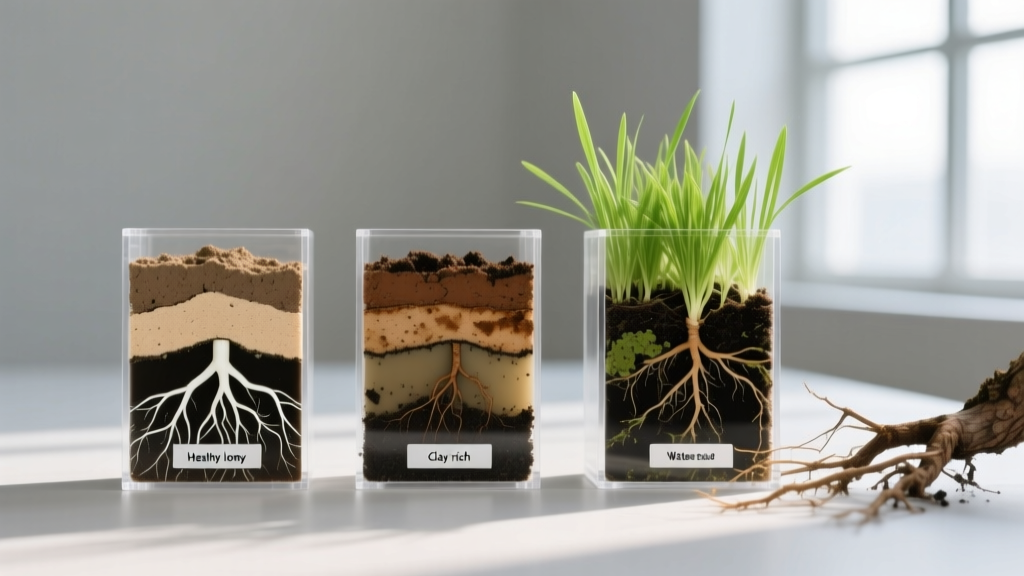
Diagnosing Root Rot and Drainage in Different Types of Soil
The Soil Texture Triangle: Identifying Your Base Problem
When garden plants exhibit stunted growth, yellowing leaves, or sudden wilting despite adequate watering, the root cause is rarely the plant itself. In nearly 80% of home garden failures, the underlying issue stems from a mismatch between plant requirements and the physical structure of the native earth. Understanding the different types soil in your yard is the first critical step in diagnosing drainage failures, compaction, and nutrient lockout.
Soil texture is defined by the ratio of sand, silt, and clay particles. According to the University of Minnesota Extension, these particle sizes dictate pore space, which in turn controls water retention and oxygen availability to roots. Before purchasing amendments, you must accurately diagnose your baseline texture using the DIY Jar Test:
- Fill a clear quart mason jar one-third full with a soil sample taken from 6 inches below the surface.
- Fill the rest with water and add one teaspoon of liquid dish soap (to separate particles).
- Shake vigorously for 3 minutes, then let it sit undisturbed for 24 hours.
- Measure the layers: Sand settles in 1 minute, silt in 2 hours, and clay takes the full 24 hours to drop out.
Once you know your dominant particle type, you can apply targeted solutions to the specific failure modes associated with each.
Diagnosing and Fixing Clay Soil Compaction
Symptoms of Clay Failure
Clay particles are microscopic and plate-like, stacking tightly together to eliminate macropores. If your soil forms a ribbon longer than 2 inches when squeezed between your thumb and forefinger, you have heavy clay. The primary diagnostic symptom of clay failure is surface water pooling for more than 4 hours after a heavy rain, followed by deep cracking during dry spells. Below the surface, this lack of oxygen creates anaerobic conditions that invite Phytophthora and Pythium root rot pathogens.
The Expert Fix: Expanded Shale and Pine Bark
The most persistent myth in gardening is that adding sand to clay improves drainage. In reality, mixing sand into heavy clay creates a dense, concrete-like matrix that worsens compaction. Instead, you must physically fracture the clay structure and introduce rigid organic matter.
- Primary Amendment: Apply expanded shale (such as PermaTill or Esh expanded shale) at a rate of 20% by volume. The porous, lightweight shale particles act as permanent wedges, preventing clay plates from re-sealing.
- Organic Matter: Incorporate 3 inches of fully composted pine bark fines (like Fafard Premium Landscape Mix). Unlike peat moss, which breaks down in a single season and re-compacts, pine bark lignin resists decomposition for 3 to 5 years, maintaining crucial macropores.
- Application: Use a broadfork to fracture the soil to a depth of 10 inches, then top-dress with the shale and bark mixture. Do not rototill, as tilling destroys existing soil aggregates and creates a hardpan layer just below the tiller's reach.
Critical Warning: Never work clay soil when it is wet. If you squeeze a handful of clay and water drips out, or it feels slick and muddy, stay off it. Working wet clay permanently destroys its structure, creating hard clods that require years of biological activity to repair.
Solving Sandy Soil Nutrient Leaching
Symptoms of Sand Failure
Sandy soil feels gritty and fails to form a ribbon. While it offers excellent drainage, its massive particle size results in very low Cation Exchange Capacity (CEC). CEC is the soil's ability to hold onto positively charged nutrient ions (like calcium, magnesium, and potassium). In sandy soils, water-soluble fertilizers simply wash straight through the root zone into the groundwater, leaving plants deficient and causing chronic chlorosis (yellowing between leaf veins).
The Expert Fix: Biochar and Coir Integration
To fix sandy soil, you must artificially increase its surface area and CEC. Standard compost helps, but it decomposes rapidly in highly aerated sand.
- Primary Amendment: Incorporate horticultural biochar (such as Wakefield Biochar) at a rate of 10% by volume. Biochar is created through pyrolysis, resulting in a highly porous carbon structure that acts like a microscopic sponge, holding both water and nutrient ions.
- Activation Step: Raw biochar can temporarily tie up nitrogen. You must 'charge' it before application by soaking it in compost tea or a liquid kelp fertilizer (like Neptune's Harvest) for 48 hours.
- Moisture Retention: Blend in coconut coir at a 15% ratio. Coir holds up to 10 times its weight in water and rewets much easier than peat moss when it dries out.
Troubleshooting Silt Soil Drainage and Crusting
Symptoms of Silt Failure
Silt particles are intermediate in size and feel smooth, like flour or talcum powder. Silt holds nutrients well but suffers from severe surface crusting. When exposed to heavy rain or overhead irrigation, silt particles wash into surface pores and dry into a hard, impermeable crust. This crust blocks seedling emergence, prevents gas exchange, and causes shallow root growth.
The Expert Fix: Cover Cropping and Straw Mulching
Mechanical amendments are less effective for silt than biological ones. The goal is to protect the surface and build vertical root channels.
- Surface Protection: Never leave silt bare. Apply a 2-inch layer of weed-free straw mulch immediately after planting to absorb the kinetic energy of raindrops.
- Biological Fracturing: In the off-season, plant Daikon radishes (tillage radishes). Their massive taproots can penetrate compacted silt up to 6 feet deep. When winter kills the radishes, the decaying roots leave behind large, permanent macropores that drastically improve spring drainage.
Soil Type Diagnostic and Amendment Matrix
| Soil Type | Primary Failure Mode | Diagnostic Symptom | Targeted Amendment | Application Rate |
|---|---|---|---|---|
| Heavy Clay | Anaerobic compaction | Water pools >4 hours; deep cracks | Expanded shale & pine bark | 20% shale, 3 inches bark |
| Coarse Sand | Nutrient leaching (Low CEC) | Rapid drying; yellowing leaves | Charged biochar & coir | 10% biochar, 15% coir |
| Fine Silt | Surface crusting | Hard surface crust; poor emergence | Daikon radish & straw mulch | 2 inches straw; fall cover crop |
Advanced Diagnostic Tools for the Home Gardener
Visual diagnosis only gets you so far. To truly master the different types soil in your landscape, you need precise data on moisture tension and pH levels, which dictate nutrient availability.
Moisture Tension Meters
Cheap probe meters that measure electrical conductivity are notoriously inaccurate in varied soil textures. Instead, invest in a tensiometer or a high-quality digital moisture meter like the Irrometer SR Soil Moisture Sensor (approx. $65). This device measures the actual suction force (centibars) the plant roots must exert to pull water from the soil. Clay soils might show 'wet' on a cheap meter while the plant is actually wilting from high suction tension; a tensiometer reveals this hidden drought stress.
Calibrated pH Pens
Soil pH controls nutrient lockout. In heavy clay, pH is highly buffered and difficult to change, while sandy soil pH can swing wildly with a single application of fertilizer. Ditch the $15 analog dials and use the Bluelab pH Pen (approx. $95). It requires calibration with pH 4.0 and 7.0 buffer solutions, but provides laboratory-grade accuracy to the decimal point, allowing you to precisely calculate the amount of elemental sulfur or garden lime needed to correct deficiencies.
Pro Tip: Before amending your soil, utilize the USDA Web Soil Survey. This free, GIS-based tool allows you to pinpoint your exact property and view the official soil series mapping, giving you a baseline understanding of your native subsoil horizons before you even dig a test hole.
Real-World Cost Analysis: Amending a 10x10 Garden Bed
Understanding the financial commitment of soil remediation helps in planning large-scale garden installations. Amending a standard 100-square-foot raised bed to a depth of 6 inches requires approximately 50 cubic feet of amendment material. Here is a realistic 2026 cost breakdown for fixing extreme soil types:
Clay Soil Remediation Budget
- Expanded Shale (PermaTill): 10 cubic feet @ $4.50/cu ft = $45.00
- Pine Bark Fines: 15 cubic feet @ $5.00/cu ft = $75.00
- Composted Manure: 25 cubic feet @ $3.00/cu ft = $75.00
- Total Material Cost: $195.00 (Labor excluded)
Sandy Soil Remediation Budget
- Horticultural Biochar: 5 cubic feet @ $9.00/cu ft = $45.00
- Coconut Coir Blocks: 8 cubic feet (expanded) @ $6.00/cu ft = $48.00
- Composted Manure: 37 cubic feet @ $3.00/cu ft = $111.00
- Total Material Cost: $204.00 (Labor excluded)
While the upfront costs of amending native soils can approach $200 per 100 square feet, the long-term reduction in plant replacement, fertilizer waste, and irrigation costs typically yields a positive return on investment within two growing seasons. By accurately diagnosing your specific soil texture and applying structurally appropriate amendments, you transition from fighting your landscape to leveraging its natural biology.

