
Gardening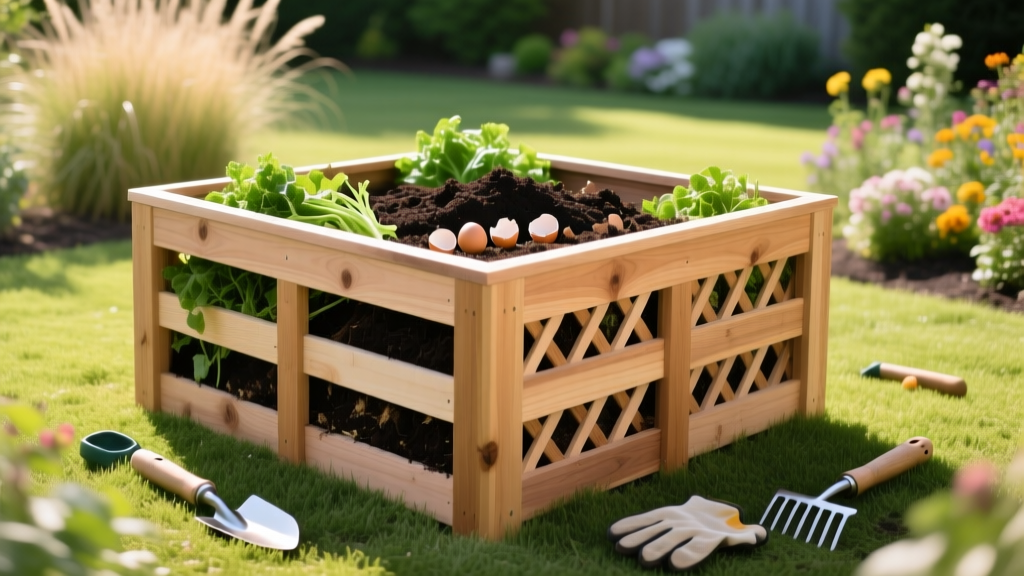
DIY Compost Bin Design: Exact Dimensions, Materials & Airflow
Most DIY compost bins fail not because of the organic ingredients placed inside them, but because of flawed structural engineering. A poorly designed enclosure traps moisture, restricts oxygen, and lacks the thermal mass required to sustain the thermophilic bacteria responsible for rapid decomposition. When building a compost bin from scratch, success relies on strict adherence to volume minimums, precise aeration metrics, and material durability.
This guide details the exact engineering specifications required to build a high-performance compost bin, eliminating the guesswork around dimensions, lumber selection, and passive airflow systems.
The 27-Cubic-Foot Rule: Why Volume Dictates Thermal Mass
The single most common design failure in residential composting is building a bin that is too small. To reach and sustain thermophilic temperatures (135°F to 160°F), a compost pile requires a minimum critical mass to insulate its core from ambient air temperatures.
Core Engineering Metric: The minimum viable dimension for a hot compost bin is 3 feet wide by 3 feet deep by 3 feet high (36' x 36' x 36'). This yields exactly 27 cubic feet of volume. Bins smaller than this will rarely exceed 100°F, resulting in slow, mesophilic decomposition that fails to kill weed seeds and pathogens.
While 27 cubic feet is the minimum, designing a 3-bay system (each bay measuring 3x3x3 feet) is the optimal configuration for continuous processing. This allows you to fill Bay 1, let it cure in Bay 2, and harvest finished humus from Bay 3. According to the Environmental Protection Agency (EPA), maintaining this volume ensures the carbon-to-nitrogen ratio and moisture levels remain stable despite external weather fluctuations.
Material Selection Matrix: Wood vs. Wire vs. Composite
The materials you choose dictate the bin's lifespan, insulation properties, and chemical safety. Avoid using old pressure-treated lumber manufactured before 2004, as it contains chromated copper arsenate (CCA), which can leach toxic arsenic into your soil. If using modern pressure-treated wood, ensure it is labeled ACQ (alkaline copper quaternary) or CA-C (copper azole), though naturally rot-resistant woods are vastly superior for organic gardening.
| Material | Lifespan | Insulation Value | Airflow Potential | 2026 Est. Cost (per bay) |
|---|---|---|---|---|
| Untreated Western Red Cedar | 10–15 years | High | Moderate (Requires drilling) | $85 – $110 |
| 16-Gauge Galvanized Hardware Cloth | 20+ years | None | Maximum | $45 – $60 |
| Composite Decking Boards | 25+ years | Low | Low (Requires large gaps) | $180 – $240 |
| Heat-Treated (HT) Shipping Pallets | 3–5 years | Low | High | $0 – $20 (hardware) |
Expert Recommendation: For the optimal balance of insulation, longevity, and chemical safety, construct the frame from 2x4 untreated cedar and line the interior walls with 1/2-inch galvanized hardware cloth. This prevents rodent intrusion while maximizing structural integrity.
Airflow Engineering: Calculating Void Space and Venting
Aerobic bacteria require oxygen to break down organic matter efficiently. Without passive airflow, the pile's core goes anaerobic, producing hydrogen sulfide (the 'rotten egg' smell) and slowing decomposition to a crawl. You must engineer a 'chimney effect' that draws cool air in from the bottom and expels hot, moisture-laden air from the top.
Drilling Specifications for Wooden Bins
If using solid wood walls (like cedar fence pickets or 1x6 boards), you must manually introduce void space.
- Hole Diameter: Use a 1/2-inch or 3/4-inch spade bit. Holes smaller than 1/2-inch clog easily with expanding compost material.
- Spacing: Drill holes every 6 to 8 inches horizontally and vertically across all four walls.
- Placement: Start drilling 6 inches above the base (to prevent structural weakening at the joints) and stop 6 inches below the top rim.
'Proper aeration is the most critical factor in hot composting. Turning the pile introduces oxygen, but a well-designed bin with adequate lateral venting reduces the need for manual turning by up to 50%.' — Penn State Extension
Moisture Retention & Drainage: The Base Layer Blueprint
A bin placed directly on flat clay soil will pool water at the bottom, drowning the lower aerobic bacteria. Conversely, a bin placed entirely on concrete loses the benefit of upward soil microbe migration and suffers from rapid moisture loss. The base must be engineered for both drainage and biological inoculation.
- Site Preparation: Excavate a 36' x 36' square to a depth of 4 inches, removing all turf grass and topsoil down to the subsoil layer.
- Aggregate Base: Fill the excavated area with 3 inches of coarse, untreated woodchips or 3/4-inch crushed gravel. This creates a French-drain effect, allowing excess leachate to percolate away from the pile.
- Biological Bridge: Leave the bottom 3 inches of the bin walls open to the soil (do not install a wire mesh floor). This allows native earthworms and soil nematodes to migrate upward into the compost as temperatures moderate.
Cost Breakdown: Building a 3-Bay Cedar System in 2026
Building a multi-bay system requires a significant upfront investment in lumber, but it yields a lifetime supply of high-grade soil amendment. Below is a realistic material breakdown based on early 2026 big-box hardware store pricing for a 3-bay system (total dimensions: 9' wide x 3' deep x 3' high).
| Component | Quantity | Unit Price | Total Cost |
|---|---|---|---|
| 4x4 Untreated Cedar Posts (8 ft) | 4 | $28.00 | $112.00 |
| 1x6 Cedar Fence Pickets (6 ft) | 60 | $4.80 | $288.00 |
| 2x4 Cedar Rails (8 ft) | 8 | $12.50 | $100.00 |
| 2.5' Galvanized Deck Screws | 2 boxes | $14.00 | $28.00 |
| Total Estimated Material Cost | $528.00 |
Cost-saving alternative: Swap the cedar pickets for 16-gauge hardware cloth stapled to standard ACQ pressure-treated 4x4 posts. This reduces the total material cost to approximately $210 while maintaining excellent airflow and structural lifespan.
Common Design Failures and Engineering Fixes
Even well-built bins can suffer from operational flaws if the internal geometry is ignored. Use this troubleshooting matrix to diagnose and correct structural issues.
| Symptom | Design Flaw | Engineering Fix |
|---|---|---|
| Pile smells like ammonia | Insufficient lateral airflow; anaerobic core | Increase aeration hole diameter to 3/4-inch; insert a perforated 4-inch PVC chimney pipe vertically into the center. |
| Edges dry out, center stays wet | Bin footprint too wide (exceeds 4 feet) | Never build a single bay wider than 36 inches. The outer 6 inches act as an insulating bio-wall; wider bins lose edge moisture. |
| Wood rotting at the base within 2 years | Direct soil contact without a moisture barrier | Elevate the bottom horizontal rail 2 inches above the gravel base using composite shims, or coat the bottom 12 inches of wood with raw linseed oil. |
| Rodents nesting in the lower third | Gaps between base and ground exceed 1/2 inch | Bury a 12-inch apron of 1/2-inch hardware cloth outward from the base, or secure the bin frame to the ground using 18-inch steel rebar stakes driven through the corner posts. |
By treating your compost bin not as a simple wooden box, but as a biological reactor requiring specific thermal and aerobic parameters, you transform yard waste into premium, pathogen-free humus in a fraction of the time. Stick to the 27-cubic-foot minimum, prioritize untreated cedar or galvanized steel, and engineer for passive airflow from day one.

