
Gardening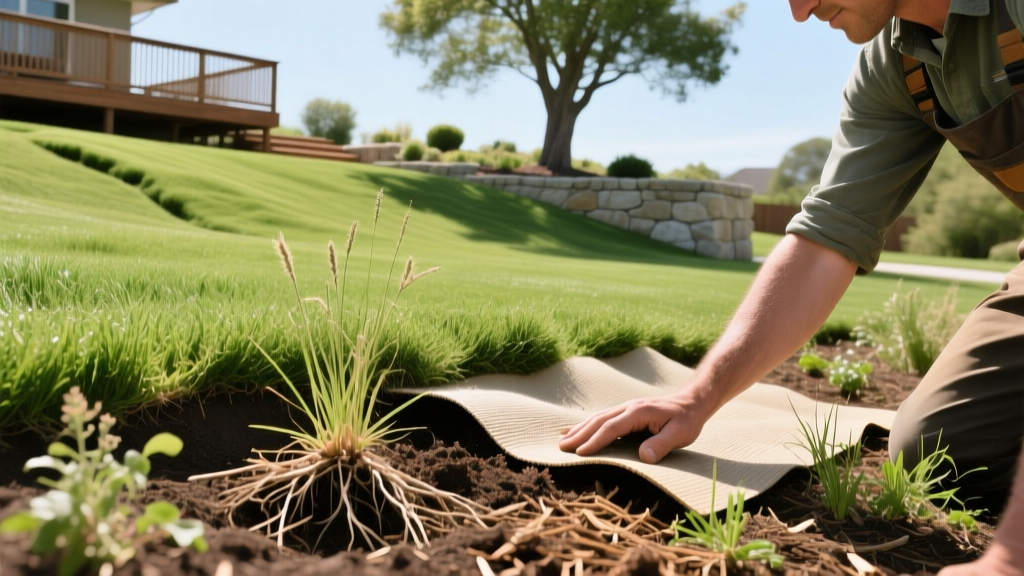
How to Stop Soil Erosion and Prevent Weed Takeover
The Erosion-Weed Pipeline: Why Bare Soil Invites Pests
Soil erosion is rarely just a topography problem; it is the silent catalyst for catastrophic weed and pest infestations. When topsoil washes away, it strips the vital microbial layer, exposes compacted subsoil, and creates the exact photoblastic conditions that weed seeds require to germinate. Understanding how to stop soil erosion is the first line of defense in any integrated pest and weed management playbook. Without a stable soil matrix, your turfgrass cannot establish, leaving bare patches where windblown spurge, dandelion, and crabgrass seeds will rapidly colonize.
Furthermore, erosion actively sabotages your chemical controls. Heavy runoff physically washes away granular pre-emergent herbicides and soil-applied grub pesticides before they can permeate the thatch layer. According to the EPA's Nonpoint Source Pollution program, sediment runoff from unprotected residential slopes carries not only soil but also bound nutrients and surface-applied chemicals directly into storm drains, rendering your expensive lawn treatments useless while polluting local waterways.
Data Highlight: The Cost of Inaction
A 1,000 sq. ft. bare slope losing 0.5 inches of topsoil annually exposes roughly 40 cubic feet of subsoil. This compacted layer lacks the organic matter needed for turfgrass, but is perfectly suited for deep-rooted invasive weeds like Japanese Knotweed and Bindweed. Rebuilding that lost topsoil costs an average of $120 to $180 in bulk compost and labor, not including the $80+ spent on post-emergent weed killers to fight the inevitable invasion.
A 1,000 sq. ft. bare slope losing 0.5 inches of topsoil annually exposes roughly 40 cubic feet of subsoil. This compacted layer lacks the organic matter needed for turfgrass, but is perfectly suited for deep-rooted invasive weeds like Japanese Knotweed and Bindweed. Rebuilding that lost topsoil costs an average of $120 to $180 in bulk compost and labor, not including the $80+ spent on post-emergent weed killers to fight the inevitable invasion.
Immediate Triage: Stabilizing Slopes Over 15% Grade
When dealing with active washouts on slopes exceeding a 15% grade, broadcast seeding alone will fail. The seed will wash into the storm sewer before germination. You must mechanically lock the soil in place while establishing a root network.
- Grade and Rake: Smooth the slope to eliminate micro-channels where water concentrates. Fill existing ruts with a 50/50 mix of topsoil and coarse sand to improve drainage.
- Apply Tackifier and Seed: Broadcast a shade-tolerant, deep-rooting seed blend like Creeping Red Fescue (Festuca rubra) at a rate of 5 lbs per 1,000 sq. ft. Spray a liquid soil tackifier (such as Profile Products PS21) to temporarily bind the soil particles.
- Deploy Jute Netting: Roll out 100% biodegradable jute netting (e.g., Roaring River Jute Matting, approx. $0.18/sq. ft.). The open weave allows sunlight for photoblastic grass seeds while catching washing sediment.
- Anchor in a Diamond Pattern: Secure the netting using 18-inch biodegradable wood stakes. Drive stakes every 3 feet in a staggered diamond pattern, ensuring the netting is pulled taut against the soil surface. Crucial step: Dig a 6-inch deep V-trench at the crest of the slope, bury the top edge of the netting, and backfill to prevent water from diving underneath the fabric.
Long-Term Armor: Groundcovers That Outcompete Weeds
Once the immediate bleeding is stopped, you need permanent biological armor. Traditional turfgrass struggles on steep inclines due to mowing difficulties and shallow root systems. Transitioning high-erosion zones to deep-rooted, low-maintenance groundcovers creates a living mulch that starves weed seeds of the sunlight and physical space they need to sprout. The University of Minnesota Extension recommends utilizing deep-rooted perennials in transitional slope zones to manage both water velocity and weed pressure.
| Groundcover Species | Max Root Depth | Weed Suppression Rating | Est. Cost (per 100 sq. ft.) |
|---|---|---|---|
| Creeping Juniper (Juniperus horizontalis) | 18 - 24 inches | Excellent (Dense mat) | $45 - $60 (Plugs) |
| Microclover (Trifolium repens var. Pirouette) | 12 - 15 inches | High (Nitrogen fixing) | $12 - $18 (Seed) |
| Creeping Phlox (Phlox subulata) | 8 - 12 inches | Moderate (Spring bloom) | $50 - $75 (Flats) |
Protecting Your Chemical Arsenal: Herbicide Retention
A core tenet of the Pest & Weed Removal Playbook is ensuring your chemicals stay where you put them. If you apply a granular pre-emergent like Prodiamine 65 WDG to an eroding slope, the carrier granules will roll into the street during the next rainstorm. To protect your chemical investments, you must alter your application timing and utilize binding agents.
The 48-Hour Stabilization Rule: Never apply pre-emergent herbicides to bare, sloping soil. Wait until your erosion control matting is installed and the seed has germinated, or apply liquid formulations (like Pendulum AquaCap) mixed with a polyacrylamide (PAM) soil binder to lock the active ingredient into the soil profile immediately upon contact.
For grub and pest control, avoid surface-applied granules on slopes. Instead, opt for liquid soil drenches applied via a hose-end sprayer, watering them in immediately with 0.5 inches of irrigation to pull the active ingredient (e.g., Imidacloprid) past the washout zone and into the root habitat of the target pests.
Troubleshooting: When Erosion Control Fails
Even well-planned stabilization can fail if edge cases are ignored. Use this decision tree to diagnose washouts:
- Symptom: Soil washing underneath the jute netting.
- Cause: Improper crest trenching or water channeling from an adjacent driveway.
- Fix: Install a 4-inch French drain or a surface swale at the top of the slope to divert runoff away from the crest before it gains velocity.
- Symptom: Netting tearing and bunching at the base.
- Cause: Using plastic staples instead of 18-inch wood stakes, or failing to overlap rolls by the required 6 inches.
- Fix: Remove damaged sections, overlap new jute by 6 inches, and anchor with U-shaped 11-gauge steel staples driven flush with the soil.
- Symptom: Weeds emerging through the erosion blanket.
- Cause: Using a non-woven plastic weed barrier instead of woven jute, trapping moisture and allowing nutsedge to pierce the fabric.
- Fix: Cut the plastic barrier, spot-treat the nutsedge with a Halosulfuron-methyl based herbicide (e.g., SedgeHammer), and replace with biodegradable excelsior or jute matting.
Frequently Asked Questions
Can I use hydraulic mulch instead of netting for steep slopes?
Yes, for slopes up to 25%, Bonded Fiber Matrix (BFM) hydraulic mulches like Profile Products ProMatrix (approx. $0.10/sq. ft.) are highly effective. They spray on as a liquid slurry of wood fibers and tackifiers, drying into a flexible crust that holds seed in place. However, for slopes exceeding 25% or areas with concentrated water flow, mechanical netting is mandatory.
How long does it take for groundcovers to suppress weeds on a slope?
Most erosion-control groundcovers take 12 to 18 months to form a dense, weed-suppressing mat. During the first year, you must manually hand-pull or spot-spray broadleaf weeds that emerge between the plugs. Avoid using non-selective herbicides like glyphosate on the slope during this establishment phase, as killing the young groundcover roots will immediately trigger a secondary erosion event.
Does aerating a sloped lawn increase erosion risk?
Core aeration on slopes greater than 10% can temporarily increase surface runoff if done right before heavy rains. If you must aerate a slope to relieve compaction and fight weed pressure, do it in early fall when rain is lighter, and immediately top-dress the slope with a 1/4-inch layer of fine compost to fill the holes and stabilize the surface.

