
Gardening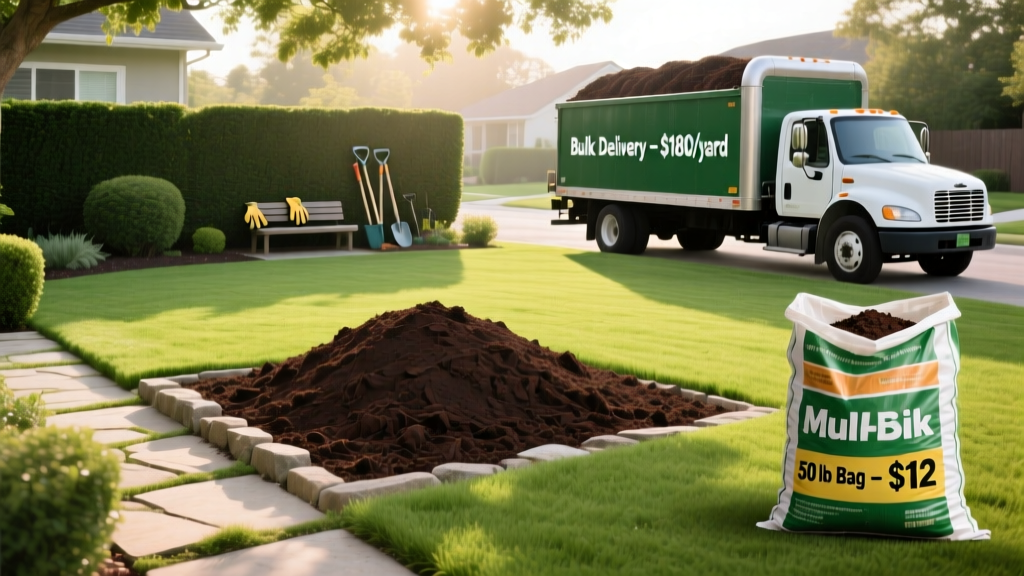
5 Yards of Mulch Cost: Bulk Delivery vs. Bagged Pricing Guide
The Bottom Line: What 5 Yards of Mulch Actually Costs
When planning a landscape refresh, understanding the true 5 yards of mulch cost requires looking beyond the per-unit price. In 2026, purchasing 5 cubic yards of bulk mulch typically costs between $225 and $450 delivered, while buying the equivalent volume in bagged mulch ranges from $270 to $510 before tax. The final price fluctuates based on the material type (hardwood, cedar, or colored), regional supply chain variables, and delivery logistics.
A cubic yard is a volume measurement equal to 27 cubic feet. Therefore, 5 cubic yards equals exactly 135 cubic feet of material. Whether you are top-dressing existing beds or establishing new garden borders, calculating your exact coverage and weighing the logistical realities of bulk drops versus palletized bags will dictate your final project budget.
Coverage Math: How Far Does 5 Cubic Yards Go?
Before ordering, you must map your square footage against your target depth. The University of Minnesota Extension recommends a 2- to 3-inch layer for most landscape beds to retain soil moisture and suppress weeds without suffocating plant roots. Exceeding 4 inches creates an anaerobic environment that invites fungal pathogens and root rot.
| Target Depth | Square Foot Coverage | Equivalent 2-Cu-Ft Bags | Ideal Application |
|---|---|---|---|
| 2 Inches | 810 sq. ft. | 68 Bags | Top-dressing existing beds, annual refresh |
| 3 Inches | 540 sq. ft. | 68 Bags | New garden beds, heavy weed suppression |
| 4 Inches | 405 sq. ft. | 68 Bags | Playground safety zones, pathways (avoid for plants) |
Note: The bag count remains 68 (135 total cubic feet ÷ 2 cubic feet per bag) regardless of depth; the depth simply dictates how far those 68 bags will stretch across your property.
Bulk Delivery vs. Bagged Pallets: A Financial Showdown
The decision to order bulk or bagged mulch hinges on your property access, vehicle capacity, and physical labor limits. Here is a direct financial and logistical comparison for a 5-yard volume.
Bulk Delivery Profile
- Material Cost: $35 - $60 per cubic yard ($175 - $300 total)
- Delivery Fee: $50 - $150 flat rate (local radius)
- Total Estimated Cost: $225 - $450
- Weight: 2,000 to 3,500 lbs (moisture dependent)
- Logistics: Requires a dump truck. The material is dumped in a single pile on your driveway or a designated tarp.
Bagged Pallet Profile
- Material Cost: $4.00 - $7.50 per 2-cu-ft bag ($272 - $510 total for 68 bags)
- Delivery Fee: $0 (if picking up) or $75+ (curbside pallet delivery)
- Total Estimated Cost: $272 - $585
- Weight: ~2,700 to 4,000 lbs total
- Logistics: 68 bags will not fit in a standard SUV. You will need a pickup truck, a trailer, or multiple trips to the garden center.
Hidden Variables That Inflate Your Final Bill
Landscaping budgets often derail when homeowners overlook secondary costs associated with material handling and site preparation. According to national home improvement data tracked by Angi, labor and site prep can easily double your material costs.
- Professional Spreading Labor: If you hire a landscaping crew to wheelbarrow and spread the 5 yards, expect to pay $45 to $85 per cubic yard, or an hourly rate of $50 to $100 per worker. Spreading 5 yards takes a two-person crew roughly 2 to 3 hours.
- Old Mulch Removal: If your beds require stripping before applying new material, disposal fees and labor will add $150 to $300 to the project.
- Weed Barrier Fabric: Installing a high-quality, woven geotextile fabric (like Typar or DeWitt) before mulching costs $0.50 to $1.50 per square foot. For a 540 sq. ft. area, add $270 to $810 to your budget.
- Driveway Protection: Bulk mulch stains concrete and asphalt. You must provide a heavy-duty tarp (at least 10x12 feet) for the dump truck driver to drop the load onto. Failure to do so may result in the driver refusing the drop or charging a cleanup fee.
Preparing Your Site for a 5-Yard Bulk Drop
A 5-yard dump truck delivery requires specific site conditions. Commercial dump trucks are heavy and carry massive payloads. Follow this checklist to ensure a successful drop:
- Verify Overhead Clearance: Dump trucks require at least 15 to 18 feet of vertical clearance to raise the bed. Check for low-hanging tree branches, utility lines, and roof eaves above your intended drop zone.
- Assess Driveway Load Limits: A fully loaded dump truck can weigh over 20,000 lbs. If you have a newly paved asphalt driveway (less than 6 months old) or decorative pavers, the truck's dual rear axles can crack or sink into the surface. Request a "tailgate drop" at the street curb if your driveway is structurally questionable.
- Mark Irrigation and Utilities: Flag all sprinkler heads, shallow drip lines, and landscape lighting wires near the drop zone and spreading paths to prevent wheelbarrow damage.
- Lay the Drop Tarp: Position a heavy-duty poly tarp exactly where you want the pile. Keep the pile at least 3 feet away from your home's foundation to prevent moisture retention against the siding, a common catalyst for wood-destroying insects.
Frequently Asked Questions
Does 5 yards of mulch fit in a standard pickup truck?
No. A standard short-bed pickup truck (like a Ford F-150 with a 5.5-foot bed) can safely hold about 1.5 to 2 cubic yards of mulch before exceeding its payload weight limit or volume capacity. Attempting to haul 5 yards in a single consumer pickup will result in severe suspension damage, blown tires, and dangerous braking distances. Always opt for delivery or a commercial trailer for a 5-yard volume.
How long does bulk mulch last before it degrades?
Organic bulk mulches, such as double-shredded hardwood or pine bark, break down at a rate of roughly 1 inch per year, adding valuable organic matter to the soil below. The Arbor Day Foundation notes that this decomposition improves soil structure and water retention. You will typically need to top-dress your beds with an additional 1 to 1.5 inches of mulch annually to maintain the optimal 3-inch depth.
Is colored mulch safe for vegetable gardens?
It is not recommended. Colored mulches (black, red, or brown) are dyed using iron oxide or carbon black. While the dyes themselves are generally non-toxic, colored mulch is frequently manufactured from recycled waste wood, including old pallets and construction debris that may contain chemical preservatives like chromated copper arsenate (CCA). For edible gardens, stick to natural, undyed pine bark, straw, or compost.
What is the cheapest type of mulch for a 5-yard order?
Undyed, single-shredded hardwood or locally sourced pine bark is typically the most economical option, ranging from $28 to $38 per cubic yard. Premium options like cedar, cypress, or playground-certified rubber mulch will push the material cost well past $65 per cubic yard, drastically altering your total project budget.

