
Gardening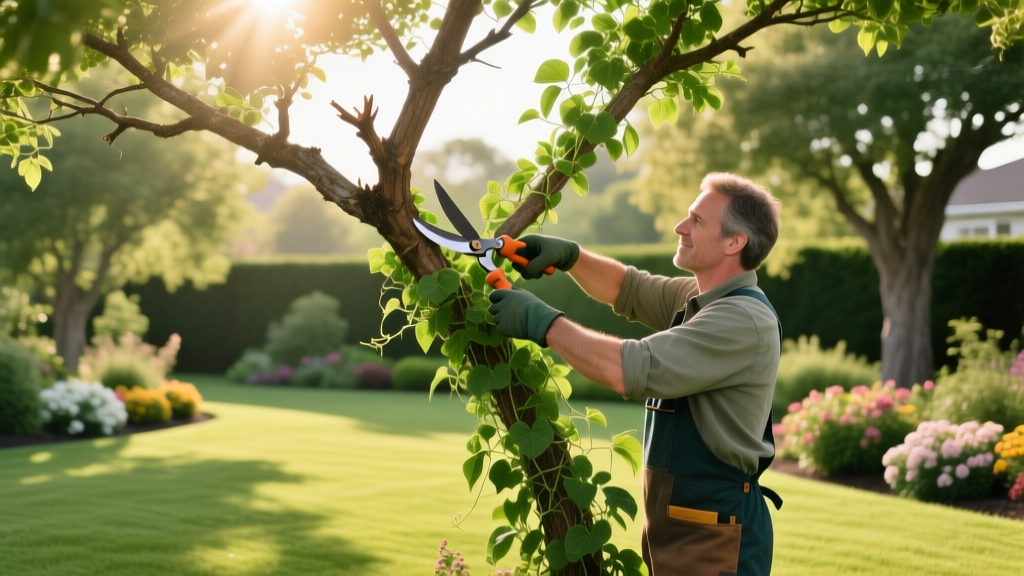
Pruning Host Trees for Climbing Plants Full Sun & Removal
The Intersection of Vines and Trees: Why Sunlight Matters
Integrating climbing plants full sun into a landscape with established trees requires precise arboricultural management. Vigorous sun-loving vines like Trumpet Creeper (Campsis radicans) or Chinese Wisteria (Wisteria sinensis) demand 6 to 8 hours of direct sunlight to bloom. When planted near trees, these climbers will aggressively scale the host trunk to reach the upper canopy. Left unmanaged, the vine shades out the host tree's foliage, adds catastrophic weight to lateral branches, and eventually kills the host through carbon starvation and structural failure.
Successfully growing full-sun climbers on or adjacent to trees is not a passive endeavor. It requires a dual-pronged approach: strategic host tree pruning to maintain light penetration and structural integrity, and a clear framework for identifying when a tree has been fatally compromised and requires removal.
Warning: Never allow aggressive aerial-rooting vines (like English Ivy or Trumpet Vine) to completely envelop a tree trunk. The vine's rootlets penetrate the bark cambium, introducing fungal pathogens and masking fatal structural decay until the tree fails in high winds.
Canopy Competition and the 25% Rule
A mature tree relies on its own leaf surface area to produce the carbohydrates necessary for root growth and defense against pests. When a climbing plant full sun reaches the canopy and begins to spread, it intercepts solar radiation. According to the International Society of Arboriculture (ISA), if a vine covers more than 25% of a host tree's crown, the tree enters a severe carbon deficit. The tree will begin to abort its own shaded leaves, relying entirely on the vine for transpiration, which disrupts the tree's natural cooling mechanisms and water uptake cycles.
Selecting the Right Climber for Tree Proximity
Not all sun-loving vines exert the same physical toll on a host tree. Selecting a climber based on its mature weight and attachment method is critical for long-term tree health.
| Climbing Plant (Full Sun) | Attachment Method | Mature Weight / Impact | Host Tree Risk Level |
|---|---|---|---|
| Campsis radicans (Trumpet Vine) | Aerial rootlets | High (Penetrates bark, heavy wood) | Severe |
| Wisteria sinensis (Chinese Wisteria) | Twining stems | Extreme (Can crush 6-inch limbs) | Severe |
| Rosa 'Zephirine Drouhin' (Climbing Rose) | Prickles (Requires tying) | Moderate (Does not penetrate bark) | Low |
| Clematis 'Jackmanii' | Leaf petioles | Low (Lightweight, herbaceous) | Minimal |
Step-by-Step Host Tree Pruning for Vine Integration
If you are committed to growing a heavy, full-sun climber on a mature tree, you must prune the host tree to accommodate both the light requirements of the vine and the structural load of the vine's mass. Follow these specific arboricultural steps, ideally using a high-quality folding saw like the Silky Gomboy 210mm for precision cuts.
- Crown Thinning for Light Penetration: Remove 15% to 20% of the host tree's live inner canopy. Make selective removal cuts just outside the branch collar to open the crown. This allows the necessary 6+ hours of direct sunlight to reach the vine's lower and middle sections while preserving the tree's outer photosynthetic shell.
- Structural Subordination: Vines add massive wind-sail area and dead weight to lateral branches. Reduce the length of the primary lateral branches that will host the vine by 20% using drop-crotch cuts. This shortens the lever arm, reducing the mechanical stress on the branch union when the vine is fully leafed out or covered in winter ice.
- Trunk Protection Installation: For vines that twine or use aerial rootlets, wrap the lower 6 feet of the host tree trunk with 1/2-inch hardware cloth or heavy-duty corrugated plastic tree guards. This physical barrier prevents the vine from girdling the trunk and protects the bark cambium from mechanical damage.
- Annual Winter Reduction: Every dormant season (late January to February), prune the vine back by 30% to 50%. According to Penn State Extension, dormant pruning invigorates spring blooming in sun-loving climbers while drastically reducing the winter weight load on the host tree's scaffolding branches.
When to Remove: Signs a Climber Has Killed the Host Tree
Despite best efforts, aggressive climbing plants full sun often overpower their host trees. Once a tree's structural integrity is compromised, it becomes a hazard. Professional removal is required when you observe the following failure modes:
- Severe Girdling and Strangulation: Twining vines like Wisteria can expand faster than the tree's secondary growth, effectively tourniqueting the phloem and xylem. If the vine has embedded itself more than 1/2-inch into the bark and the canopy above is showing dieback, the tree is dead or dying.
- Canopy Dieback Exceeding 40%: If more than 40% of the host tree's crown is deadwood due to vine shading, the tree lacks the energy reserves to compartmentalize decay. It is no longer a viable host and poses a dropping hazard.
- Conks and Fruiting Bodies: The presence of fungal conks (like Ganoderma or Laetiporus) at the base of the vine-smothered trunk indicates advanced internal heart rot. The vine's moisture retention against the bark has accelerated fungal degradation.
Cost Reality for Vine-Smothered Tree Removal: Removing a tree heavily engulfed by a climbing plant is significantly more expensive than standard removals. The vine masks deadwood, shifts the tree's center of gravity, and prevents climbers from safely using spikes. Expect to pay between $1,800 and $3,500 for a crane-assisted removal of a medium-sized (50-70 ft) vine-smothered tree, compared to $800-$1,500 for a standard open-canopy removal.
Safe Vine Severing Protocol Before Removal
If a tree must be removed, do not attempt to rip the vine off the trunk prior to felling. The vine acts as a tension cable; removing it suddenly can cause the weakened, decayed trunk to snap unpredictably. Instead, use a chainsaw or hand saw to cut a 4-inch section out of the vine's main stem at the base. Allow the vine to die and desiccate on the tree for 4 to 6 weeks before the arborist crew begins the dismantling process.
"When assessing a vine-covered tree, arborists must assume the internal wood is compromised. The microclimate created by the dense vine foliage retains moisture against the bark, accelerating decay organisms that would otherwise be inhibited by direct sunlight and air flow." — ISA Certified Arborist Risk Assessment Guidelines.
FAQ: Managing Sun-Loving Vines on Mature Trees
Can I grow climbing plants full sun on a newly planted tree?
No. A newly planted tree (under 3 years old) lacks the established root system and trunk caliper to support the weight and moisture competition of a vigorous climber. Wait until the host tree has a minimum trunk diameter of 6 inches at breast height (DBH) before introducing a heavy vine.
Will pruning the host tree stimulate the vine to grow faster?
Crown thinning the host tree increases sunlight penetration, which will stimulate more aggressive vegetative growth and blooming in the full-sun climber. You must be prepared to prune the vine itself 2 to 3 times per growing season to prevent it from immediately re-shading the newly opened canopy.
What is the best alternative to growing vines directly on tree bark?
Install a freestanding, heavy-duty steel trellis or arbor 18 to 24 inches away from the tree's trunk, positioned on the south or west side to capture full sun. This provides the vine with the sunlight it requires while completely eliminating the risk of bark penetration, girdling, and canopy competition with the host tree.

