
Gardening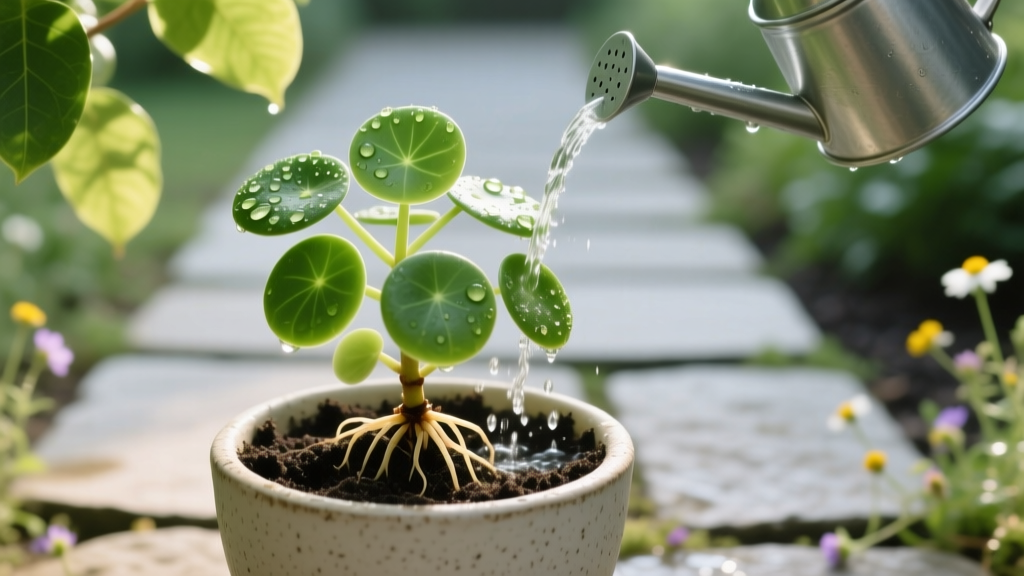
How to Water a Money Plant During Root Establishment
The 'Money Plant' Identity Crisis: Know Your Species
Before adjusting your watering can, you must identify which 'money plant' you are establishing. The common name causes massive confusion in the horticultural trade, leading to fatal watering errors during the vulnerable first 30 days after potting. The establishment phase—when a plant is generating new root hairs to anchor into fresh media—requires precise moisture management. Overwatering during this window causes Pythium root rot, while underwatering desiccates fragile new root tips.
- Epipremnum aureum (Pothos/Devil's Ivy): Widely called 'Money Plant' in the UK and Asia. A tropical aroid that requires consistent moisture but demands high soil aeration.
- Pachira aquatica (Money Tree): Often mislabeled as a money plant in the US. A semi-succulent wetland tree with a water-storing braided trunk, highly susceptible to trunk rot if overwatered.
- Crassula ovata (Jade Plant): Sometimes called the money plant. A true succulent requiring a completely different, drought-heavy establishment protocol.
This guide focuses on the establishment protocols for Epipremnum aureum and Pachira aquatica, the two most common houseplants fitting this search intent. According to the Missouri Botanical Garden, understanding the native hydrology of your specific cultivar is the first step in preventing establishment failure.
The 30-Day Establishment Protocol
When you pot a newly propagated cutting or a bare-root shipment into fresh soil, the root system is in shock. Standard watering schedules do not apply. You must transition the plant through three distinct hydration phases.
Phase 1: The Settling Period (Days 1–7)
Water the plant thoroughly immediately after potting to eliminate air pockets around the roots. Use room-temperature water (68°F–72°F) to avoid thermal shock to the root cap. For the next 6 days, do not water again. The fresh potting mix holds sufficient capillary moisture. Your goal is to allow the top 1 inch of soil to dry, signaling the roots to seek deeper moisture.
Phase 2: Root Probing (Days 8–21)
During week two and three, the plant pushes out fragile white root hairs. These hairs die within minutes if exposed to dry air or bone-dry soil, but they will rot if submerged in anaerobic mud. Water only when a wooden skewer inserted into the center of the pot comes out with barely damp soil clinging to the bottom third. Apply water slowly using a long-spout can to avoid displacing the unanchored stem.
Phase 3: Normalization (Days 22–30)
By week four, gentle resistance when you tug the base of the stem indicates successful root anchoring. You can now transition to a standard wet-dry cycle. For Pachira aquatica, the Royal Horticultural Society recommends allowing the top two inches of compost to dry out completely between waterings to protect the caudex (swollen trunk base).
The Moisture Matrix: When to Water Based on Pot & Soil
There is no universal 'water every X days' rule. Evaporation rates are dictated by pot volume, soil porosity, and ambient humidity. Use this decision matrix to calculate your baseline watering volume and frequency during the establishment phase.
| Species | Pot Size & Material | Soil Mix Composition | Target Dry-Down Time | Water Volume per Session |
|---|---|---|---|---|
| E. aureum (Pothos) | 4-inch Terracotta | 50% Potting Soil, 30% Perlite, 20% Orchid Bark | 5–7 Days | 6–8 oz (until 10% runoff) |
| E. aureum (Pothos) | 6-inch Glazed Ceramic | 50% Potting Soil, 30% Perlite, 20% Orchid Bark | 8–10 Days | 12–16 oz (until 10% runoff) |
| P. aquatica (Money Tree) | 6-inch Nursery Pot (in cache pot) | 60% Cactus Mix, 40% Pumice | 10–14 Days | 16–20 oz (flush salts) |
| P. aquatica (Money Tree) | 8-inch Terracotta | 60% Cactus Mix, 40% Pumice | 7–10 Days | 24–30 oz (flush salts) |
Expert Insight: Never let a newly established Pachira aquatica sit in a saucer of drained water. The braided trunks act like wicks, drawing stagnant water upward into the core of the braid, causing irreversible internal mushiness within 48 hours. Always empty the cache pot 15 minutes after watering.
Precision Tools for Perfect Hydration
Guesswork kills establishing plants. Invest in these specific tools to remove the ambiguity from your watering routine:
- XLUX Soil Moisture Meter (Model T10): Priced around $12, this analog probe measures volumetric water content. Insert it 2 inches from the pot edge and halfway down the root ball. For Pothos, water when the needle drops to 3 (dry). For Money Trees, wait until it hits 2.
- Haws 1.5L Traditional Watering Can: The brass 'oval' rose attachment delivers a gentle, rain-like shower that won't crater the soil or expose shallow, newly forming roots. Retails for approximately $45.
- Distilled or Reverse Osmosis (RO) Water: Tap water often contains chlorine and dissolved salts (fluoride/calcium). Establishing root tips are highly sensitive to salt burn. Using distilled water (approx. $1.50/gallon) for the first 30 days prevents tip necrosis and soil crusting.
Troubleshooting Establishment Watering Errors
If your plant shows distress during the first month, diagnose the watering error immediately using this symptom framework. According to Penn State Extension, early intervention is the only way to save a plant from secondary fungal pathogens.
Symptom: Lower Leaves Turning Yellow and Dropping
- Cause: Overwatering / Hypoxia. The soil is staying wet too long, depriving roots of oxygen.
- Fix: Stop watering immediately. Use a chopstick to poke 5 deep aeration holes into the soil to introduce oxygen. Move the plant to a location with higher air circulation. Do not water again until the moisture meter reads completely dry.
Symptom: Crispy Brown Edges on New Growth
- Cause: Underwatering or low ambient humidity combined with high light. The roots cannot push water fast enough to the extremities.
- Fix: Check the soil. If it is bone dry, perform a bottom-watering soak. Place the nursery pot in a basin of room-temperature water for 20 minutes to rehydrate the hydrophobic peat moss. Increase local humidity to 50-60% using a pebble tray.
Symptom: Mushy, Blackening Stem Base
- Cause: Pythium or Phytophthora root rot. The establishment phase has failed due to chronic soil saturation.
- Fix: This is a critical emergency. Unpot the plant immediately. Wash the roots in a 3% hydrogen peroxide solution to kill fungal spores. Snip away all black, slimy roots with sterilized shears. Repot into 100% dry perlite or sphagnum moss to force new root generation, and withhold water for 48 hours.
Frequently Asked Questions
Should I use ice cubes to water my Money Tree?
No. The 'ice cube method' is a marketing myth that harms tropical plants. Dropping 30°F ice onto the soil surface causes thermal shock to the shallow feeder roots, stunting the establishment process and potentially triggering cold-induced leaf drop. Always use room-temperature water.
Can I establish a Pothos cutting directly in water instead of soil?
Yes, Epipremnum aureum roots easily in water. However, water roots are structurally and physiologically different from soil roots; they lack root hairs and are adapted to an aquatic environment. If you plan to eventually move the plant to soil, establish it in a 50/50 mix of water and moist perlite to encourage the development of soil-adapted root structures from day one.

