
Gardening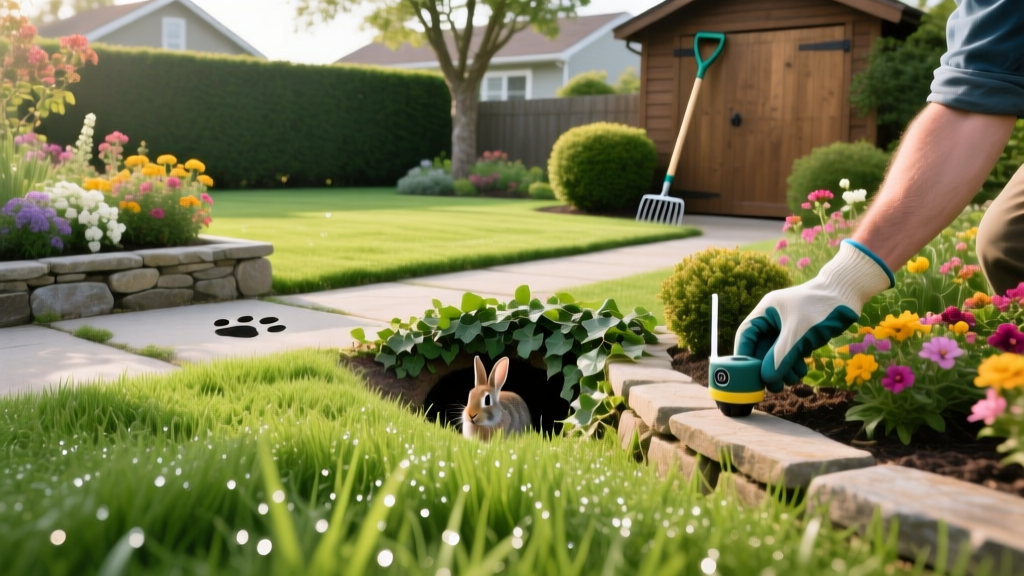
Keeping Bunnies Out of the Garden: Diagnosis and Proven Solutions
Diagnosing Rabbit Damage: Is It Actually Bunnies?
Before investing time and capital into exclusion materials, you must confirm that Eastern Cottontails (Sylvilagus floridanus) or local hare species are the actual culprits. Misdiagnosing pest damage leads to ineffective solutions; a fence built for rabbits will not stop groundhogs, and repellents formulated for deer will fail against lagomorphs.
The 45-Degree Stem Cut Test
Rabbits possess sharp, chisel-like incisors that allow them to clip stems, leaves, and small branches cleanly. When examining damaged plants like hostas, young vegetable transplants, or woody shrubs, look for cuts made at a precise 45-degree angle. The Clemson University Home & Garden Information Center notes that this clean, angled shear is the definitive hallmark of rabbit feeding. In contrast, deer lack upper incisors, resulting in ragged, torn, and frayed stem ends. Voles, meanwhile, leave distinct 1/8-inch wide parallel teeth marks when gnawing bark at the soil line, rather than clipping branches outright.
Scat and Track Identification
Confirm your visual diagnosis by scouting for droppings. Rabbit scat consists of round, pea-sized pellets (roughly 1/4 inch in diameter) often found in small, concentrated piles near their feeding zones. Deer pellets are significantly larger, oval-shaped, and clumped, while vole droppings are smaller, irregular, and typically hidden within their subterranean runways.
The Physics of Exclusion: Fencing Specifications That Work
Physical exclusion is the only 100% reliable method for keeping bunnies out of the garden year-round. However, standard hardware store advice often leads to failure because it ignores the digging mechanics of rabbits. To build a bunny-proof barrier, you must adhere to strict material and installation specifications.
Material Selection: Gauge and Mesh Size
Do not use standard 2-inch chicken wire; young kits can easily squeeze through the gaps. You must use 1-inch hexagonal mesh. Furthermore, select 19-gauge or 20-gauge galvanized steel. Avoid vinyl-coated or PVC-wrapped wire, as UV degradation and temperature fluctuations cause the coating to crack and peel within two to three seasons, leading to rapid rust and structural failure. Expect to pay between $1.50 and $2.50 per linear foot for high-quality 19-gauge galvanized 1-inch hex wire.
The L-Shaped Apron Technique
Rabbits are prolific diggers and will simply excavate beneath a vertical fence. To counter this, install a 36-inch wide roll of fencing. Bury the bottom 6 inches vertically, but before backfilling, bend the lowest 6 inches outward at a 90-degree angle, away from the garden, creating an "L-shaped apron" that rests just below the soil surface. When a rabbit attempts to dig at the base of the fence, their paws hit the horizontal wire mesh, triggering a psychological barrier that stops the excavation. The remaining 24 inches of fencing should extend above ground, which is sufficient to deter jumping, as rabbits rarely vault over 2-foot barriers when a solid visual block is present.
Chemical and Organic Repellents: Efficacy Matrix
While fencing is permanent, repellents serve as a secondary defense for ornamental beds where fencing is aesthetically unviable. Repellents rely on either olfactory (scent) or gustatory (taste) aversion. According to the University of Minnesota Extension, efficacy drops significantly if the repellent is not reapplied after rainfall or heavy irrigation. Below is a comparison of the most effective active ingredients currently on the market.
| Active Ingredient | Mode of Action | Brand Examples | Cost (32oz) | Reapplication Rate | Best Use Case |
|---|---|---|---|---|---|
| Putrescent Whole Egg Solids | Olfactory / Taste | Liquid Fence, Deer Off | $18 - $24 | Every 30 days & after rain | Perimeter spray & direct foliar |
| Capsaicin (Hot Pepper Wax) | Taste / Pain | Bonide Hot Pepper Wax | $12 - $16 | Every 14 days & heavy rain | Direct foliar spray on edibles |
| Thiram (Fungicide) | Taste Aversion | Bonide Rabbit Scat | $15 - $20 | Dormant season only | Woody shrubs & tree bark (Winter) |
| Predator Urine (Coyote/Fox) | Olfactory Fear | Shake-Away, PredatorPee | $16 - $22 | Every 7-10 days | Perimeter granules (Low efficacy in rain) |
Pro Tip: Rabbits quickly habituate to single-mode repellents. For maximum efficacy in high-pressure areas, rotate between an olfactory repellent (putrescent egg) in the spring and a gustatory repellent (capsaicin) in the mid-summer to prevent behavioral adaptation.
Habitat Modification: Eliminating the "Bunny Motel"
Rabbits operate on a strict risk-reward matrix regarding cover. They rarely venture more than 10 to 15 feet away from protective brush, tall grass, or structural hiding spots to feed. If your garden is located in the center of a large, open lawn, it is naturally less attractive to them.
To manipulate this behavior, eliminate the "Bunny Motel" adjacent to your planting zones. Clear out brush piles, remove dense patches of ivy or pachysandra within 20 feet of your garden beds, and install heavy-duty wire mesh skirting around the perimeter of sheds, decks, and porches to prevent them from nesting underneath. By pushing their safe cover back 20+ feet, you force them to cross open, exposed terrain where they feel highly vulnerable to aerial predators like hawks and owls, drastically reducing their willingness to forage in your vegetable plots.
Troubleshooting Common Exclusion Failures
Warning: The Gate Gap Vulnerability
The most common point of failure in an otherwise perfect rabbit fence is the gate clearance. Rabbits can compress their ribcages and squeeze through gaps as small as 1.5 inches. If your garden gate sweeps over uneven soil, install a flexible rubber weatherstripping sweep or a rigid 2x4 wooden baffle along the bottom edge of the gate. Ensure the maximum clearance between the gate bottom and the soil is less than 1 inch at all points of the swing arc.
Tip: Managing Winter Snowdrifts
In northern climates, a 24-inch above-ground fence becomes useless once snow accumulates, effectively lowering the barrier and allowing rabbits to walk right over the top. If you live in a region with heavy winter snowfall, increase your above-ground fencing height to 36 inches. Alternatively, use removable, zip-tied snow fencing extensions attached to your primary wire mesh during November, and remove them in early April to maintain aesthetic appeal during the primary growing season.
By combining precise diagnostic techniques, structurally sound 1-inch hexagonal fencing with an L-shaped apron, and strategic habitat modification, you can establish a permanent, highly effective defense system that keeps your garden thriving and bunny-free.

