
Gardening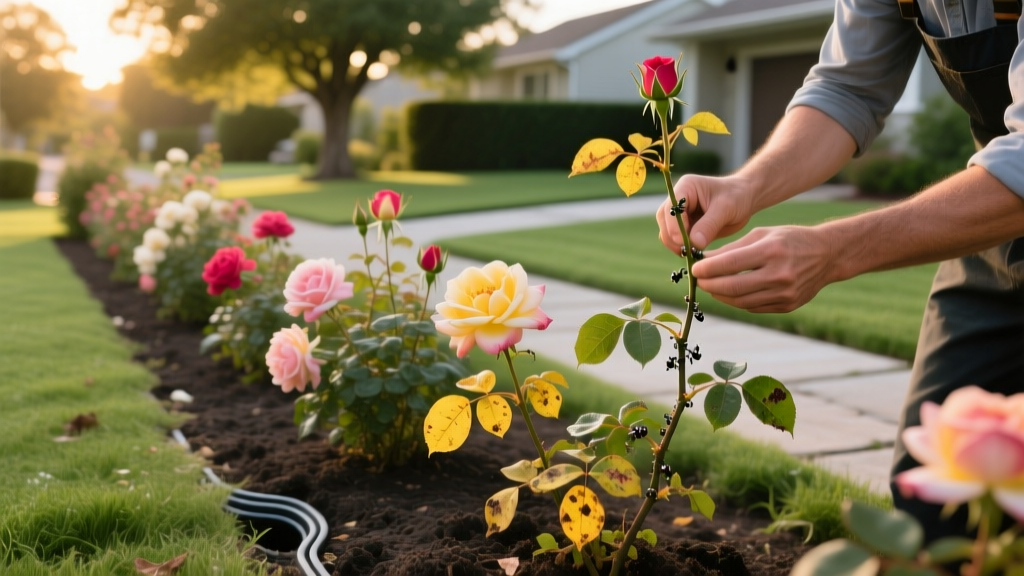
Diagnosing Failing Low Maintenance Roses: Problems and Solutions
The Reality of 'Low Maintenance' Roses
The horticultural market was revolutionized by the introduction of the original Knock Out rose (Rosa 'Radrazz') in 2000, promising disease resistance and continuous blooming without the rigorous spraying schedules required by hybrid teas. Today, the low maintenance roses category includes the Drift, Oso Easy, and Flower Carpet series. However, 'low maintenance' does not mean 'no maintenance.' When these shrubs fail, homeowners often misdiagnose the causes as general neglect rather than identifying specific pathological, nutritional, or environmental stressors.
This diagnostic guide moves beyond generic advice to provide exact failure modes, chemical interventions, and cultural corrections for the most common issues plaguing modern shrub roses.
Symptom-to-Solution Diagnostic Matrix
Use this matrix to quickly identify the primary stressor affecting your roses. Accurate diagnosis is critical before applying any chemical or cultural treatment.
| Visual Symptom | Probable Cause | Immediate Fix | Preventative Measure |
|---|---|---|---|
| Circular black spots with fringed margins on leaves, followed by defoliation | Black Spot (Diplocarpon rosae) | Remove fallen leaves; apply myclobutanil or chlorothalonil fungicide | Maintain 3-inch mulch ring; avoid overhead irrigation |
| Canes turning bright red, excessive thorniness, distorted 'witches broom' growth | Rose Rosette Disease (Emaravirus) | Complete removal and destruction of the entire plant and root system | Monitor for eriophyid mites; remove wild multiflora roses nearby |
| Leaves skeletonized, flowers destroyed overnight in early summer | Japanese Beetles (Popillia japonica) | Hand-pick into soapy water; apply spinosad spray in the evening | Apply imidacloprid soil drench in early spring before bloom |
| Yellowing between leaf veins on new growth; stunted blooms | Iron Chlorosis (high soil pH > 7.0) | Apply Fe-EDDHA chelated iron as a soil drench | Lower soil pH to 6.0-6.5 using elemental sulfur |
| White, powdery coating on new shoots and buds; buds fail to open | Powdery Mildew (Podosphaera pannosa) | Prune affected tips; apply neem oil or potassium bicarbonate spray | Ensure 6+ hours of direct sun; space plants 4 feet apart for airflow |
Deep Dive: Fungal Pathogens in 'Resistant' Varieties
A common point of failure for homeowners is the assumption that low maintenance roses are entirely immune to fungal diseases. While the original Knock Out rose was highly resistant to black spot upon release, the pathogen Diplocarpon rosae has evolved. According to research documented by the University of Minnesota Extension, new virulent strains (such as race 9) have overcome the genetic resistance of older shrub rose cultivars.
Targeted Fungal Treatment Protocol
If your shrub roses are defoliating in mid-to-late summer, follow this specific protocol:
- Sanitation: Rake all fallen leaves and remove any remaining infected foliage from the plant. The fungus overwinters in leaf litter.
- Chemical Intervention: Apply a systemic fungicide containing myclobutanil (e.g., Spectracide Immunox) or a contact protectant like chlorothalonil. Cost is typically $12 to $18 for a ready-to-use 32oz sprayer.
- Application Timing: Spray every 10 to 14 days during wet, humid periods (temperatures between 65°F and 80°F). Ensure coverage on the underside of the leaves where stomata are concentrated.
The Fatal Threat: Rose Rosette Disease (RRD)
Even the most robust low maintenance roses possess zero genetic resistance to Rose Rosette Disease. Caused by the Rose rosette emaravirus (RRV) and transmitted by the microscopic eriophyid mite (Phyllocoptes fructiphilus), RRD is a death sentence for the infected plant. The NC State Extension emphasizes that miticides are largely ineffective at preventing transmission because the mites move via wind currents before chemicals can eliminate them.
⚠️ Warning: Do Not Prune RRD Symptoms
If you observe the hallmark symptoms—rapid, elongated bright red shoots, hyper-thorniness, and deformed 'witches broom' clusters—do not attempt to prune out the infected canes. The virus is systemic. You must dig out the entire plant, including the root ball, bag it securely, and dispose of it in the trash. Sterilize your spade and pruning shears with a 10% bleach solution or 70% isopropyl alcohol before working near other roses.
Nutritional Failures: The Iron Chlorosis Misdiagnosis
When low maintenance roses exhibit interveinal chlorosis (yellow leaves with dark green veins), homeowners frequently apply standard nitrogen-heavy fertilizers (like a 24-8-16 lawn fertilizer) or basic iron sulfate. This is a critical error if your soil pH is above 7.0, which is common in the American Midwest and West.
In alkaline soils, standard iron sulfate binds to calcium and becomes unavailable to the rose roots. To solve this, you must use a specific chelated iron formulation: Fe-EDDHA. Unlike Fe-EDTA, which breaks down at a pH above 7.0, Fe-EDDHA remains stable and bioavailable in soils with a pH up to 9.0. Expect to pay between $20 and $35 for a 5-pound bag of Fe-EDDHA chelate. Apply 1 to 2 tablespoons per gallon of water as a soil drench at the drip line of the shrub.
Pest Pressure and Pruning Vulnerabilities
While modern roses resist many diseases, they remain highly palatable to insects. The University of Wisconsin-Madison Horticulture department notes that Japanese beetles are particularly attracted to the volatile compounds emitted by rose blooms. Furthermore, improper pruning creates entry points for secondary pests like cane borers and wasps.
The Carpenter's Glue Pruning Trick
When pruning out winter dieback or shaping your shrub in early spring, you are leaving exposed vascular tissue. Cane borers and stem-nesting wasps will drill into the soft pith of the cut cane, hollowing it out and causing the entire cane to die back to the graft union.
- The Cut: Always prune at a 45-degree angle, exactly 1/4 inch above an outward-facing bud.
- The Seal: Immediately after making a cut on a cane thicker than a pencil, apply a drop of standard Elmer's Carpenter's Wood Glue or white PVA glue over the exposed pith. The glue dries into a hard, waterproof seal that physically blocks borers from entering, without introducing the phytotoxic chemicals found in commercial pruning paints.
Decision Tree: Assessing Winter Dieback
Following a harsh winter, low maintenance roses often look completely dead. Before cutting the shrub down to the graft union, perform this diagnostic sequence:
The Scratch Test Protocol
- Start at the top: Use your thumbnail to gently scratch the bark of the highest cane.
- Evaluate the cambium: If the layer immediately beneath the bark is bright green and moist, the cane is alive. Stop pruning above this point.
- Move downward: If the tissue is brown, dry, or brittle, move 6 inches down the cane and repeat the scratch test.
- Identify the graft: If you reach the swollen knob at the base (the graft union) and still see no green tissue, the scion has died. If new growth is emerging below the graft knob, it is rootstock (often Rosa multiflora or R. draba), which will produce small, single-petal white flowers, not the low maintenance blooms you purchased. Dig and replace the plant.
Expert Insight: The most common mistake with low maintenance roses is 'lacing'—allowing the center of the shrub to become a dense thicket of crossing, inward-facing canes. Even disease-resistant varieties will develop powdery mildew if the interior lacks UV exposure and airflow. Annually remove up to 1/3 of the oldest, thickest canes at the soil line to force new, vigorous basal breaks from the crown.

