
Gardening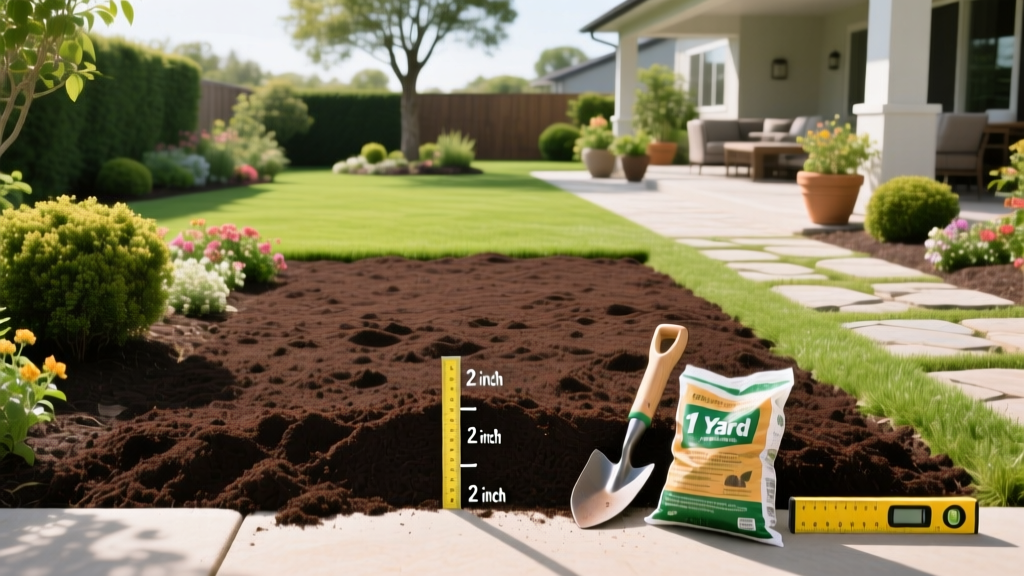
How Much Does 1 Yard of Mulch Cover? Depth & Cost Guide
The Short Answer: 1 Yard of Mulch Coverage by Depth
When planning a landscaping project, understanding exactly how much does 1 yard of mulch cover is the difference between ordering a perfect amount and paying for wasted material or expensive second deliveries. One cubic yard equals 27 cubic feet. The total square footage it covers depends entirely on the thickness of the layer you apply.
Quick Coverage Reference (1 Cubic Yard):
- 1-inch depth: Covers 324 square feet (Top-dressing existing mulch)
- 2-inch depth: Covers 162 square feet (Standard annual refresh)
- 3-inch depth: Covers 108 square feet (New beds or heavy weed suppression)
- 4-inch depth: Covers 81 square feet (Maximum weed block, coarse materials)
For most residential garden beds, a 2-to-3-inch layer is the agronomic sweet spot. Applying mulch thicker than 4 inches can suffocate plant roots, trap excess moisture against stems, and invite fungal diseases—a harmful practice known as 'volcano mulching' according to the University of Minnesota Extension.
The Math: Calculating Mulch Coverage for Your Beds
Do not rely on visual estimation. To calculate exactly how many cubic yards you need, use the standard landscaping divisor formula. This removes the guesswork from irregularly shaped beds.
Step 1: Measure Square Footage Accurately
For rectangular beds, multiply length by width. For curved or circular beds, use a 100-foot fiberglass tape measure to find the longest and widest points, or break the curve into smaller geometric rectangles and add their areas together. A laser distance measurer is highly recommended for large perimeter beds.
Step 2: Choose Your Target Depth
Decide on your depth in inches. If you are refreshing an existing bed that already has 1 inch of decomposed mulch, you only need to add 1.5 to 2 inches of new material to reach the optimal 3-inch total depth.
Step 3: Apply the Cubic Yard Formula
Use this exact formula to convert your measurements into cubic yards:
[Length (ft) × Width (ft) × Depth (inches)] ÷ 324 = Cubic Yards Needed
Example: A garden bed that is 20 feet long, 5 feet wide, and requires a 3-inch depth.
(20 × 5 × 3) = 300.
300 ÷ 324 = 0.92 cubic yards. In this scenario, you would order exactly 1 yard of bulk mulch or purchase 13 bags of 2-cubic-foot bagged mulch.
Bulk vs. Bagged Mulch: Coverage and Cost Breakdown
Once you know your required volume, the next decision is purchasing format. The coverage of 1 yard of mulch remains mathematically identical whether bought in bulk or bags, but the economics and physical labor differ drastically.
| Metric | Bulk Mulch (Per Yard) | Bagged Mulch (Per Yard Equiv.) |
|---|---|---|
| Volume Equivalency | 1 Cubic Yard (27 cu ft) | 13.5 Bags (Standard 2 cu ft size) |
| Material Cost | $30 – $45 | $54 – $108 ($4.00 - $8.00/bag) |
| Delivery / Transport | $50 – $120 flat delivery fee | Free (if hauling yourself in a truck/SUV) |
| Labor & Waste | Requires shoveling; zero plastic waste | Easy to carry; generates 13+ plastic bags |
| Best Use Case | Projects requiring 2+ yards | Small touch-ups requiring < 1 yard |
Warning on Bagged Mulch Math: Many homeowners mistakenly believe 10 bags equal a yard. Because standard bags are 2 cubic feet, it takes exactly 13.5 bags to equal 27 cubic feet (1 yard). If you buy 10 bags, you are only getting 0.74 cubic yards, which will leave you short on coverage.
Hidden Variables That Alter Mulch Coverage
The mathematical formulas above assume perfectly flat, compacted ground. In real-world application, several physical variables will alter how far your mulch actually stretches.
1. Material Density and Settling
Not all mulch is created equal. Shredded hardwood mulch is dense and tends to settle by 10% to 15% after the first heavy rain. If you apply 3 inches of fresh hardwood, expect it to compress to 2.5 inches within a month. Conversely, pine straw or pine bark nuggets are highly porous and do not compress significantly, meaning a yard of pine straw will visually cover more area at a 3-inch loft than a yard of shredded hardwood.
2. Substrate Conditions
Applying mulch directly over bare, tilled soil will result in a 5% to 10% loss of volume as the bottom layer sinks into the soft earth. If you are applying mulch over an existing layer of compacted soil, old decomposed mulch, or landscape fabric, your coverage will align perfectly with the mathematical calculations.
3. Sloped Terrain
Gravity and water runoff steal mulch from sloped beds. On a gradient greater than 15%, mulch will naturally migrate downward, thinning out the top of the slope and piling up at the bottom. For slopes, Penn State Extension recommends using heavier, interlocking materials like shredded bark or wood chips rather than lightweight straw or smooth river rock, and applying a slightly thicker 4-inch base at the top of the slope to account for migration.
Pro Tips for Ordering and Applying Mulch
- The 10% Buffer Rule: Always add 10% to your final cubic yard calculation to account for spillage, uneven ground, and settling. If your math says 2.5 yards, order 3 yards.
- Check the Moisture Content: Bulk mulch delivered after a week of rain is significantly heavier and packs tighter in the delivery truck. A 'wet yard' may physically cover slightly less area than a 'dry yard' because the water weight compresses the material during transit.
- Keep Away from Trunks: When spreading your calculated yard of mulch, maintain a strict 3-inch gap between the mulch edge and the base of tree trunks or shrub stems to prevent rot and rodent damage.
- Dye Fading: If purchasing color-enhanced bulk mulch (red, black, or brown), be aware that the iron oxide or carbon black dyes can leach onto concrete driveways during the first rainfall. Lay down a tarp where the wheelbarrow crosses hardscapes.
Frequently Asked Questions
How many wheelbarrow loads are in 1 yard of mulch?
A standard residential wheelbarrow holds roughly 3 cubic feet when filled to the brim. Therefore, 1 cubic yard (27 cubic feet) equals exactly 9 full wheelbarrow loads. However, because filling a wheelbarrow to the absolute brim makes it nearly impossible to push without spilling, expect to move 11 to 12 realistic, manageable loads per yard.
Will 1 yard of mulch fit in a standard pickup truck?
Yes, but with caveats. A standard half-ton pickup truck (like a Ford F-150 or Chevy Silverado 1500) has a bed volume of roughly 60 to 70 cubic feet. While 1 yard (27 cubic feet) easily fits in the bed space-wise, you must consider weight. One yard of dry shredded hardwood weighs about 400–500 lbs, which is well within a half-ton truck's payload. However, if the bulk mulch is soaking wet, it can weigh up to 800–1,000 lbs per yard, which will max out the payload capacity of smaller mid-size trucks (like a Toyota Tacoma).
Does rubber mulch cover the same area as wood mulch?
Mathematically, yes—a cubic yard of rubber mulch covers the same square footage at a given depth. Practically, rubber mulch does not decompose, blow away, or settle like wood mulch. You generally only need a 1.5-inch to 2-inch layer of rubber mulch for playgrounds or landscaping, meaning 1 yard of rubber mulch will effectively cover 162 to 216 square feet long-term without requiring annual top-offs.

