
Gardening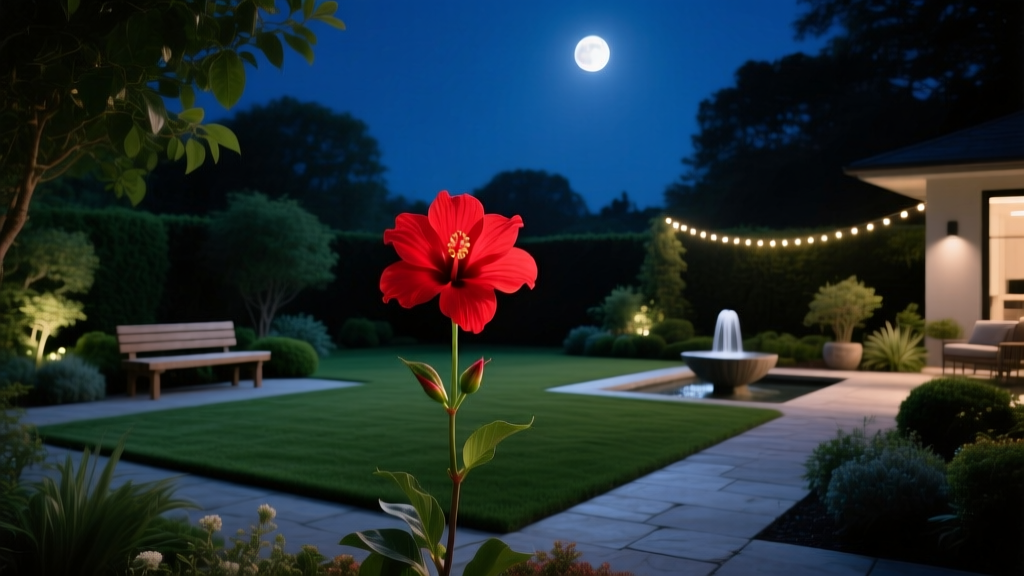
Night Garden Design: Making a Red Flower Shining in the Moonlight
The Biological Challenge: Why Red Disappears at Night
Designing a night garden presents a unique horticultural and optical challenge, particularly when your focal point is a red flower shining in the moonlight. To achieve this, you must first understand the Purkinje effect. As ambient light levels drop, the human eye transitions from photopic (cone-based) vision to scotopic (rod-based) vision. Rods are highly sensitive to blue and green wavelengths but virtually blind to long red wavelengths. Under pure lunar illumination, a vibrant crimson rose will actually appear as a dark, muddy grey or black void.
Optical Fact: True moonlight has a correlated color temperature (CCT) of roughly 4100K to 5000K, appearing slightly blue-shifted to the human eye. To create the illusion of a red flower shining in the moonlight, landscape architects must artificially simulate this cool lunar downlight while simultaneously applying targeted, warm-spectrum accent lighting directly onto the red petals to stimulate the eye's remaining cone receptors.
According to guidelines published by DarkSky International, outdoor lighting must balance human visibility with ecological preservation. By utilizing fully shielded, low-lumen LED fixtures, you can illuminate specific botanical specimens without contributing to skyglow or disrupting local pollinator navigation.
Selecting Cultivars for Night Visibility
Not all red flowers are created equal when the sun goes down. To maximize light reflection and contrast, select cultivars that feature glossy foliage, silver-backed leaves, or bicolor patterns. The Royal Horticultural Society (RHS) notes that variegated and silver foliage acts as a natural reflector in low-light conditions, creating a glowing halo that draws the eye toward the darker red blooms.
| Cultivar | Type | Night Garden Strategy | USDA Zones |
|---|---|---|---|
| Salvia microphylla 'Hot Lips' | Perennial | Bicolor white/red blooms; the white tips glow brightly in moonlight, framing the red base. | 7-9 |
| Rosa 'Mister Lincoln' | Hybrid Tea | Highly glossy dark green foliage reflects ambient light; velvety red petals require direct 2700K accent. | 5-9 |
| Tulipa 'Red Riding Hood' | Bulb | Foliage features striking silver-purple flecks that catch and scatter low-level lunar light. | 3-8 |
| Dianthus 'Neon' | Perennial | Fringed, ruffled petals create micro-shadows and highlights, giving the flower 3D depth at night. | 4-8 |
The Lighting Matrix: Simulating Lunar Conditions
Achieving the precise aesthetic of a red flower shining in the moonlight requires a two-tiered lighting approach. You cannot simply blast the flower with a floodlight; this destroys the nocturnal ambiance and flattens the visual depth. Instead, use the following layered technique.
Layer 1: The Moonlight Canopy (4000K - 5000K)
Install fully shielded downlights in the branches of an overstory tree, 20 to 30 feet above the garden bed. Use 2W to 3W LEDs with a 4000K to 5000K color temperature. This cool, blue-shifted light mimics the natural spectrum of the moon. Aim for a soft illumination level of 0.5 to 1.0 foot-candles on the ground. To allow this light to penetrate, practice crown thinning on the tree, removing 15% to 20% of the inner crossing branches to create dappled light pools on the soil below.
Layer 2: The Red Accent (2700K)
Because the 4000K moonlight will turn your red flowers black, you must introduce a hidden, warm-spectrum accent light. Place a brass micro-well light or directional spot just 12 inches from the base of the plant.
- Fixture Selection: Choose a low-voltage (12V) brass fixture with a 10-degree to 15-degree narrow beam spread. Wide beams will wash out the surrounding moonlight effect.
- Bulb Specification: Insert a 1W or 2W LED bulb rated for exactly 2700K (warm white). This specific wavelength stimulates the eye's red cones without overpowering the cool ambient moonlight.
- Placement & Angling: Mount the fixture at ground level, angled upward at 45 degrees. Never back-light a red flower, as this will turn it into a dark silhouette against the brighter background.
- Smart Integration: In 2026, smart transformers (like the WAC Lighting Smart Transformer or similar Home Assistant-compatible models) allow you to link your accent lights to lunar cycle APIs. The system can automatically dim the accent lights on nights with a full moon and brighten them during a new moon, maintaining a consistent visual balance year-round.
For comprehensive data on LED efficacy and spectral output, the U.S. Department of Energy Solid-State Lighting program provides extensive testing on how different color temperatures impact nighttime visual acuity and circadian rhythms.
Hardscaping and Reflective Mulches
To amplify the effect of your lighting without adding more fixtures, utilize reflective ground covers. Avoid dark hardwood mulches, which absorb light. Instead, use:
- Decomposed Granite (DG): Opt for a 'champagne' or light silver DG. It reflects up to 40% of ambient moonlight back onto the underside of the flower canopy.
- Tumbled Sea Glass or River Pebbles: A 1-inch top-dressing of light-colored, smooth stones creates a luminous base that contrasts sharply with the deep red petals above.
- Silver Foliage Companions: Interplant your red flowers with Artemisia schmidtiana 'Silver Mound' or Senecio cineraria (Dusty Miller). The dense, white trichomes on these leaves act as natural reflectors, bouncing the 4000K moonlight onto the red blooms.
Troubleshooting Common Night Garden Failures
Diagnostic Guide: When the Red Flower Won't Shine
- Symptom: The red flower looks flat and orange.
Fix: Your accent light is too close or too bright. Move the 2700K fixture back 6 inches and swap to a 1W bulb to restore the velvety texture of the petals. - Symptom: The flower is completely invisible/black.
Fix: The 4000K moonlight is overpowering the accent light, or the accent beam angle is too wide. Switch to a 10-degree narrow spot optic. - Symptom: Glare is blinding the viewer.
Fix: You have a line-of-sight issue. Install a 3-inch brass glare shield (visor) on the accent fixture and lower it deeper into the mulch bed.
Frequently Asked Questions
How much does it cost to install this specific lighting setup?
As of 2026, professional installation of a high-end, low-voltage night garden lighting system averages $160 to $240 per fixture, including the transformer, wire, and labor. A focused bed with one moonlight and three red-flower accents will typically cost between $800 and $1,200.
Will the 2700K accent light disrupt nocturnal pollinators?
While any artificial light can impact insect behavior, using a 1W LED with a narrow 10-degree beam restricts the light spill to the flower itself. Furthermore, keeping the light below 3000K minimizes the blue-spectrum emissions that are most disruptive to moth and bat navigation.
Can I use solar-powered lights for this effect?
Currently, most consumer solar lights lack the optical precision (narrow beam angles) and high CRI (Color Rendering Index) required to accurately render red pigments at night. For a true moonlight effect, hardwired low-voltage LEDs powered by a smart transformer remain the professional standard.

