
Gardening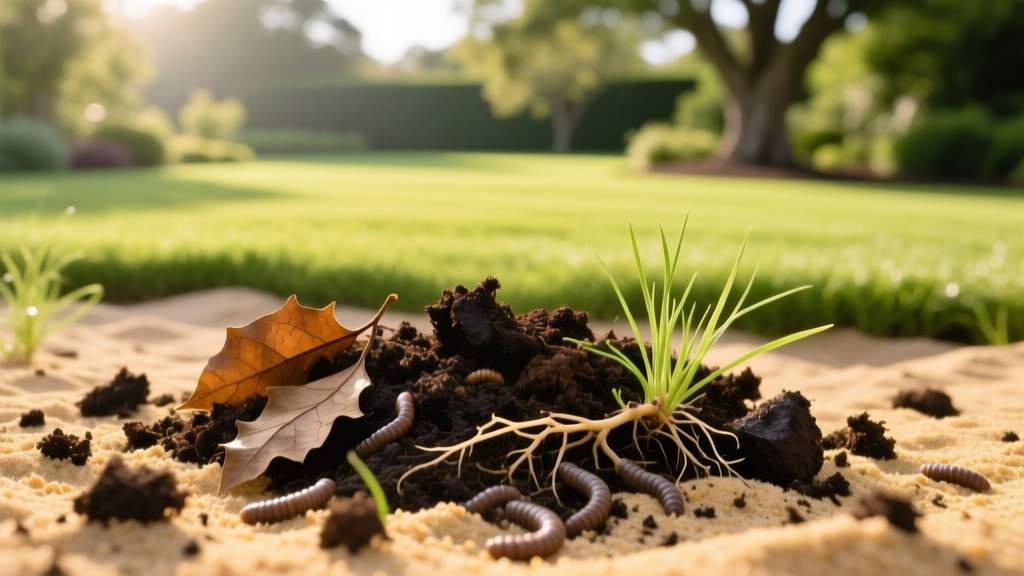
Best Organic Matter for Sandy Soil: Chemical-Free Amendment Guide
The Hidden Chemistry of Sandy Soil Leaching
Sandy soil presents a unique challenge for organic gardeners: its large particle size creates massive macro-pores, causing water and dissolved nutrients to drain away before plant roots can absorb them. When you rely on synthetic, chemical-based fertilizers in sandy environments, up to 60% of the applied nitrogen can leach directly into the groundwater. Transitioning to chemical-free cultivation requires fundamentally altering the soil's physical and chemical structure. The only sustainable mechanism for this is the strategic integration of high-quality organic matter.
According to the USDA Natural Resources Conservation Service, building soil organic carbon is the primary driver for improving water infiltration and retention in coarse-textured soils. By targeting a soil organic matter (SOM) volume of 5% to 8%, you can transform hydrophobic, nutrient-poor sand into a resilient, biologically active sandy loam.
Cation Exchange Capacity (CEC): The Metric That Matters
Before selecting an amendment, you must understand Cation Exchange Capacity (CEC). CEC measures the soil's ability to hold onto positively charged nutrients (like calcium, magnesium, and potassium). Pure sand has a dismal CEC of 1 to 5 meq/100g. In contrast, humus (fully decomposed organic matter) boasts a CEC of 150 to 300 meq/100g. By introducing specific organic materials, you are essentially installing microscopic nutrient sponges that eliminate the need for constant chemical reapplication.
⚠️ Critical Warning: The 'Sand + Clay' Myth
Never attempt to fix sandy soil by adding heavy clay. Without the mediating presence of abundant organic matter, mixing sand and clay creates a dense, concrete-like matrix that restricts root penetration and suffocates soil microbiology. Organic matter is the mandatory bridge between soil textures.
Top 5 Chemical-Free Organic Amendments Ranked
Not all organic matter performs equally in sandy environments. Below is a data-driven comparison of the most effective amendments for maximizing water retention and biological activity without synthetic inputs.
| Amendment Type | Water Retention Boost | CEC Contribution | Avg. Cost (per cu ft) | Breakdown Rate |
|---|---|---|---|---|
| Sphagnum Peat Moss | High (Holds 10-12x weight) | Moderate | $1.50 - $2.50 | Slow (3-5 years) |
| Buffered Coco Coir | Very High (Holds 8-10x weight) | Moderate | $2.00 - $3.50 | Medium (2-3 years) |
| Leaf Mold Compost | High | High | Free - $1.00 | Medium (1-2 years) |
| Charged Biochar | Extreme (Highly porous) | Very High | $8.00 - $15.00 | Permanent (Centuries) |
| Vermicompost (Castings) | Moderate | Extreme (Microbial) | $4.00 - $7.00 | Fast (Seasonal) |
1. Buffered Coco Coir (The Sustainable Peat Alternative)
While sphagnum peat moss has historically been the standard for water retention, its extraction damages fragile peat bog ecosystems. Buffered coco coir (processed to remove excess sodium and potassium) is the superior chemical-free alternative. It maintains a near-neutral pH of 5.8 to 6.8, unlike peat which requires heavy limestone applications to neutralize its high acidity. Apply coir at a rate of 2 cubic feet per 100 square feet of sandy bed space.
2. Pre-Charged Biochar
Biochar is essentially charcoal produced through pyrolysis. Its microscopic lattice structure provides permanent housing for soil bacteria and mycorrhizal fungi. Crucial Edge Case: Never apply raw, uncharged biochar to sandy soil. Raw biochar acts like a dry sponge and will actively strip (rob) existing nitrogen from your soil, causing severe plant chlorosis. Always purchase 'inoculated' or 'charged' biochar, or soak raw biochar in compost tea or liquid kelp for 14 days before application. Apply at a rate of 10% by volume to the top 6 inches of soil.
3. Leaf Mold Compost
Unlike standard hot compost, which is bacterial-dominated, leaf mold is decomposed primarily by fungi. This makes it the ultimate organic matter for sandy soil intended for perennial borders, fruiting shrubs, and trees, which rely on fungal networks for nutrient uptake. According to research highlighted by Cornell University's Soil Health initiative, fungal-dominated organic matter significantly improves soil aggregation, binding loose sand particles into stable micro-clumps.
4. Vermicompost (Worm Castings)
Worm castings do not provide massive bulk for physical soil structure, but they are unmatched in biological density. They contain water-soluble humic acids that coat sand particles, drastically improving their CEC. Because of the high cost, use vermicompost as a targeted 'banding' amendment: place a 1-inch layer directly in the planting trench or hole rather than broadcasting it across the entire sandy surface.
Step-by-Step Incorporation Protocol
Transforming sandy soil requires precise physical integration. Follow this protocol for new garden beds:
- Moisture Prep: Water the sandy area deeply 24 hours before working. Dry sand repels organic matter and creates dust clouds that waste valuable amendments.
- Base Layering: Spread 2 to 3 inches of your bulk amendment (Coco Coir or Leaf Mold) evenly across the surface.
- Biological Inoculation: Sprinkle 5 lbs of granular mycorrhizal fungi (species like Rhizophagus intraradices) per 1,000 square feet over the organic layer.
- Mechanical Integration: Use a broadfork or a rear-tine tiller to mix the amendments into the top 6 to 8 inches of sand. Do not till deeper; bringing subsoil sand to the surface dilutes your organic concentration.
- Surface Capping: Finish with a 1-inch top-dressing of vermicompost and a 2-inch layer of arborist wood chips to prevent UV degradation of the newly integrated organic matter.
Troubleshooting Common Sandy Soil Failures
Diagnostic Decision Tree
Symptom: Water pools on the surface for 5 minutes, then instantly vanishes, leaving the subsoil dry.
Cause: Hydrophobic sand. Fine sand particles coated in natural waxes from decomposing pine needles or eucalyptus repel water.
Organic Fix: Apply a natural, chemical-free surfactant like Yucca schidigera extract (1 oz per gallon of water) to break the surface tension, followed by a heavy top-dressing of compost.
Symptom: Plants exhibit stunted growth and pale yellow leaves 3 weeks after adding fresh wood chips or unaged manure.
Cause: Nitrogen immobilization (Robbery). Soil microbes are consuming all available nitrogen to break down high-carbon materials (C:N ratio above 30:1).
Organic Fix: Immediately side-dress plants with organic blood meal or alfalfa meal (apply 2 lbs per 100 sq ft) to provide a rapid nitrogen source for the microbes without using synthetic urea.
Long-Term Maintenance Without Synthetics
Organic matter in sandy soil oxidizes and breaks down faster than in clay soils due to high oxygen levels in the macro-pores. To maintain your 5-8% SOM target without chemical fertilizers, implement a continuous cover-cropping rotation. Sow buckwheat or crimson clover during off-seasons. These crops scavenge leaching nutrients, hold them in their biomass, and release them back into the sand when chopped and dropped as green manure. This closed-loop system ensures your sandy soil remains a biologically vibrant, chemical-free ecosystem year after year.

