
Gardening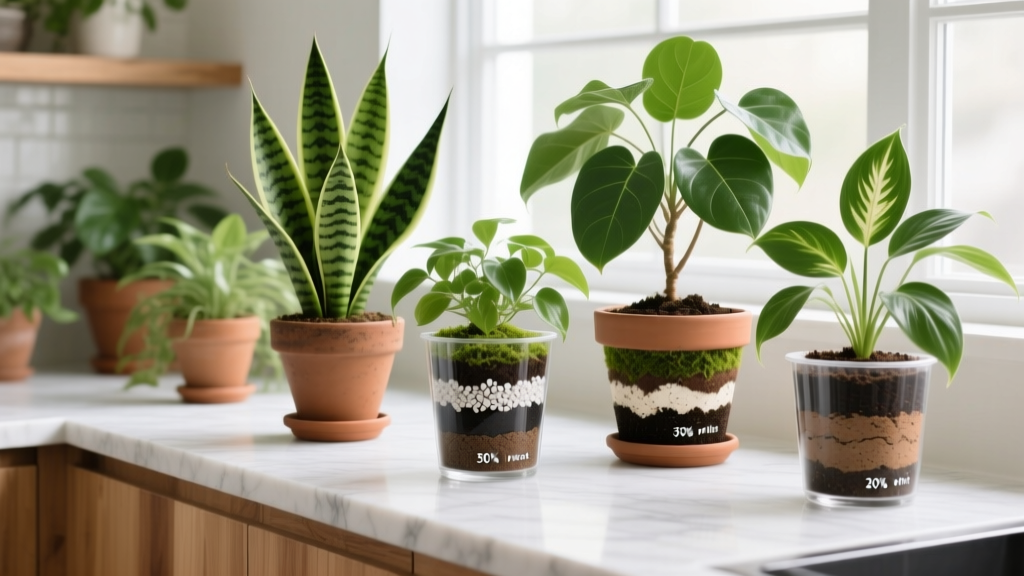
Peat Moss for Indoor Plants: Exact Soil Mixing Ratios & Guide
The Science of Sphagnum Peat in Container Soils
Peat moss—specifically Canadian Sphagnum peat—remains a foundational component in professional and hobbyist indoor horticulture. Its value lies in its exceptional cation exchange capacity (CEC), which typically ranges from 100 to 200 meq/100g. This high CEC allows the peat to hold onto essential nutrient cations (like calcium, magnesium, and potassium) and release them to plant roots over time, preventing rapid nutrient leaching during frequent indoor waterings.
However, using raw peat moss for indoor plants directly from the bale is a primary cause of root rot and nutrient lockout. Unamended Sphagnum peat has a naturally low pH between 3.5 and 4.5, and its physical structure becomes highly hydrophobic (water-repellent) once it dries out below a 30% moisture threshold. To leverage its moisture-retention benefits without suffocating roots, it must be structurally amended with aeration materials and chemically buffered.
Expert Insight: A standard 3.8 cubic foot bale of compressed, premium Canadian peat moss (from brands like Sun Gro or Premier Tech) costs between $18 and $26 in 2026. When fully hydrated and fluffed, this single bale yields approximately 6 to 7 cubic feet of usable growing media, making it highly cost-effective compared to pre-bagged boutique aroid mixes.
Exact Peat Moss Mixing Ratios by Plant Type
Different houseplant families require distinct moisture-to-oxygen ratios in their root zones. The following matrix provides precise volumetric ratios for mixing peat-based soils tailored to specific indoor plant categories.
| Plant Category | Peat Moss | Aeration (Perlite/Pumice) | Organic/Structure (Bark/Coir) | Target pH |
|---|---|---|---|---|
| Aroids (Monstera, Philodendron) | 20% | 30% Perlite | 40% Orchid Bark, 10% Worm Castings | 5.8 - 6.2 |
| Calatheas & Marantas | 40% | 30% Perlite | 20% Coco Coir, 10% Charcoal | 6.0 - 6.5 |
| Ferns & Begonias | 50% | 30% Perlite | 20% Vermiculite | 5.5 - 6.0 |
| Succulents & Cacti | 10% | 50% Pumice | 30% Coarse Sand, 10% Bark | 6.0 - 7.0 |
Step-by-Step: Hydrating and Buffering Peat Moss
Never mix dry peat moss directly into a pot. Dry peat is hydrophobic and will wick moisture away from plant roots. Follow this preparation protocol before planting:
- Break the Hydrophobic Barrier: Place the required volume of dry peat into a mixing tub. Add warm water (around 90°F/32°C) mixed with one drop of liquid castile soap or a dedicated horticultural surfactant. The surfactant reduces water's surface tension, allowing it to penetrate the dry peat fibers.
- Hydrate and Rest: Mix thoroughly until the peat resembles a wrung-out sponge. Cover the tub and let it sit for 12 to 24 hours. This resting period ensures moisture reaches the core of the peat particles.
- Buffer the pH: To raise the pH from 4.0 to a plant-friendly 6.0, incorporate dolomitic limestone. The exact rate is 4 to 5 ounces of dolomitic lime per cubic yard of peat, which translates to roughly 1 level teaspoon per gallon of dry peat moss. Dolomitic lime is preferred over calcitic lime because it supplies magnesium, a secondary macronutrient that Sphagnum peat inherently lacks.
- Test the Moisture: Squeeze a handful of the buffered mix. It should hold its shape and yield only one or two drops of water. If water streams out, it is too wet; let it air-dry on a tarp for a few hours before potting.
Peat Moss vs. Coco Coir: The Indoor Gardening Debate
While coco coir has gained massive market share due to its renewable status, peat moss offers distinct chemical and physical advantages for specific indoor applications. Understanding these trade-offs is critical for long-term plant health.
- Cation Exchange Capacity (CEC): Peat moss (100-200 meq/100g) significantly outperforms coco coir (40-80 meq/100g). In high-leaching indoor environments where frequent watering is required, peat holds onto liquid fertilizers much longer than coir.
- Salt Content: Unbuffered coco coir often contains high levels of naturally occurring sodium and potassium salts, which can cause nutrient antagonism (specifically locking out calcium and magnesium). Peat moss is naturally low in salts, providing a cleaner blank slate for custom fertilization regimens.
- Decomposition Rate: Peat moss breaks down faster than coir. In an indoor pot, peat-based soils will begin to lose their structural integrity and acidify after 18 to 24 months, necessitating a full repot. Coir can maintain its physical structure for 3 to 4 years.
- Environmental Impact: Peat harvesting releases stored carbon, prompting organizations like the Royal Horticultural Society (RHS) to push for peat-free alternatives. However, the Canadian Sphagnum Peat Moss Association (CSPMA) notes that Canadian peatlands regenerate at a rate 60 times faster than they are harvested, with strict provincial regulations mandating bog restoration.
Troubleshooting Common Peat Moss Failures
When peat-based soils fail, the symptoms usually manifest in predictable ways. Use this diagnostic framework to correct issues:
Symptom: Soil Shrinks and Pulls Away from Pot Edges
Cause: The peat moss has dried out completely, reverting to its hydrophobic state. Watering from the top will result in channeling, where water runs down the sides of the pot without wetting the root ball.
Fix: Submerge the entire pot in a basin of room-temperature water for 2 to 3 hours (bottom-watering). Capillary action will force moisture back into the peat core. Add a drop of surfactant to the basin water to speed up re-wetting.
Symptom: White or Yellowish Crust on the Soil Surface
Cause: As peat moss decomposes over its 18-24 month lifespan, it releases humic acids, lowering the soil pH below 5.0. Simultaneously, synthetic fertilizers leave behind unabsorbed mineral salts that accumulate on the surface as water evaporates.
Fix: Scrape off the top inch of soil. Flush the remaining soil with distilled water to dissolve and drain excess salts. Top-dress with a 1/2 inch layer of earthworm castings, which contain beneficial microbes that help buffer pH and break down compacted organic matter.
Managing the Lifespan of Peat-Based Soils
Unlike mineral soils, peat moss is an organic material that undergoes biological decomposition. As microbes break down the peat, the particles shrink, reducing the macroporosity of the soil. This leads to a dangerous drop in oxygen levels within the root zone, often mistaken for overwatering.
To maintain optimal root health, schedule a complete soil replacement for peat-heavy mixes (like those used for Calatheas and Ferns) every 18 to 24 months. For chunkier aroid mixes where peat makes up only 20% of the volume, the structural integrity of the orchid bark and perlite will support the root zone longer, allowing you to stretch repotting intervals to 30 months. Always monitor soil density; if the top layer feels dense and compacted when pressed with a finger, the peat has broken down and immediate repotting is required.

