
Gardening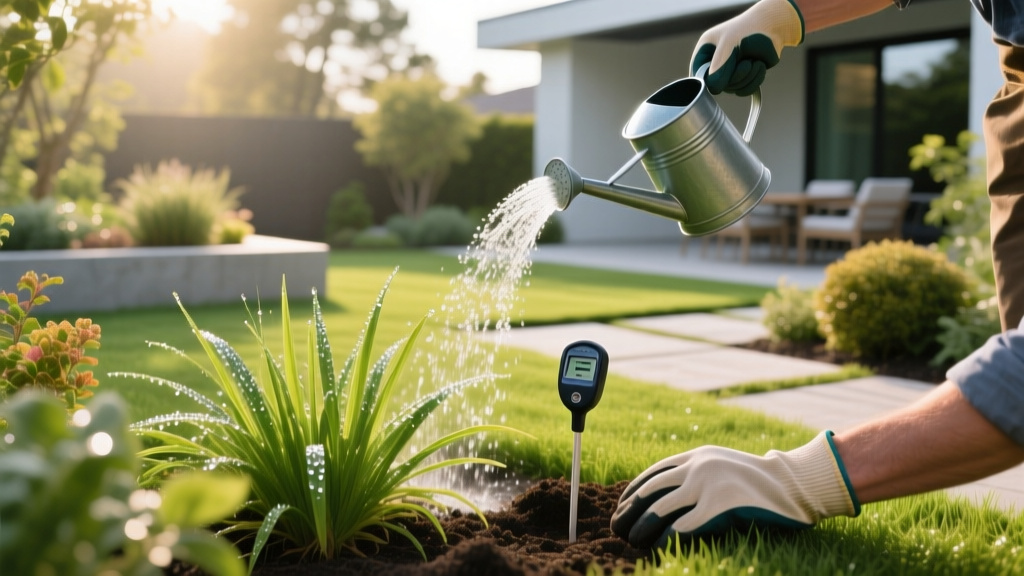
How Often Should I Water My Plants? Dosage & Cost Guide
The Flaw in Calendar-Based Watering Schedules
When gardeners ask, "how often should I water my plants," the most common—and most damaging—advice they receive is a calendar schedule, such as "every other day" or "twice a week." This approach ignores the three variables that actually dictate plant hydration: soil retention capacity, evapotranspiration (ET) rates, and precise water dosage. Watering a little bit every day encourages shallow root systems that scorch in summer heat and promotes fungal diseases on constantly wet foliage.
Professional horticulturists and landscape architects do not water by the day; they water by the dosage. The goal is to apply a specific volume of water to reach the active root zone, then allow the soil to dry down to a specific tension level before reapplying. This guide breaks down the exact mathematics of plant watering dosage, provides a frequency matrix based on soil and plant type, and calculates the actual utility costs of maintaining your landscape in 2026.
The Dosage Formula: Converting Inches to Gallons
The universal baseline for landscape hydration is the "one inch per week" rule. However, an inch of rain is a measurement of depth, not volume. To automate your irrigation or hand-water accurately, you must convert depth into gallons. According to EPA WaterSense guidelines, outdoor water use can account for up to 30% of total household water consumption, making precise dosage calculations critical for both plant health and budget management.
The Golden Conversion Ratio:
1 inch of water applied to 1 square foot of soil = 0.623 gallons.
Therefore, to apply 1 inch of water to a 100-square-foot raised bed, you need exactly 62.3 gallons of water per week.
If you are using a standard garden hose with a typical flow rate of 9 gallons per minute (GPM), it will take approximately 6.9 minutes of continuous spraying to deliver one inch of water to that 100-square-foot bed. If you are using a 2-gallon watering can, you will need to make 31 trips. Understanding this math prevents the chronic underwatering that occurs when gardeners assume a quick 30-second spray with a hose nozzle is sufficient.
Plant Watering Frequency & Dosage Matrix
Frequency is dictated by how fast your specific soil type drains the applied dosage. Sandy soils drain rapidly and require split dosages, while clay soils hold water tightly and require less frequent, slower applications to prevent runoff. The University of Wisconsin Extension emphasizes that matching application rates to soil infiltration rates is the primary defense against water waste.
| Plant Category | Soil Type | Target Weekly Dosage | Recommended Frequency | Application Method |
|---|---|---|---|---|
| Annual Vegetables | Loam / Raised Bed | 1.0 - 1.5 inches | Every 2-3 days | Drip tape (0.9 GPH) |
| Established Perennials | Clay-heavy | 0.5 - 1.0 inches | Once per week | Micro-sprinklers |
| Shrubs & Hedges | Sandy | 1.0 inch | Twice per week | 2 GPH button drippers |
| Cool-Season Turfgrass | Compacted Loam | 1.0 - 1.5 inches | 2 times per week (Cycle/Soak) | MP Rotator nozzles |
| Newly Planted Trees | Any | 10-15 gal per caliper inch | Every 3-4 days (First year) | Slow-release tree bag |
Calculating Your 2026 Irrigation Costs
Water is a metered utility, and understanding the financial impact of your dosage schedule is essential for landscape budgeting. In 2026, the average cost of municipal water in the United States hovers around $5.50 to $7.50 per CCF (Hundred Cubic Feet). One CCF equals exactly 748 gallons. This translates to an average cost of $0.008 to $0.01 per gallon for water alone.
The Hidden Sewer Fee Trap
The most critical financial variable in outdoor watering is wastewater (sewer) billing. Most municipalities calculate sewer charges based on your total water meter usage. If your home does not have a dedicated irrigation meter, every gallon you put on your lawn is billed as if it went down your toilet, effectively doubling or tripling your watering cost to $0.02 - $0.03 per gallon.
- Cost to apply 1 inch of water to 1,000 sq ft (623 gallons) without an irrigation meter: ~$12.46 to $18.69 per watering session.
- Cost to apply 1 inch of water to 1,000 sq ft with a dedicated irrigation meter: ~$4.98 to $6.23 per watering session.
If you maintain a 5,000-square-foot lawn requiring 1.5 inches of water per week during peak summer, you are using 4,672 gallons weekly. Without an irrigation meter, this can add $90 to $140 per month to your utility bill purely from unmonitored sewer fees. Installing a separate irrigation sub-meter (typically a $250-$400 upfront cost plus plumber fees) pays for itself in a single summer season for most mid-sized landscapes.
Precision Hardware: Emitters and Smart Controllers
Achieving exact dosages requires hardware that delivers predictable flow rates. Standard spray nozzles are highly susceptible to wind drift and evaporation loss (often losing 20-30% of dosage before it hits the soil). Upgrading to precision hardware ensures your calculated gallons actually reach the root zone.
Drip Irrigation Components
For garden beds, drip irrigation operates at low pressure (15-25 PSI) and delivers water directly to the soil. Look for pressure-compensating (PC) emitters, which maintain the exact same GPH output regardless of elevation changes or hose length.
- Netafim Techline CV (0.9 GPH): Subsurface drip tubing with built-in check valves to prevent soil from sucking back into the emitters. Ideal for raised beds and row crops. Cost: ~$0.45 per linear foot.
- Rain Bird Xeri-Bug 2 GPH Dripper: Point-source emitter for individual shrubs or potted containers. Allows you to calculate exactly how many minutes to run the zone (e.g., 2 gallons needed = 1 hour run time). Cost: ~$0.85 per unit.
Smart Controllers for Dosage Automation
Smart controllers adjust your watering frequency and duration based on local weather data, effectively automating the ET (evapotranspiration) calculations.
- Rachio 3 Smart Sprinkler Controller (8-Zone, $229): Features "Weather Intelligence Plus" which automatically skips watering during freezing temps, high winds, or after local rainfall. Its "Cycle and Soak" feature is critical for clay soils, breaking a 40-minute dosage into four 10-minute cycles to prevent runoff.
- Orbit B-hyve XR (16-Zone, $189): A highly cost-effective alternative that integrates with Soil Moisture Sensors. Instead of relying purely on weather forecasts, it reads actual tension data from the soil to dictate dosage frequency.
Troubleshooting: The Soil Moisture Decision Tree
Before adjusting your irrigation timer, you must verify the actual moisture level in the root zone. Visual symptoms on leaves (wilting) can indicate both overwatering and underwatering, as both conditions cause root failure and prevent water uptake. Use this diagnostic sequence before altering your dosage:
- The 6-Inch Screwdriver Test: Push a standard flathead screwdriver into the soil near the plant base. If it penetrates 6 inches with zero resistance, the soil is saturated. Action: Skip watering today; your frequency is too high.
- The Core Sample Check: Use a soil probe to pull a 4-inch core. Squeeze the soil in your fist. If it forms a tight ball that weeps water, it is waterlogged. If it crumbles instantly into dust, it is hydrophobic and underwatered. If it forms a loose ball that breaks apart when poked, moisture is optimal.
- Digital Tensiometer Verification: For high-value crops or sensitive perennials, insert a digital soil moisture meter (such as the Ecowitt WH51, which transmits data to a smart hub). Readings below 20% volumetric water content (VWC) in loam soils indicate immediate watering is required; readings above 45% indicate you are drowning the root zone and depleting soil oxygen.
Mastering how often to water your plants is ultimately an exercise in applied mathematics and soil observation. By abandoning arbitrary calendar schedules in favor of calculated gallon dosages, upgrading to pressure-compensating drip emitters, and auditing your utility billing structure, you will cultivate deeper root systems, reduce fungal pathogen pressure, and lower your annual landscape water expenditure by 20% to 40%.

