
Gardening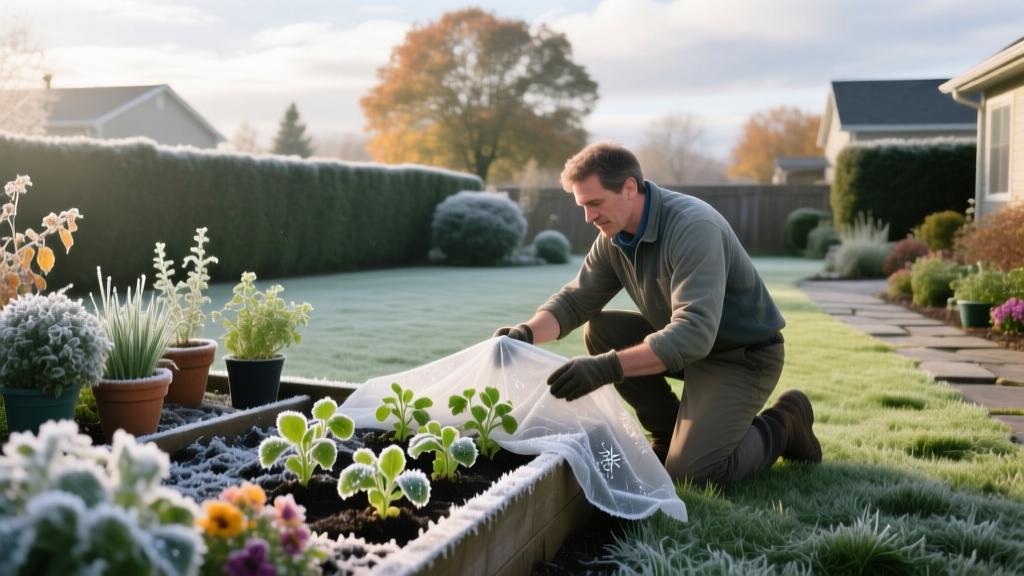
How to Protect Plants From Freezing: Frost Defense Strategies
The Physics of Freezing: Why Plants Die in the Cold
Before deploying protective gear, you must understand the biological mechanism of freeze damage. When ambient temperatures drop below 32°F (0°C), ice crystals begin to form in the extracellular spaces of plant tissue. This draws water out of the cells, causing severe dehydration. If the temperature drops rapidly or falls below a plant's hardiness threshold, intracellular ice forms, rupturing the cell walls and causing irreversible tissue necrosis. Protecting plants is not just about blocking wind; it is about trapping radiant heat, maintaining humidity, and preventing ice nucleation on the leaf surface.
According to the Old Farmer's Almanac, understanding the difference between a frost advisory and a freeze warning dictates your entire defense strategy. A frost advisory means temperatures will hover between 33°F and 36°F, threatening tender annuals. A freeze warning indicates temperatures will drop to 32°F or lower, requiring heavy intervention for all but the most cold-hardy perennials.
Diagnosing the Threat: Radiation Frost vs. Advection Freeze
Not all cold events are created equal. Misdiagnosing the type of freeze will lead to failed protection methods. Use this diagnostic matrix to identify the threat and select the correct countermeasure.
| Characteristic | Radiation Frost | Advection Freeze |
|---|---|---|
| Weather Conditions | Clear skies, calm winds (under 5 mph) | Cloudy or clear, strong winds (over 10 mph) |
| Temperature Profile | Ground is colder than the air above it | Cold air mass moves in; uniform cold profile |
| Primary Damage Vector | Radiant heat loss from leaves to the night sky | Convective heat stripping by moving wind |
| Best Defense Strategy | Frost blankets, thermal mass, overhead covers | Windbreaks, enclosed cold frames, active heating |
Passive Protection: Selecting the Right Frost Covers
Spunbond polypropylene frost blankets are the industry standard for radiation frost protection. However, buying the wrong weight will either crush your plants or fail to trap enough heat. In 2026, the market is dominated by specific fabric grades, and choosing correctly is vital for your garden's survival.
Agribon Fabric Grades: A Buyer's Guide
- Agribon AG-15 (0.45 oz/sq yd): Primarily an insect barrier. Offers only 1°F to 2°F of frost protection. Do not use for freezing events.
- Agribon AG-19 (0.55 oz/sq yd): The standard frost blanket. Allows 85% light transmission and provides 2°F to 4°F of protection. Ideal for light frosts down to 28°F. Cost: $18 to $22 for a 10x100 foot roll.
- Agribon AG-30 (0.9 oz/sq yd): Heavyweight blanket. Allows 70% light transmission but provides 4°F to 6°F of protection. Use for hard freezes down to 26°F. Cost: $25 to $30 for a 10x100 foot roll.
- Agribon AG-50 (1.5 oz/sq yd): Extreme winter protection. Allows only 50% light transmission. Provides up to 8°F of protection but must be removed during the day to prevent light deprivation. Cost: $35+ per roll.
Pro Tip: Never let frost blankets touch the foliage of your plants. The fabric conducts cold directly to the leaves it touches, creating localized freeze burn. Always use wire hoops, PVC pipes, or wooden stakes to create an air gap between the plant canopy and the blanket.
Microclimates and Cloches: Protecting Individual Seedlings
For newly transplanted tomatoes, peppers, and squash, full-bed covers are often overkill and impractical. Cloches create a localized microclimate that traps soil heat and humidity.
Hard vs. Soft Cloches
Hard Cloches (Glass or Rigid Plastic): These offer excellent wind resistance and trap heat efficiently. However, they lack ventilation. On a sunny day following a cold night, internal temperatures in a glass cloche can spike above 100°F, cooking the plant. You must manually remove the cap or prop them open every morning. Commercial polycarbonate cloches with adjustable top vents (like the 12-inch Garden Supply models, retailing around $14 each) solve this issue.
Soft Cloches (Hot Caps): Made from waxed paper or thin polyethylene, these are cheap ($1 to $2 each) and disposable. They are best used for a maximum of 5 to 7 days to harden off seedlings. They offer minimal thermal mass and are easily crushed by heavy snow or hail.
According to the Royal Horticultural Society, utilizing homemade cloches from recycled 1-gallon plastic milk jugs is highly effective for short-term emergencies, provided the bottom is cut out and the cap is removed during daylight hours to allow for essential air exchange.
Thermal Mass Hacks: Storing Daytime Heat for Nighttime Release
When dealing with advection freezes where wind strips away ambient heat, passive covers alone may not suffice. You must introduce thermal mass to your garden beds to absorb solar radiation during the day and release it slowly at night.
The Black Water Jug Method
- Collect 1-gallon plastic jugs and paint the exterior with flat black spray paint (Rust-Oleum High Heat or standard exterior black).
- Fill the jugs with water and place them directly inside your cold frames, low tunnels, or clustered around the base of sensitive perennials.
- Water has a specific heat capacity roughly four times greater than soil. A cluster of five 1-gallon jugs can raise the ambient temperature inside a 4x4 foot cold frame by 2°F to 3°F throughout the night.
- For larger scale protection, use 55-gallon black polyethylene rain barrels placed on the north side of your garden beds to absorb sun and radiate heat southward over the crops.
Active Heating Solutions for Extreme Drops
When the National Weather Service issues an extreme cold warning (temperatures plunging below 20°F), passive methods fail. You must introduce active heat. The University of Minnesota Extension notes that active heating is usually reserved for high-value crops, commercial greenhouses, or prized ornamental specimens, but homeowners can adapt these tools for raised beds.
- Soil Heat Cables: Products like the Frost King heat tape or specialized horticultural soil warming cables (e.g., the 48-foot Redi-Heat cable, approx. $45) can be buried 2 inches below the soil surface. When connected to a thermostat-controlled outdoor outlet, they prevent the root zone from freezing, which is often more lethal to perennials than foliar frost.
- Incandescent Bulbs: Placing a string of old-school incandescent C9 Christmas lights (not LEDs, which emit zero heat) under a frost blanket can raise the canopy temperature by 4°F to 5°F. Ensure the bulbs do not physically touch the plastic or fabric to prevent melting.
- Ceramic Pot Heaters: A DIY terracotta heater using a ceramic heat lamp bulb and an inverted 12-inch clay pot can serve as a localized radiant heater inside a small hoop house. Always use a GFCI-protected outdoor extension cord to prevent lethal electrical shorts in damp conditions.
Post-Freeze Triage: What to Do (and What NOT to Do)
If your plants are hit by an unexpected freeze despite your preparations, your immediate reaction will determine if they survive. The most common mistake gardeners make is premature pruning.
Warning: Do not prune blackened, mushy, or dead-looking foliage immediately after a freeze. The damaged tissue acts as an insulating layer for the healthy stems below. Furthermore, pruning stimulates new, tender growth that will be instantly killed by the next frost event. Wait until the danger of frost has entirely passed in spring, and you see new green buds emerging from the lower nodes before cutting back the dead wood.
For herbaceous plants that have collapsed into a wet, slimy mess (like hostas or dahlias), gently clear the rotting matter away from the crown to prevent fungal crown rot, but leave the root system entirely undisturbed. Water the soil deeply after a freeze event; dry soil freezes faster and deeper than moist soil, and rehydrating the root zone helps the plant recover from the severe cellular dehydration caused by extracellular ice formation.

