
Gardening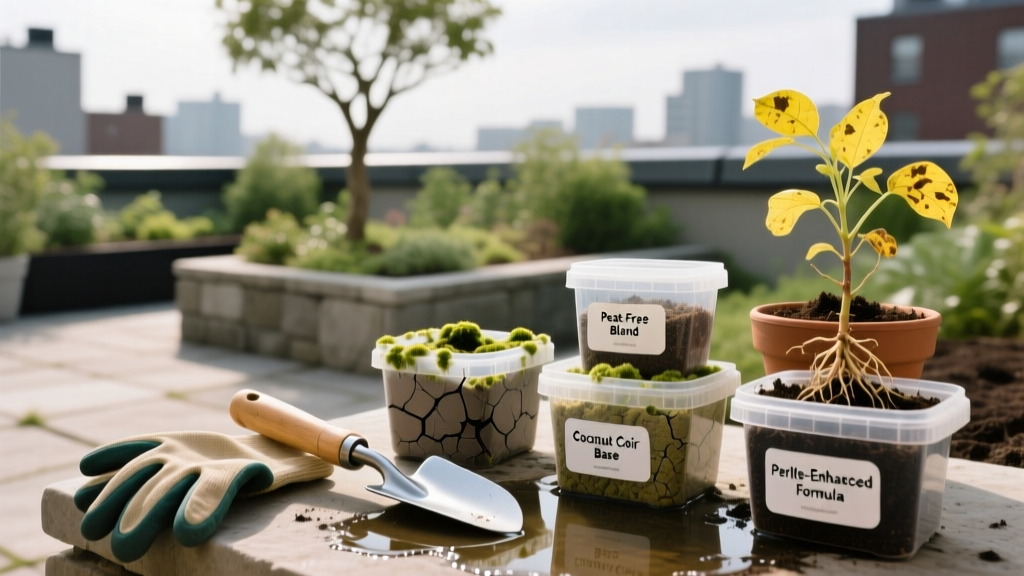
Soilless Potting Soil Failures: Diagnosis and Expert Fixes
The Diagnostic Matrix: Identifying Your Substrate Failure
Commercial and bagged soilless potting soil blends—primarily composed of sphagnum peat moss, coco coir, perlite, and pine bark—are engineered for aeration and drainage. However, they lack the mineral buffering capacity of native topsoil. Over a 6-to-12-month lifecycle, these organic matrices physically and chemically degrade. Peat particles break down, reducing macro-porosity, while accumulated fertilizer salts alter the osmotic pressure. Before discarding a struggling plant, cross-reference its symptoms with the diagnostic matrix below to identify the exact substrate failure.
| Primary Symptom | Root Cause in Soilless Media | Immediate Diagnostic Fix |
|---|---|---|
| Water pools on surface; dry pockets remain after watering | Peat moss cuticle hydrophobia (rewetting resistance) | Apply yucca-based surfactant; implement bottom-watering |
| Leaf tip burn; stunted new growth; white crust on soil surface | Salt toxicity and Cation Exchange Capacity (CEC) collapse | Flush with 3x container volume; measure EC with a meter |
| Yellowing leaves despite regular feeding; purple stems | Nutrient lockout via pH drift (typically dropping below 5.2) | Test pH; apply liquid dolomitic lime suspension |
| Small black flies hovering; seedlings damping off | Fungus gnats (Bradysia spp.) breeding in moist organic matter | Apply BTI soil drench; top-dress with calcined clay |
Failure 1: Hydrophobic Peat and Rewetting Resistance
The most frequent complaint regarding aged soilless potting soil is its sudden refusal to absorb water. This is not merely a matter of the soil being 'too dry.' Sphagnum peat moss contains natural waxy cuticles. When the moisture content of peat drops below 30% by volume, these cuticles become highly hydrophobic. Water applied from a watering can will simply channel down the sides of the pot through macropores, leaving the central root ball completely desiccated.
The Solution: Mechanical agitation is insufficient once hydrophobia sets in. You must lower the surface tension of the irrigation water. Commercial greenhouse growers use non-ionic wetting agents. For home gardeners, a yucca extract-based soil penetrant like AquaGro 2000 G (approximately $45 per gallon) is the industry standard. Mix at a rate of 2 ounces per gallon of water. The natural saponins in the yucca extract strip the waxy coating from the peat fibers, allowing capillary action to resume. For immediate triage without purchasing a wetting agent, submerge the entire pot in a basin of room-temperature water for 45 minutes to force hydration via osmotic pressure, then add two drops of mild, non-antibacterial dish soap to your next watering to act as a temporary surfactant.
Failure 2: Cation Exchange Collapse and Salt Toxicity
Unlike mineral soils, which possess a high Cation Exchange Capacity (CEC) ranging from 15 to 40 meq/100g, standard soilless potting soil blends have a CEC of merely 1 to 5 meq/100g, according to Penn State Extension. CEC is the substrate's ability to hold onto positively charged nutrient ions (like calcium, magnesium, and potassium) and release them to plant roots. Because soilless mixes lack this buffering capacity, any water-soluble synthetic fertilizer you apply remains entirely in the soil solution.
When growers apply liquid fertilizers (e.g., Jack's 20-20-20) at standard rates weekly, the salts do not bind to the peat or coir. They accumulate. Over months, the Electrical Conductivity (EC) of the substrate spikes above 3.0 mS/cm, creating an osmotic gradient that physically pulls water out of the plant's root tips, causing necrosis and 'fertilizer burn.'
Warning: The Perlite Fluoride Hazard
Many bagged soilless mixes rely heavily on perlite for aeration. Under acidic conditions (pH below 5.5) and high salt accumulation, perlite can release soluble fluoride ions. This causes severe leaf tip and margin necrosis in fluoride-sensitive species, including Dracaena, Calathea, Spider Plants, and members of the Marantaceae family. If growing these species, select a perlite-free soilless mix utilizing pumice or parboiled rice hulls instead.
Many bagged soilless mixes rely heavily on perlite for aeration. Under acidic conditions (pH below 5.5) and high salt accumulation, perlite can release soluble fluoride ions. This causes severe leaf tip and margin necrosis in fluoride-sensitive species, including Dracaena, Calathea, Spider Plants, and members of the Marantaceae family. If growing these species, select a perlite-free soilless mix utilizing pumice or parboiled rice hulls instead.
The Solution: Implement a strict leaching fraction protocol. Once a month, irrigate the container with plain, pH-adjusted water equal to three times the volume of the pot. If your pot holds 1 gallon of soilless potting soil, slowly pour 3 gallons of water through it to flush accumulated salts out of the drainage holes. To prevent future spikes, transition from liquid synthetics to a resin-coated controlled-release fertilizer (CRF) like Osmocote Pro 19-6-12 (approx. $60 for a 50lb bag). CRFs release nutrients based on soil temperature and moisture, maintaining the substrate EC in the safe 1.0 to 1.5 mS/cm range. For precision monitoring, invest in an Apera Instruments EC20 pocket meter ($160) and perform a 1:2 (soil:water) extraction test every 60 days.
Failure 3: Fungus Gnats and Organic Matter Breakdown
Fungus gnats (Bradysia spp.) are not just a nuisance; their larvae feed on fine root hairs and root tips, severely stunting plant growth and vectoring root rot pathogens like Pythium and Fusarium. Soilless potting soil provides the ideal breeding ground because the top 1.5 inches of peat and coir remain consistently moist, and the decomposing organic matter feeds the fungal biofilm that the larvae consume.
The Solution: Yellow sticky traps only catch adults and do nothing to stop the reproductive cycle. You must target the larval stage in the substrate. The most effective biological control is Bacillus thuringiensis israelensis (BTI), sold commercially as Mosquito Bits. Steep 4 tablespoons of Mosquito Bits in 1 gallon of warm water for 30 minutes, strain the liquid, and use it to drench the soilless potting soil. Repeat every 7 days for three cycles. To physically block adults from laying eggs in the moist substrate, top-dress the soil with a half-inch layer of calcined clay, such as Turface MVP ($25 per 40lb bag). The calcined clay dries rapidly on the surface, creating an arid, impenetrable barrier that disrupts the gnat life cycle while maintaining aeration below.
The 15-Minute Substrate Rescue Protocol
If your plant is declining rapidly and you suspect total substrate failure (compaction, severe salt buildup, and root rot), you do not always need to perform a full, stressful repotting. Use this targeted rescue protocol:
- Aerate: Insert a 1/4-inch wooden dowel or chopstick into the soilless potting soil at 5-point intervals around the root ball, pushing down to the bottom of the pot. Twist to fracture compacted peat layers.
- Flush: Move the plant to a sink or outdoors. Pour 3x the container volume of distilled or reverse-osmosis water through the aeration holes to wash out toxic salt accumulations.
- Inoculate: Mix 1 tablespoon of mycorrhizal fungi powder (e.g., MycoGrow Soluble) into a gallon of water and drench the aerated holes. The fungi will colonize the damaged root tips, extending their absorptive reach.
- Cap: Apply a 1-inch top dressing of dry Turface MVP or coarse horticultural sand to the surface to immediately halt moisture loss and deter pest oviposition.
Frequently Asked Questions
Can I reuse failed soilless potting soil for new plants?
Yes, but it requires remediation. Old soilless mix has depleted nutrient reserves, compacted physical structure, and potential pathogen loads. To reuse it, spread the old mix on a tarp in direct sunlight for 48 hours to solarize and kill pathogens. Then, amend it with 30% fresh perlite by volume to restore macro-porosity, and mix in a slow-release organic fertilizer like Espoma Garden-tone to rebuild the microbiome before replanting.
Why does my soilless potting soil turn green on the surface?
The green layer is not mold; it is a combination of algae and cyanobacteria. It indicates that the surface of your soilless mix is staying too wet and receiving high light exposure. While not directly harmful to mature plant roots, it forms a crust that restricts gas exchange (oxygen in, CO2 out) at the soil line. Scrape it off, reduce your watering frequency, and improve air circulation with an oscillating fan.
Is coco coir better than peat moss in soilless mixes?
Coco coir rewets much easier than peat moss and resists hydrophobia, making it superior for automated irrigation or forgetful waterers. However, as noted by the University of Wisconsin-Madison Extension, coir naturally contains high levels of potassium and sodium. If using a high-coir soilless potting soil blend, you must use a specialized 'coir-formulated' base fertilizer that is lower in potassium and higher in calcium and magnesium to prevent severe nutrient antagonism and lockout.

