
Gardening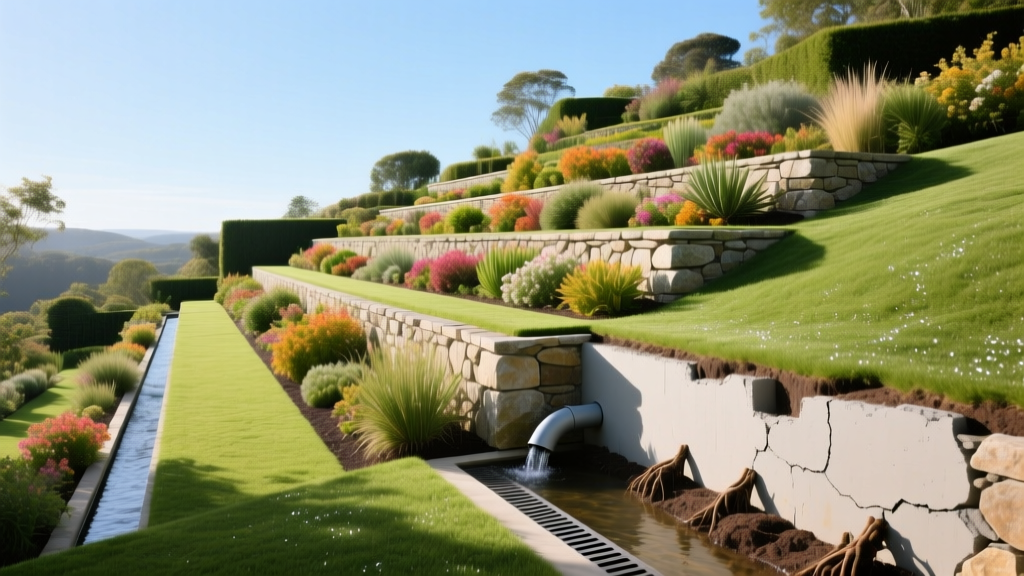
Terraced Gardening Troubleshooting: Fixing Drainage, Erosion, and Wall Failures
The Hidden Engineering Behind Terraced Gardens
Terraced gardening transforms unusable, steep slopes into highly productive, tiered planting zones. However, when retaining walls bulge, topsoil washes into the lower yard, or terrace beds turn into waterlogged swamps, the root cause is almost always improper hydrostatic management and slope engineering. A terrace is not just a raised bed; it is a retaining structure that must withstand thousands of pounds of lateral earth and water pressure.
This diagnostic guide identifies the three most critical failure modes in terraced gardening and provides exact, actionable engineering and horticultural solutions to stabilize your slopes for the long term.
Symptom 1: Retaining Wall Bulging, Leaning, or Collapse
Diagnosis: Hydrostatic Pressure and Inadequate Reinforcement
If your segmental concrete blocks are pushing outward, or your timber walls are bowing in the center, you are experiencing hydrostatic pressure failure. When rain saturates the soil behind the wall, the soil expands and pushes laterally. Water weighs 62.4 pounds per cubic foot; a saturated terrace bed can exert over 1,000 pounds of lateral pressure per square foot on a retaining wall. Furthermore, if the wall exceeds 3 feet in height and lacks geogrid reinforcement, the structural mass of the wall alone cannot resist the overturning moment of the soil wedge.
Solution: Retrofitting Drainage and Geogrid Reinforcement
To fix a failing wall without complete demolition, you must relieve the water pressure and mechanically tie the wall to the soil mass.
- Excavate the Backfill Zone: Dig out the soil directly behind the failing wall section to a depth of 12 to 18 inches, or until you reach the undisturbed native soil slope.
- Install a French Drain Base: Lay a 4-inch SDR 35 perforated PVC pipe (not corrugated black pipe, which crushes under heavy loads) at the base of the excavation. Ensure the pipe maintains a minimum 1% downward slope (1/8 inch drop per foot) to daylight at the lowest edge of the terrace.
- Replace Soil with Aggregate: Backfill the 12-to-18-inch trench exclusively with 3/4-inch washed crushed stone. Do not use pea gravel; the rounded edges of pea gravel roll and fail to lock together, providing zero structural support. Crushed stone has angular facets that interlock, creating a stable, free-draining mass.
- Install Geogrid (For walls over 3 feet): If the wall is taller than 3 feet, you must integrate biaxial geogrid (such as Tensar BX1200 or Mirafi 500X). Lay the geogrid horizontally between the block courses, extending it back into the native soil at a distance equal to 60% of the wall's height. This creates a 'mechanically stabilized earth' (MSE) mass, effectively turning the soil itself into the retaining structure.
Warning: Never use landscape fabric between the crushed stone backfill and the retaining wall blocks. While it keeps soil out of the gravel, it eventually clogs with fine silt, creating an impermeable dam that traps water and accelerates wall failure. Rely on the 3/4-inch crushed stone's natural void spaces for drainage.
Symptom 2: Topsoil Washout and Surface Erosion
Diagnosis: High-Velocity Surface Runoff
If you notice deep gullies forming in your terrace beds, or if mulch and topsoil are spilling over the front lip of the wall after heavy rains, your surface water management is failing. This occurs when the terrace bed lacks a containment lip, or when the slope above the top terrace channels concentrated, high-velocity water directly onto the exposed soil.
Solution: Velocity Reduction and Soil Armoring
According to Penn State Extension, managing surface runoff before it hits the terrace face is critical for long-term slope stability. Implement these targeted fixes:
- Build a 2-Inch Soil Lip: When grading the terrace bed, mound the soil slightly at the very front edge (behind the capstone) to create a 2-inch raised lip. This forces water to pool temporarily and infiltrate the bed rather than immediately sheeting over the wall edge.
- Install Check Dams: If water flows down a swale or pathway above the terrace, build small, 6-inch-high check dams using river rock or timber across the flow path every 4 to 6 feet. This breaks the water's kinetic energy, reducing its velocity to non-erosive levels.
- Armor the Soil with Deep-Rooted Perennials: Bare soil is highly vulnerable. Plant deep-rooted, slope-stabilizing native grasses like Switchgrass (Panicum virgatum) or deep-rooted groundcovers like Creeping Juniper (Juniperus horizontalis). Their root systems create a biological rebar matrix that holds the topsoil in place during 2-inch-per-hour rainfall events.
Symptom 3: Waterlogged Terrace Beds and Root Rot
Diagnosis: The Clay Pan Effect
When terrace beds remain soggy for days after a rain, resulting in yellowing plant foliage and root rot, the issue is usually an impermeable subsoil layer. During the initial excavation and grading of the terraces, heavy machinery or repeated foot traffic often compacts the native clay subsoil at the base of the bed. This creates a 'clay pan'—a hard, impermeable layer that traps irrigation and rainwater in the imported topsoil above it, effectively turning your terrace into a bathtub.
Solution: Subsoil Fracturing and Vertical Drainage Chimneys
To fix a waterlogged terrace without removing all the plants and topsoil, you must break the clay pan and provide an escape route for the trapped water.
- Deep Tine Aeration: Use a walk-behind deep-tine aerator or a manual broadfork to penetrate the compacted subsoil layer to a depth of at least 8 to 10 inches. Do this when the soil is slightly moist, not saturated, to effectively fracture the clay rather than just punching holes in it.
- Install Vertical Gravel Chimneys: Dig 6-inch diameter holes through the topsoil and into the fractured subsoil, spaced every 4 feet across the terrace bed. Fill these holes with coarse builder's sand or 1/2-inch gravel. These 'chimneys' intercept trapped surface water and channel it down through the compacted layer into the more permeable subsoil below.
- Amend with Expanded Shale: For chronic drainage issues, top-dress the bed with expanded shale (often sold under brand names like PermaTill or Escalite). Unlike organic compost, which breaks down and compacts over time, expanded shale is a permanently porous, lightweight ceramic aggregate that permanently increases the macro-porosity of heavy clay soils.
Terrace Wall Material Comparison Matrix
Choosing the right retaining material dictates both your upfront costs and the wall's lifespan. Below is a 2026 market comparison of common terraced gardening materials.
| Material Type | Avg. Cost (Per Sq. Ft. of Face) | Expected Lifespan | Drainage Requirement | Max Height (Unreinforced) |
|---|---|---|---|---|
| Treated Timber (6x6) | $15 - $25 | 15 - 20 Years | High (Prone to rot if wet) | 4 Feet |
| Segmental Concrete Block | $25 - $45 | 50+ Years | Moderate (Requires gravel backfill) | 3 Feet (Higher with geogrid) |
| Natural Flagstone/Boulder | $40 - $80 | 100+ Years | Low (Natural gaps allow weeping) | 3 Feet |
| Poured Concrete (Formed) | $60 - $110 | 75+ Years | Very High (Requires weep holes) | Unlimited (Engineered) |
Seasonal Terrace Maintenance Checklist
Preventative maintenance is significantly cheaper than structural repair. Follow this biannual checklist to ensure your terraced garden remains stable.
Spring Inspection (Post-Thaw)
- Clear Weep Holes: Use a wire brush or compressed air to clear any soil, debris, or insect nests from the weep holes or gaps at the base of the retaining wall.
- Check Geogrid Exposure: Ensure UV rays have not degraded any exposed geogrid near the capstones; cover exposed synthetic mesh with soil or mulch immediately.
- Regrade Washouts: Fill any localized surface depressions in the terrace beds with a 50/50 mix of topsoil and compost to prevent water from pooling against the wall base.
Winterization (Late Fall)
- Divert Surface Water: Install temporary splash blocks or extend downspouts to ensure roof runoff does not discharge directly onto the top terrace.
- Avoid Salt Accumulation: If your terraces border a driveway or walkway, avoid using sodium chloride (rock salt) for ice melt. The salt-laden meltwater will infiltrate the terrace, destroying soil structure and causing osmotic shock to plant roots. Use calcium magnesium acetate (CMA) instead.
- Inspect Capstones: Re-adhere any loose concrete capstones using a polyurethane-based landscape block adhesive (such as Loctite PL Landscape) before freeze-thaw cycles widen the gaps.
By addressing hydrostatic pressure, managing surface velocity, and breaking up compacted subsoils, you can transform a failing, eroding slope into a permanently stable and highly productive terraced garden. For further reading on slope stabilization techniques, consult the University of Minnesota Extension's guide on retaining walls, which provides excellent regional insights on frost-heave mitigation for northern climates.

