
Gardening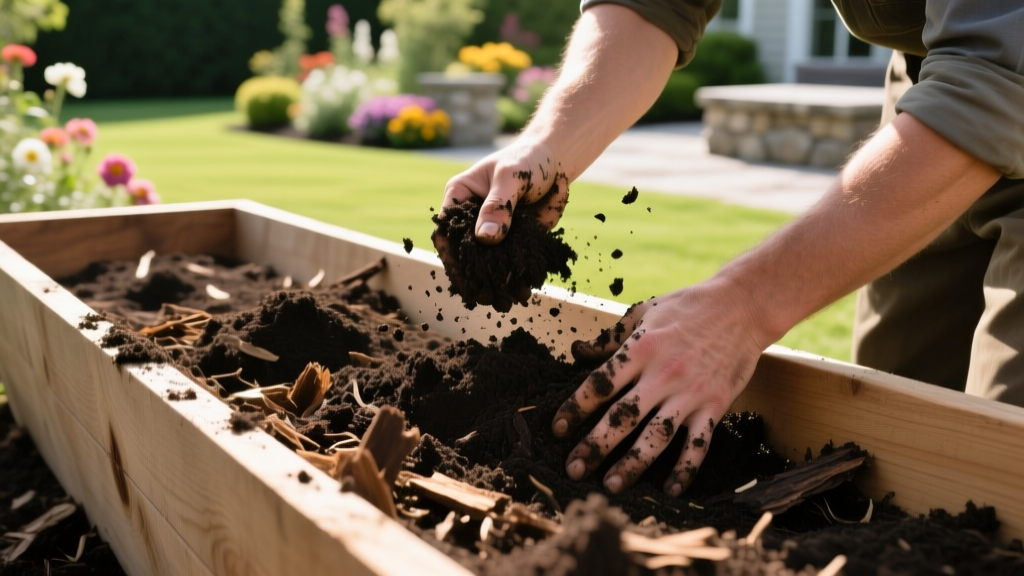
Topsoil Compost Mix Ratios: How to Amend Garden Soil Properly
Building a resilient garden starts below the surface. A properly formulated topsoil compost mix provides the structural integrity, moisture retention, and biological activity necessary for aggressive root growth. However, blindly dumping equal parts of dirt and decaying organic matter into a bed is a recipe for compaction, nutrient lockout, and root rot. The ideal ratio shifts dramatically depending on whether you are filling a raised bed, amending heavy clay, or trying to loosen sandy loam.
This guide details the exact volumetric ratios, sourcing economics, and mechanical blending techniques required to engineer a high-performance topsoil compost mix for your specific garden architecture.
The Mechanics of a Topsoil Compost Mix
Topsoil and compost serve entirely different agronomic functions. Topsoil provides the mineral matrix—sand, silt, and clay—that anchors roots and dictates baseline drainage. Compost provides humus, which increases the Cation Exchange Capacity (CEC), allowing the soil to hold onto positively charged nutrient ions like calcium, magnesium, and potassium.
The Golden Rule of Soil Structure: Topsoil dictates the physics of your garden (drainage, aeration, root penetration). Compost dictates the chemistry and biology (nutrient availability, microbial food webs). You must balance both to avoid structural collapse or nutrient burn.
When organic matter exceeds 30% by volume in a mineral soil matrix, the soil loses its structural skeleton. The compost breaks down over the season, causing the soil level to drop and the remaining particles to compact into a dense, anaerobic layer. Conversely, a mix with less than 5% organic matter will fail to retain moisture during summer heat spikes.
Exact Ratios for Different Garden Scenarios
Use the matrix below to determine the precise volumetric blend for your specific planting environment. These ratios assume the use of screened topsoil (free of debris larger than 3/8 inch) and fully finished, cured compost.
| Scenario | Screened Topsoil | Finished Compost | Aeration / Other | Target Use Case |
|---|---|---|---|---|
| Raised Beds | 60% | 30% | 10% (Pumice/Perlite) | Vegetables, deep-rooted perennials |
| In-Ground Clay | Native Soil | 20% (Top-dressed) | 0% | Lawns, shrub borders, in-ground beds |
| In-Ground Sandy | Native Soil | 30% (Incorporated) | 0% | Drought-prone zones, coastal gardens |
| Containers | 40% | 30% | 30% (Coir/Pumice) | Patio pots, window boxes |
Scenario 1: Raised Bed Vegetable Gardens
Raised beds exist outside the native soil profile, meaning you are entirely responsible for their drainage and nutrient profile. The 60/30/10 ratio is the industry standard for high-yield vegetable production. The 10% aeration component is critical; without it, the weight of the compost and topsoil will compress the lower 6 inches of the bed, creating a perched water table that rots taproots like carrots and parsnips.
Pro Tip: Swap standard perlite for expanded shale or horticultural pumice. Perlite is lightweight and floats to the surface over time, ruining the visual aesthetic and failing to provide deep-structural aeration. Pumice (sized 1/8 to 1/4 inch) locks into the soil matrix permanently.
Scenario 2: The In-Ground Clay Trap (Avoiding the Bathtub Effect)
When amending heavy clay soil, the most common and fatal mistake is digging a planting hole and filling it with a loose, 50/50 topsoil compost mix. This creates the bathtub effect. Water easily drains into the loose amended hole but cannot percolate through the dense, unamended clay walls surrounding it. The hole fills with water, and the plant drowns.
According to Penn State Extension, the correct method for clay amendment is broad-scale top-dressing. Apply a 2-inch layer of pure compost over the entire planting area and let earthworms and freeze-thaw cycles incorporate it naturally over 12 to 18 months. If you must till, incorporate compost into the top 6 inches of the entire bed, not just individual planting holes, to maintain uniform drainage.
Sourcing Economics: Bulk vs. Bagged in 2026
The cost disparity between bulk delivery and bagged retail products dictates your sourcing strategy. Here is the financial breakdown for filling a standard 4x8x1-foot raised bed (requiring approximately 32 cubic feet, or 1.2 cubic yards).
The Bulk Route
- Material Cost: Screened topsoil averages $25–$35 per cubic yard; premium leaf-mold compost averages $40–$55 per cubic yard.
- Delivery Fee: Most local landscape supply yards charge a flat $50–$90 delivery fee for a single-axle dump truck.
- Total Estimated Cost: ~$140–$180 delivered.
- The Catch: You must have a driveway or tarp to receive the dump, and you must manually wheelbarrow the material to the beds. Bulk yards also rarely guarantee weed-free compost; you may inherit local weed seeds.
The Bagged Route
- Material Cost: A 1.5 cubic foot bag of Kellogg Garden Organics Raised Bed mix retails for $8–$12. Premium brands like Coast of Maine castings blends run $16–$22 per cubic foot.
- Total Estimated Cost: ~$170–$250 (assuming 21 standard bags).
- The Catch: Higher upfront cost, but bagged mixes from reputable brands are pasteurized, weed-free, and often pre-blended with slow-release organic fertilizers (like kelp meal or bone char).
Warning: The 'Free' Compost Trap
Municipal compost facilities often offer free or cheap compost. While excellent for broad-scale lawn top-dressing, municipal compost frequently contains high levels of sodium, heavy metals, or persistent herbicides (like aminopyralid) that survive the digestive tracts of livestock and the composting process. Always request a bioassay test or stick to OMRI-listed bagged compost for edible raised beds.
Municipal compost facilities often offer free or cheap compost. While excellent for broad-scale lawn top-dressing, municipal compost frequently contains high levels of sodium, heavy metals, or persistent herbicides (like aminopyralid) that survive the digestive tracts of livestock and the composting process. Always request a bioassay test or stick to OMRI-listed bagged compost for edible raised beds.
Common Blending Mistakes and Troubleshooting
Even with the correct ratios, physical and chemical anomalies can derail your topsoil compost mix. Use this troubleshooting framework to diagnose issues before planting.
- Hydrophobic Dry-Out: If your compost contains high levels of peat moss or dried wood fines, it can become hydrophobic, repelling water entirely. The Fix: Pre-moisten the dry ingredients in a wheelbarrow 24 hours before blending, or add a non-ionic surfactant (like a few drops of pure castile soap per gallon of water) to break the surface tension.
- Nitrogen Immobilization: If you use unfinished compost (identifiable by a sour smell or visible wood chunks), the bacteria breaking down the high-carbon material will steal nitrogen from the soil, starving your plants. The Fix: Add 2 cups of blood meal or alfalfa meal per cubic yard of mix to provide a rapid nitrogen bridge for the microbes.
- Alkaline Lockout: Many commercial composts are heavily limed to reduce odor during processing, pushing the pH above 7.5. This locks out iron and manganese, causing chlorosis (yellowing leaves) in acid-loving plants. The Fix: Test the mix with a calibrated meter (such as the Apera Instruments PH20). If pH exceeds 7.2, incorporate elemental sulfur at a rate of 1 lb per 100 square feet to gradually lower the alkalinity.
Validating Your Mix: The Squeeze Test
Before committing your topsoil compost mix to a raised bed, perform a mechanical squeeze test to validate the moisture-holding capacity and structural integrity. Grab a handful of the blended soil and squeeze it tightly in your fist.
- Ideal Mix: Forms a loose ball that holds its shape but crumbles easily when poked with one finger. A few drops of water may appear between your knuckles.
- Too Much Clay/Topsoil: Forms a hard, dense ball that feels slick and does not crumble. Add more compost and pumice.
- Too Much Compost/Sand: Fails to form a ball and falls apart immediately upon opening your hand. Add more mineral topsoil or a coir binder.
For further reading on long-term soil biology, the USDA Natural Resources Conservation Service provides extensive data on how organic matter integration impacts local watershed retention and microbial biomass over multi-year cycles.
Frequently Asked Questions
Can I use potting soil instead of topsoil in my mix?
No. Potting soil is engineered to be extremely lightweight and is usually composed of peat, coir, and bark, lacking the mineral weight required to anchor tall plants like tomatoes or corn in an outdoor raised bed. Stick to mineral-heavy screened topsoil for structural support.
How often should I add compost to an existing topsoil mix?
Organic matter oxidizes and breaks down at a rate of roughly 1 inch per year in active vegetable gardens. Top-dress your beds with 1 to 2 inches of pure compost every early spring, allowing the first few rains to wash it into the root zone without aggressive tilling, which destroys fungal hyphae networks.

