
Gardening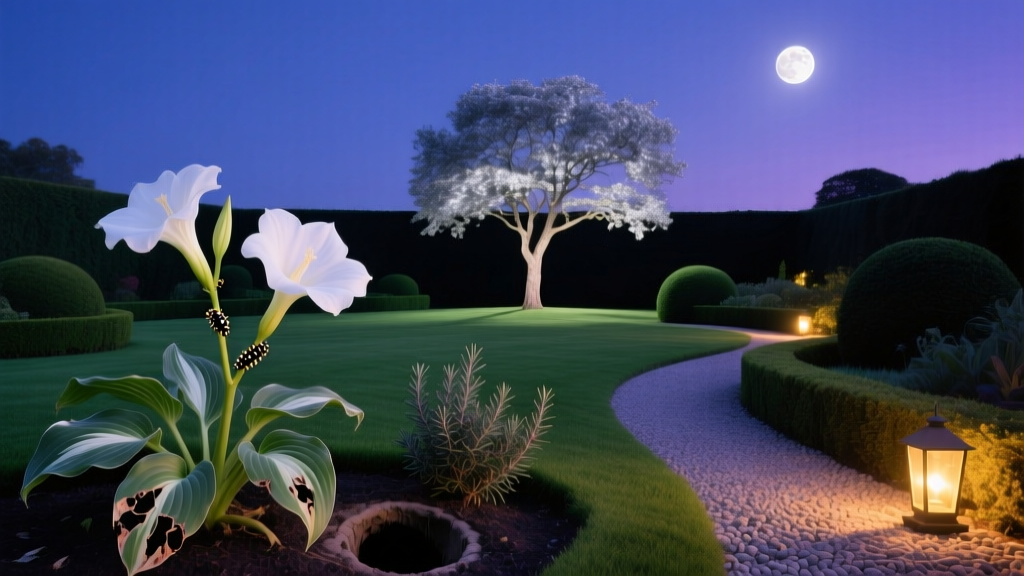
Troubleshooting Moon Gardens: Fix Night Blooms and Pest Damage
Moon gardens—landscapes engineered for twilight and nighttime enjoyment—rely on a precise combination of high-albedo white flowers, silver-variegated foliage, and night-emitting volatile organic compounds (VOCs). However, many homeowners treat these spaces exactly like daytime borders, resulting in muddy-looking blooms, closed flowers, and severe pest defoliation. Diagnosing these failures requires understanding the unique photoperiodic and environmental mechanics of evening horticulture.
Symptom 1: White Blooms Look Muddy, Gray, or Dull at Dusk
The Diagnosis: Pigment Reflection Failure and Ambient Light Deficit
At twilight, the light spectrum shifts heavily toward blue and ultraviolet wavelengths due to Rayleigh scattering. Flowers that appear pure white at noon often possess underlying cream, ivory, or pale yellow pigments that absorb blue light, causing them to look gray or muddy in the evening. Furthermore, a lack of reflective hardscaping prevents the minimal available moonlight from bouncing back to the human eye.
The Solution: Cultivar Selection and Hardscape Integration
- Audit your cultivars: Remove 'cream' variants. Replace them with genetically pure white cultivars that lack underlying carotenoid pigments. For example, swap standard daylilies for Hydrangea arborescens 'Annabelle' or the pure-white Oriental lily Lilium 'Casa Blanca'.
- Introduce reflective groundcover: Incorporate white limestone gravel, crushed oyster shell, or light-colored decomposed granite in pathways adjacent to the planting beds. These materials act as passive reflectors, amplifying ambient moonlight by up to 30% compared to dark mulch.
- Deploy silver foliage: Interplant with Senecio cineraria (Dusty Miller) or Artemisia schmidtiana 'Silver Mound'. The dense trichomes (leaf hairs) on these plants scatter low-light photons exceptionally well, creating a glowing backdrop for the white blooms.
Pro Tip: Avoid using dark hardwood mulches like black dyed cedar in moon gardens. If you must use organic mulch for soil moisture retention, top-dress it with a 1-inch layer of reflective pea gravel to maintain the necessary light albedo.
Symptom 2: Night-Blooming Flowers Remain Tightly Closed
The Diagnosis: Photoperiodic Disruption or Thermoperiodic Misalignment
This is the most common failure in modern moon gardens, directly caused by residential light pollution and a misunderstanding of botanical triggers. Night-blooming plants generally fall into two categories: photoperiodic (triggered by darkness) and thermoperiodic (triggered by temperature drops). Exposing a photoperiodic plant to evening security lights will permanently suppress its blooming cycle.
The Solution: Dark-Sky Shielding and Trigger Matching
To fix closed blooms, you must first identify the trigger mechanism of your specific plants and adjust the environment accordingly.
| Plant Species | Blooming Trigger | Required Environmental Fix |
|---|---|---|
| Ipomoea alba (Moonflower) | Photoperiodic (Darkness) | Eliminate all artificial light exceeding 0.5 lux within 20 feet. |
| Oenothera biennis (Evening Primrose) | Thermoperiodic (Temp Drop) | Ensure planting site is not near heat-retaining masonry or HVAC exhaust. |
| Datura inoxia (Angel's Trumpet) | Circadian (Internal Clock) | Maintain consistent watering; drought stress will override internal blooming clocks. |
For photoperiodic plants, audit your landscape lighting. According to guidelines from DarkSky International, fixtures near moon gardens must be fully shielded (no light emitted above the horizontal plane) and utilize amber LEDs (1800K to 2000K color temperature) rated under 100 lumens. Standard 3000K or 4000K white LEDs emit high levels of blue light, which actively suppresses the phytochrome receptors responsible for triggering petal unfurling in moonflowers.
Symptom 3: Severe Slug and Snail Defoliation
The Diagnosis: The Damp-Dark Buffet Effect
Moon gardens inherently favor the exact microclimate that gastropods require: deep shade, high humidity, and undisturbed groundcover. Because homeowners often water their evening gardens in the late afternoon to prepare them for nighttime viewing, they inadvertently create a frictionless, damp highway for slugs precisely when they emerge to feed.
The Solution: Targeted Iron Phosphate and Moisture Timing
Abandon copper tape and beer traps; they are statistically ineffective in large outdoor beds. Instead, implement a two-pronged approach:
- Shift Irrigation Schedules: Water moon garden beds exclusively between 6:00 AM and 8:00 AM. This allows the top 1 inch of soil and foliage to dry completely before dusk, removing the moisture film slugs need for locomotion.
- Apply Iron Phosphate Baits: Use an organic-certified iron phosphate bait (such as Sluggo). Unlike older metaldehyde baits, which are highly toxic to pets and wildlife, iron phosphate breaks down into soil nutrients. Apply at a rate of 1 teaspoon per square yard, scattering it in a 3-inch perimeter around the base of high-value specimens like Hosta plantaginea (August Lily) and Nicotiana sylvestris. The University of Minnesota Extension confirms that iron phosphate stops slug feeding within 3 to 6 days without harming earthworms.
Symptom 4: Fragrance is Weak or Missing Entirely
The Diagnosis: Wind Shear and VOC Dissipation
Night-blooming plants release heavy, sweet volatile organic compounds (like linalool and benzyl acetate) to attract nocturnal moth pollinators. If you cannot smell your Brugmansia or Phlox paniculata 'David', the issue is rarely the plant itself; it is usually wind shear dispersing the VOCs before they reach your seating area, or planting the specimens too far from the olfactory zone.
The Solution: Siting Framework and Windbreaks
Fragrance in a moon garden operates on a strict distance-to-density ratio. Heavy night fragrances typically dissipate within a 6-to-8-foot radius in still air.
"To maximize olfactory impact, plant high-VOC emitters in dense drifts of three to five plants, positioned no more than 4 feet upwind from your primary evening seating area. Utilize dense evergreen screens to block prevailing crosswinds that strip the scent layer away."
Use the Missouri Botanical Garden Plant Finder to verify the specific bloom time and fragrance intensity of cultivars before purchasing, ensuring you select varieties bred for scent rather than just visual petal size.
Advanced Diagnostics: Soil Moisture and Root Rot in Night Shade
Many classic moon garden plants, such as Epiphyllum oxypetalum (Night-Blooming Cereus) and various woodland white-flowering ferns, are highly susceptible to phytophthora root rot. Because these plants are often tucked into shaded, protected corners of the yard, soil evaporation rates drop significantly after sunset.
Warning: If your night-blooming cereus develops black, mushy basal stems, you are overwatering. Perform a percolation test: dig a 12-inch hole and fill it with water. If it does not drain within 2 hours, amend the planting zone with 30% by volume of expanded shale or pumice to increase macro-porosity before replanting.
By shifting your diagnostic focus from daytime aesthetics to the specific photoperiodic, thermoperiodic, and microclimatic realities of the evening, you can transform a struggling, muddy-looking yard into a vibrant, fragrant nocturnal landscape.

