
Gardening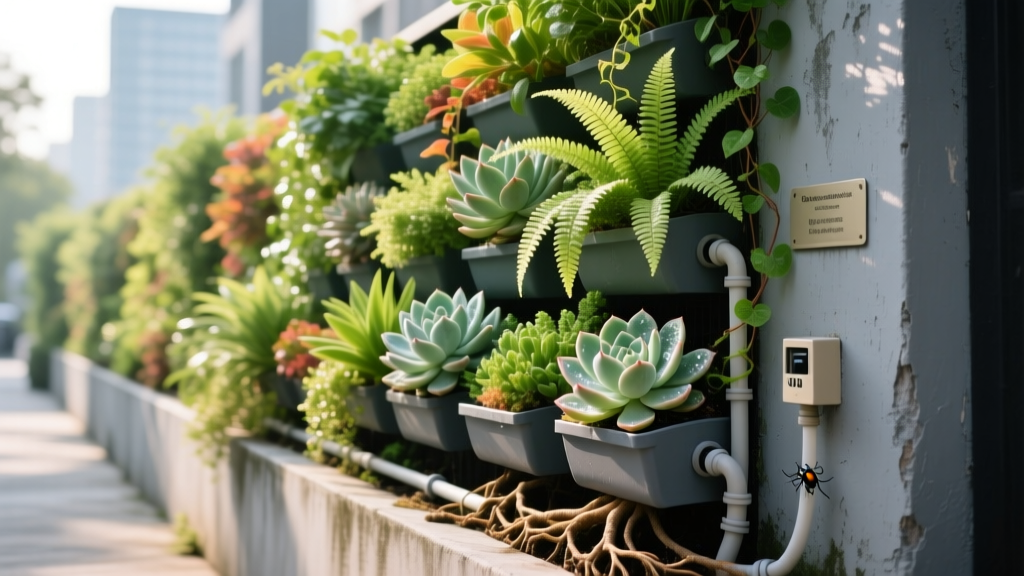
Expert Vertical Garden Ideas for Long Grey Boundary Walls & Fixes
The Grey Wall Microclimate: Diagnosing Thermal & Structural Barriers
When evaluating vertical garden ideas for long grey boundary walls, homeowners and landscapers frequently overlook the hostile microclimate these structures create. Unpainted concrete, cinderblock, and grey rendered brick possess high thermal mass. During peak summer, a west-facing grey wall can reach surface temperatures exceeding 65°C (149°F). This radiant heat bakes the root zones of adjacent plants, causing rapid moisture loss and cellular tissue damage.
Furthermore, long boundary walls often act as wind tunnels, accelerating evaporation, while their sheer length complicates uniform irrigation. According to research published by the University of Florida IFAS Extension, vertical greening systems must account for substrate drying rates that can be up to three times faster than ground-level beds due to wind shear and reflected radiation. Diagnosing these specific failure points is the mandatory first step before selecting a mounting system or plant palette.
Moisture Trapping and Efflorescence: The Silent Wall Killers
The most common structural failure in boundary wall gardens is not the collapse of the plants, but the degradation of the wall itself. Grey concrete and mortar joints are highly porous. When a vertical garden system is mounted flush against the wall, capillary action draws irrigation water directly into the masonry.
Diagnosis: White, powdery deposits (efflorescence) appearing on the grey wall, or spalling (flaking) of the render behind the planters.
Cause: Moisture trapped between the planting media and the wall dissolves soluble salts within the concrete. As the water evaporates into the air gap, salts crystallize on the surface, expanding and cracking the render.
Fix: Never mount planters flush. Install a high-density polyethylene (HDPE) dimpled drainage mat (such as VersiDrain 25P) directly against the wall, followed by a mandatory 50mm (2-inch) standoff air gap created by stainless steel mounting brackets. This air gap breaks the capillary bridge and allows convective cooling.
Calculating Structural Load Limits
Before drilling into a long boundary wall, calculate the saturated dead load. Standard lightweight vertical garden potting mixes weigh approximately 1,100 kg/m³ when fully saturated. A modular system projecting 200mm from the wall, covering a 5-meter long by 2-meter high section (10m²), will add roughly 2,200 kg (4,850 lbs) of sheer downward force. Ensure your wall's footing and the chosen masonry anchors (use M10 stainless steel wedge anchors for solid concrete, or chemical resin anchors for hollow cinderblock) are rated for this specific shear load.
System Selection Matrix: Matching Hardware to the Grey Wall
Not all vertical systems survive the reflected glare of a grey boundary wall. Felt pockets, while cheap, degrade rapidly under high UV and heat reflection. Below is a diagnostic matrix to select the correct infrastructure for your specific wall conditions in 2026.
| System Type | Best Model/Brand | Cost per m² (2026) | Thermal Insulation | Best Wall Aspect |
|---|---|---|---|---|
| Modular HDPE Plastic | Atlantis Gro-Wall Pro-45 | $160 - $220 | High (Built-in air gaps) | West/Sun-baked Grey Walls |
| Recycled Felt Pockets | Woolly Pocket Wally S | $90 - $130 | Low (Roots overheat easily) | South/East Shaded Grey Walls |
| Stainless Cable Trellis | Jakob Rope Systems Webnet | $250 - $400 | N/A (Climbers use wall) | North/Deep Shade Grey Walls |
| Tray-Based Metal | ELT Living Walls | $300 - $450 | Medium (Metal conducts heat) | Commercial/Interior Grey Walls |
For long, sun-exposed grey boundary walls, the Atlantis Gro-Wall Pro-45 remains the industry standard. Its rigid HDPE construction resists UV degradation, and the individual 45-degree angled cells prevent water from the top tier immediately flooding the bottom tier, a common flaw in vertical tray systems.
Plant Palettes Engineered for Reflected Heat and Glare
The Royal Horticultural Society (RHS) emphasizes that plant selection for vertical structures must prioritize drought tolerance and shallow root adaptability. When dealing with the reflected glare of a grey wall, you need species with sclerophyllous (hard, leathery) leaves or silver foliage that reflects solar radiation.
The High-Heat West-Facing Palette
- Westringia fruticosa (Coastal Rosemary): Extremely tolerant of radiant heat. Use the 'Wynyabbie Gem' cultivar for dense, cascading coverage that hides the grey wall entirely.
- Rhaphiolepis indica (Indian Hawthorn): Provides structural evergreen density and pink spring blooms. Its waxy leaf cuticle prevents moisture loss against hot concrete.
- Dianella caerulea (Blue Flax Lily): Excellent for the lower, slightly shaded tiers. The strappy leaves create a striking textural contrast against rigid grey masonry.
The Shade-Tolerant South/East Palette
- Asplenium nidus (Bird's Nest Fern): Thrives in the humid micro-pockets created by dense planting on shaded walls.
- Epipremnum aureum (Pothos): Aggressive trailing habit. Use variegated cultivars like 'Marble Queen' to brighten dark, unlit grey boundary walls.
Irrigation Diagnosis: Preventing Dry-Out and Root Rot
Gravity is the enemy of vertical irrigation. Water naturally flows downward, meaning the top tiers of a long boundary wall garden dry out in hours, while the bottom tiers become waterlogged, leading to anaerobic root rot.
The Fix: Abandon standard drip lines. Install pressure-compensating (PC) drippers with built-in check valves, such as the Netafim PCJ 2 L/hr dripper. The check valve prevents the system from draining out through the lowest emitters when the pump turns off, ensuring uniform pressure across a 10-meter long wall. Run 16mm poly tubing horizontally across each tier, with one 2L/hr dripper per planting cell. Automate the system using a smart controller (like the Rachio 3) paired with a soil moisture sensor placed in the top tier—the first zone to dry out.
Substrate Engineering for Vertical Retention
Do not use standard garden soil or heavy potting mixes; they will compact, suffocate roots, and overload the wall anchors. Mix a custom substrate: 50% premium coir-based potting mix, 30% coarse horticultural perlite (for aeration), and 20% composted pine bark fines. Incorporate a controlled-release fertilizer like Osmocote Pro (18-4.8-8.3) at a rate of 5 grams per liter of media to provide steady nutrition without the salt buildup associated with liquid fertigation.
Symptom-Cause-Fix: Vertical Garden Troubleshooting Guide
Symptom: Brown, crispy leaf margins specifically on the bottom tier plants.
Cause: Salt toxicity. Liquid fertilizers accumulate in the lowest tiers due to gravitational leaching.
Fix: Switch to slow-release granular prills in the media. Implement a monthly 'flush cycle' where the irrigation runs for 15 minutes with pure water to wash accumulated salts out of the bottom drainage ports.
Cause: Salt toxicity. Liquid fertilizers accumulate in the lowest tiers due to gravitational leaching.
Fix: Switch to slow-release granular prills in the media. Implement a monthly 'flush cycle' where the irrigation runs for 15 minutes with pure water to wash accumulated salts out of the bottom drainage ports.
Symptom: Plants in the center of the long wall are wilting, while edges are fine.
Cause: Pressure drop in the irrigation line. Standard drip lines lose pressure over long horizontal runs (>8 meters).
Fix: Loop the irrigation tubing (connect both ends to the mainline) to equalize pressure, or upgrade to a higher flow pump (minimum 40 PSI at the manifold) and use Netafim PC drippers.
Cause: Pressure drop in the irrigation line. Standard drip lines lose pressure over long horizontal runs (>8 meters).
Fix: Loop the irrigation tubing (connect both ends to the mainline) to equalize pressure, or upgrade to a higher flow pump (minimum 40 PSI at the manifold) and use Netafim PC drippers.
Symptom: White powdery residue on the grey wall behind the garden.
Cause: Efflorescence from capillary moisture transfer.
Fix: Remove the lowest row of planters, install an HDPE dimpled drainage mat against the masonry, and ensure a physical 50mm air gap is maintained via standoff brackets.
Cause: Efflorescence from capillary moisture transfer.
Fix: Remove the lowest row of planters, install an HDPE dimpled drainage mat against the masonry, and ensure a physical 50mm air gap is maintained via standoff brackets.
Successfully greening a long grey boundary wall requires treating the structure not just as a blank canvas, but as an active thermal and hydrological component of the garden. By engineering the air gap, selecting rigid modular hardware, and utilizing pressure-compensating irrigation, you transform a hostile concrete barrier into a resilient, thriving vertical ecosystem.

