
Gardening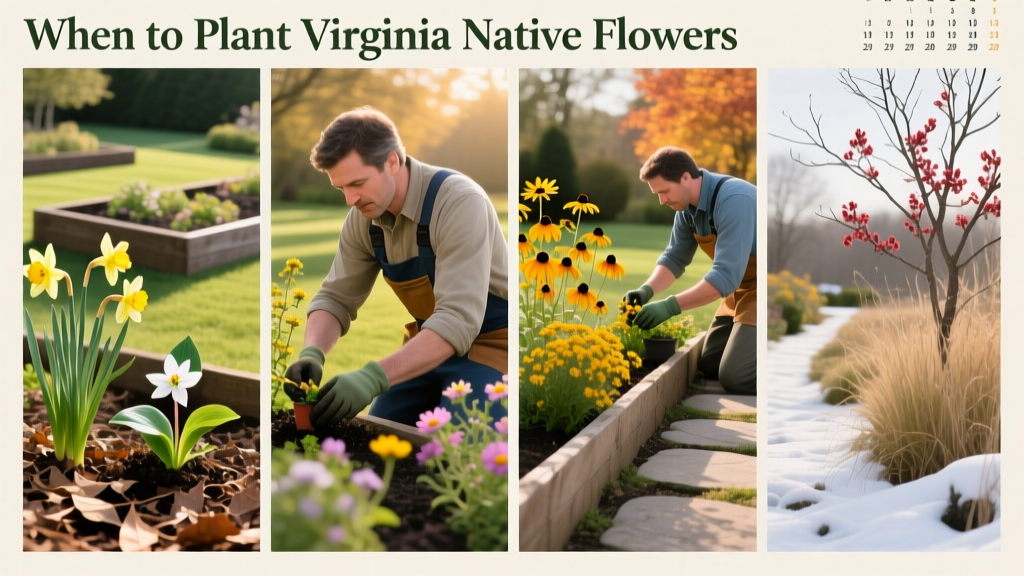
When to Plant Virginia Native Flowers: A Seasonal Calendar
Understanding Virginia's Diverse Microclimates
Virginia is not a monolithic growing environment. The state spans three distinct physiographic regions—Mountain, Piedmont, and Coastal Plain (Tidewater)—which correspond to USDA Hardiness Zones 5b through 8a. Successful cultivation of Virginia native flowers requires aligning your planting schedule with your specific region's frost-free window and soil thermal profile.
Regional Frost & Growing Day Baselines
- Mountain Region (Zones 5b-6b): Last spring frost: May 10–20. First fall frost: Oct 1–15. Approx. 150 frost-free days.
- Piedmont Region (Zones 6b-7b): Last spring frost: April 15–25. First fall frost: Oct 20–Nov 5. Approx. 190 frost-free days.
- Coastal/Tidewater (Zones 7b-8a): Last spring frost: March 25–April 10. First fall frost: Nov 10–25. Approx. 220 frost-free days.
According to the Virginia Native Plant Society, selecting ecotypes adapted to your specific region is just as critical as timing. A Purple Coneflower (Echinacea purpurea) grown from Tidewater seed stock may struggle with the winter freeze cycles of the Shenandoah Valley, even if planted at the exact right time.
The Spring Window: Transplants and Plugs
Spring planting in Virginia is a race against the summer heat. The goal is to establish a robust root system before July's high temperatures induce drought stress. For native perennials, soil temperature is a more reliable planting trigger than the calendar date. Wait until the soil temperature at a 4-inch depth consistently reaches 50°F (10°C).
Spring Planting Schedule by Species
| Native Species | Planting Format | Min. Soil Temp | Ideal VA Window | Avg. Plug Cost |
|---|---|---|---|---|
| Eastern Red Columbine (Aquilegia canadensis) | Plugs / 1-Gallon | 45°F | March 15 - April 20 | $4.50 - $6.00 |
| Virginia Bluebells (Mertensia virginica) | Bare Root / Rhizome | 40°F | Feb 20 - March 15 | $3.00 - $5.00 |
| Butterfly Weed (Asclepias tuberosa) | Deep Plugs (3.5"+) | 55°F | April 20 - May 15 | $5.50 - $8.00 |
| Wild Geranium (Geranium maculatum) | Plugs / Divisions | 48°F | March 25 - April 30 | $4.00 - $5.50 |
Pro Tip: Avoid planting taprooted natives like Butterfly Weed or Baptisia in late spring. If the taproot hits the bottom of a standard shallow plug tray and begins to spiral, the plant will stunt. Always purchase taprooted species in deep 'cone' cells (minimum 3.5 inches deep) or 1-gallon pots ($14–$22) to prevent root girdling.
Summer Establishment: Heat Mitigation Protocols
Planting Virginia native flowers between June 15 and August 31 is generally discouraged due to the dual stress of transplant shock and high evapotranspiration rates. However, if summer planting is unavoidable—such as filling gaps in a newly installed landscape—you must implement aggressive mitigation strategies.
- Shade Cloth Deployment: Erect a temporary frame using 40% to 50% shade cloth over the planting bed for the first 14 days. This reduces leaf scorch and lowers soil surface temperatures by up to 10°F.
- Hydrogel Root Dipping: Before transplanting, dip the root ball in a potassium-based cross-linked polyacrylamide hydrogel solution (e.g., Terra-Sorb). This coats the roots in a water-retaining matrix that slowly releases moisture during the critical first 72 hours.
- Deep-Cycle Irrigation: Abandon daily light sprinklings. Water deeply twice a week (delivering 1 inch of water per session) to force roots to chase moisture downward, away from the baking topsoil.
Fall Planting: The Optimal Window for Deep Roots
For the vast majority of Virginia native perennials, autumn is the superior planting season. The Virginia Tech Cooperative Extension consistently highlights fall as the ideal time for establishing woody and herbaceous perennials. As air temperatures drop, top-growth slows, but soil temperatures remain warm enough to fuel aggressive root expansion.
The 6-Week Root Establishment Rule
To ensure winter survival, native flowers must be planted at least six weeks before the ground freezes solid. In the Piedmont and Coastal regions, this means planting between September 15 and November 10. In the Mountain region, compress this window to September 1 and October 15. Planting too late results in 'frost heave,' where the freeze-thaw cycle pushes shallow-rooted plugs entirely out of the soil.
Fall Soil Preparation Specifics
Virginia's native red clay (common in the Piedmont) is notoriously dense. Do not amend the planting hole exclusively with peat moss or compost, as this creates a 'bathtub effect' where water pools in the loose hole and drowns the native roots. Instead, practice 'wide-hole, native-soil' planting:
- Dig a hole 2 to 3 times wider than the root ball, but no deeper.
- Backfill with the exact native soil you removed.
- Apply a 2-inch layer of shredded hardwood mulch over the surface, keeping it 2 inches away from the plant's crown to prevent rot.
Winter Stratification: Sowing Seeds for Spring
Many Virginia native flowers possess built-in dormancy mechanisms that prevent their seeds from germinating prematurely during a warm winter spell. To break this dormancy, seeds require cold moist stratification. If you are growing from seed, winter is your active working season.
Stratification Requirements for Popular VA Natives
| Species | Stratification Days | Method | Optimal Sowing Date |
|---|---|---|---|
| Swamp Milkweed (Asclepias incarnata) | 30 Days | Fridge / Outdoor | Late November |
| New England Aster (Symphyotrichum novae-angliae) | 60 Days | Fridge / Outdoor | Mid-December |
| Wild Indigo (Baptisia tinctoria) | 15 Days + Scarification | Hot Water Soak + Fridge | Early January |
The Milk Jug Winter Sowing Method
Instead of cluttering your refrigerator, utilize the natural Virginia winter. The 'milk jug method' acts as a miniature greenhouse that naturally stratifies seeds while protecting them from birds and heavy washout.
- Clean a translucent 1-gallon plastic milk or water jug. Cut it almost in half horizontally, leaving a 1-inch hinge at the back.
- Poke four drainage holes in the bottom and four ventilation holes near the top.
- Fill the bottom with 3 inches of a sterile, peat-based seed starting mix. Moisten thoroughly.
- Sow seeds on the surface (most native seeds require light to germinate; do not bury them deeply). Press gently into the soil.
- Tape the jug closed with duct tape, remove the cap, and place it outside in a spot that receives winter rain but is shielded from harsh, desiccating northwest winds.
- Monitor in late March. Once seedlings develop their first set of true leaves, cut the tape and open the jug to harden them off before transplanting into deep cell trays.
By aligning your planting and sowing schedules with Virginia's specific regional rhythms, you bypass the high mortality rates associated with improper timing. Native flowers are highly resilient once established, but their initial survival hinges entirely on respecting the seasonal calendar and local soil thermodynamics. For comprehensive regional ecotype sourcing, always consult the Lady Bird Johnson Wildflower Center's Virginia collection database to ensure your genetics are locally adapted.

