
Gardening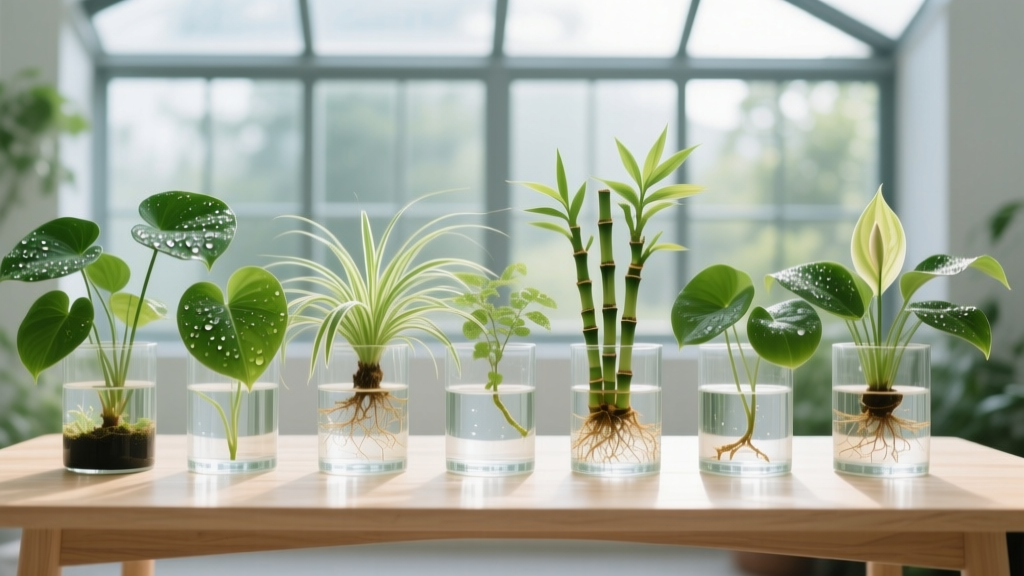
Beginner Guide: 10 Plants That Thrive in Water Without Soil
Growing houseplants without soil is no longer just a trendy propagation phase; it is a viable, long-term cultivation method known as hydroculture or passive hydroponics. For beginners, understanding which plants that thrive in water can survive indefinitely in a liquid medium requires moving beyond simple mason jars and tap water. When you bypass soil, you eliminate fungus gnats, soil-borne pathogens, and unpredictable watering schedules, but you must manually manage oxygenation and nutrient delivery.
This guide breaks down the exact botany, vessel mechanics, and nutrient protocols required to maintain a thriving, soil-free indoor garden.
The Botany of Water Roots: Why Some Plants Adapt
Not all plants can survive long-term submersion. Plants that thrive in water possess the genetic ability to develop aerenchyma tissue—a spongy, air-filled network inside their roots that transports oxygen from the leaves down to the submerged root tips. Soil-grown roots are thick and covered in root hairs designed to extract moisture from dirt particles. Water roots, by contrast, are pale, smooth, and highly branched to maximize surface area for nutrient absorption directly from the liquid.
Pro Tip: If you take a soil-grown plant and wash its roots to move it into water, it will likely suffer transplant shock. The soil roots will rot because they lack aerenchyma tissue. Always start with fresh stem cuttings to force the plant to generate true water roots from the nodes.
Top 10 Plants That Thrive in Water (Selection Matrix)
Based on oxygen tolerance and nutrient uptake efficiency, these ten species are the most resilient for beginners. According to research on houseplant propagation from the University of Minnesota Extension, semi-woody and vining aroids exhibit the highest success rates in liquid cultures.
| Plant Species | Light Requirement | Water Change Frequency | Long-Term Viability |
|---|---|---|---|
| Pothos (Epipremnum aureum) | Low to Bright Indirect | Every 3-4 weeks | Excellent (Years) |
| Philodendron Heartleaf | Medium Indirect | Every 3-4 weeks | Excellent (Years) |
| Syngonium podophyllum | Medium Indirect | Every 2-3 weeks | Very Good |
| Lucky Bamboo (Dracaena sanderiana) | Low to Medium | Every 2 weeks | Excellent (Years) |
| Spider Plant (Chlorophytum comosum) | Bright Indirect | Every 2 weeks | Good (Needs high O2) |
| Coleus (Plectranthus scutellarioides) | Bright Indirect | Weekly | Moderate (6-12 months) |
| Tradescantia zebrina | Bright Indirect | Weekly | Moderate (Stems rot eventually) |
| English Ivy (Hedera helix) | Medium to Bright | Every 3 weeks | Very Good |
| Peace Lily (Spathiphyllum) | Low to Medium | Every 2 weeks | Good (Requires large vessel) |
| Begonia (Cane types) | Bright Indirect | Every 2 weeks | Good |
Vessel Dynamics: Oxygen Exchange Rates
The most common reason water-cultured plants fail is oxygen depletion. Roots consume dissolved oxygen (DO) to perform cellular respiration. If the water becomes stagnant and DO drops below 4 ppm, root rot (Pythium) rapidly takes over.
The Surface Area Rule
Avoid narrow-neck bottles for long-term growth. While they look aesthetically pleasing and hold stems upright, the narrow opening restricts gas exchange between the air and the water surface.
- Narrow-Neck Vessels (e.g., test tubes, wine bottles): Best for initial propagation (weeks 1-4). Once roots reach 3 inches, transfer them.
- Wide-Mouth Vessels (e.g., fishbowls, wide mason jars): Ideal for long-term growth. The wider the water surface, the higher the passive oxygen diffusion rate.
- LECA / Semi-Hydroponic Pots: Using a net pot filled with Lightweight Expanded Clay Aggregate (LECA) sitting in a water reservoir ($12-$20 for a basic setup) provides the ultimate balance of moisture, structural support, and oxygenation.
Step-by-Step Cutting Protocol
According to propagation guidelines published by the University of Florida IFAS Extension, precise node placement is critical for adventitious root initiation.
- Identify the Node: Locate the brown, slightly raised bump on the stem where the leaf petiole meets the main vine. This contains the meristematic cells required for root generation.
- The 45-Degree Cut: Using sterilized bypass pruning shears (wiped with 70% isopropyl alcohol), make a clean cut exactly 1/4 inch below the node. Angling the cut at 45 degrees increases the surface area for water uptake and prevents the stem from sitting flat against the bottom of the glass, which causes tissue necrosis.
- Defoliation: Remove all leaves that will sit below the water line. Submerged leaves will rot within 48 hours, spiking ammonia levels and triggering bacterial blooms.
- Water Selection: Do not use water straight from the tap if your municipality uses chloramine. Chloramine does not off-gas like chlorine. Use filtered water, distilled water, or tap water treated with a standard aquarium dechlorinator (like Seachem Prime at 1 drop per gallon).
Nutrient Dosing: The Hydroponic Shift
Plain water contains zero nitrogen, phosphorus, or potassium. A cutting will survive on the stored energy in its stem for about 8 weeks. After that, it must be fed. Standard liquid houseplant fertilizers (like Miracle-Gro Indoor Plant Food) are formulated for soil microbes to break down; they will cause foul-smelling bacterial blooms in pure water.
Critical Warning: Never use soil fertilizers in water-only setups. You must use a synthetic, urea-free hydroponic nutrient.
Exact Dosing Framework for Beginners
For long-term water culture, use Dyna-Gro Foliage-Pro (9-3-6) or General Hydroponics MaxiGro (10-5-14). These contain all essential micronutrients (calcium, magnesium, iron) that are naturally present in potting soil but absent in tap water.
- Dosage: Mix at 1/4 strength. For Dyna-Gro, this is exactly 1/2 teaspoon per gallon of water.
- Frequency: Add the nutrient solution every time you top off or change the water.
- Flushing: Every 4th water change, use plain, un-dosed water to flush out accumulated mineral salts that can burn the delicate water roots.
Troubleshooting Common Water-Culture Failures
1. Algae Blooms (Green Water)
Cause: Light hitting the water combined with dissolved nutrients.
Fix: Move the vessel out of direct sunlight, or switch from clear glass to opaque ceramic or dark-tinted glass. Algae competes with roots for dissolved oxygen and nutrients. If algae appears, scrub the vessel with a 10% bleach solution, rinse thoroughly, and prune away any slimy root matter.
2. Mushy, Brown, or Foul-Smelling Roots
Cause: Pythium root rot due to hypoxia (lack of oxygen) or bacterial infection from a submerged leaf.
Fix: Remove the plant. Snip off all brown/mushy roots with sterile scissors until you reach firm, white tissue. Rinse the remaining roots in a 3% hydrogen peroxide solution for 30 seconds to kill surface pathogens. Transfer to a freshly sanitized, wide-mouth vessel with fresh, dechlorinated water.
3. Stunted Growth and Yellowing Leaves
Cause: Nutrient deficiency, specifically nitrogen or magnesium, or pH lockout.
Fix: Tap water is often alkaline (pH 7.5 to 8.0). At high pH, plants cannot absorb iron or manganese, even if nutrients are present. Test your water pH using a $10 digital meter. If it is above 7.0, add 1 drop of pH Down (phosphoric acid) per gallon to bring the water to the optimal hydroponic range of 5.8 to 6.2.
Transitioning Water Plants Back to Soil
If you decide to move a water-thriving plant back into a traditional potting mix, you cannot simply bury the water roots. Water roots lack the structural integrity to push through dense soil and will suffocate.
The Transition Protocol: Plant the water-rooted cutting in a highly aerated, chunky aroid mix (50% orchid bark, 30% perlite, 20% coco coir). Keep the soil consistently moist—not soggy—for the first three weeks. The plant will slowly abort its fragile water roots and push out new, thick, fuzzy soil roots adapted to the drier, aerated environment.

