
Gardening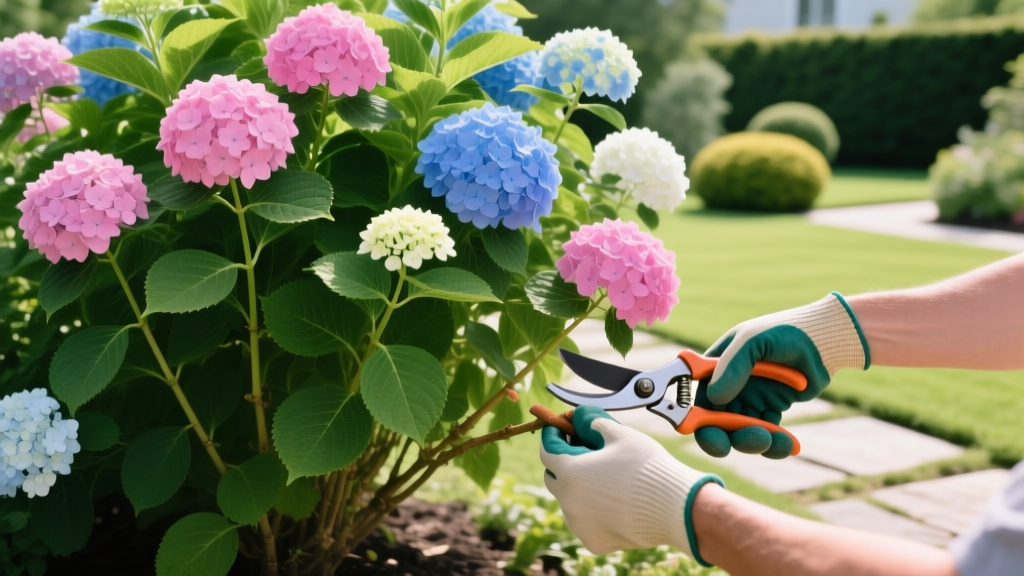
When to Cut Back a Hydrangea: A Regional Seasonal Pruning Guide
The Botanical Rule: Identify Your Bloom Wood
Determining when to cut back a hydrangea requires understanding a fundamental botanical mechanism: whether your specific species blooms on old wood (last year's growth) or new wood (the current season's growth). Pruning at the wrong time does not merely reduce flower count; it can completely eliminate the season's bloom cycle. Before making a single cut, you must accurately identify the species and map it to your regional climate calendar.
| Species | Common Name | Blooms On | USDA Zones |
|---|---|---|---|
| Hydrangea macrophylla | Bigleaf, Mophead, Lacecap | Old Wood | 5-9 |
| Hydrangea quercifolia | Oakleaf | Old Wood | 5-9 |
| Hydrangea paniculata | Panicle (e.g., 'Limelight') | New Wood | 3-8 |
| Hydrangea arborescens | Smooth (e.g., 'Annabelle') | New Wood | 3-9 |
Note: Remontant cultivars like the 'Endless Summer' series bloom on both old and new wood, but they should still be treated primarily as old-wood bloomers in colder zones to maximize early summer flower production.
When to Cut Back a Hydrangea: The Regional Phenology Calendar
Generic advice like 'prune in early spring' fails to account for regional microclimates and late frost risks. The optimal pruning window shifts dramatically depending on your USDA Hardiness Zone. Using phenological indicators—observable natural events like the blooming of specific companion plants—provides a much more accurate calendar than fixed dates.
USDA Zones 4–5 (Upper Midwest, Northeast, High Altitude)
In regions with severe winters and unpredictable late spring freezes, pruning new-wood hydrangeas (H. paniculata and H. arborescens) too early exposes the hollow pith of the stems to winter moisture. This causes freeze-thaw cane splitting, leading to dieback. Wait until the Forsythia bushes drop their yellow petals (typically late April to mid-May). For old-wood bloomers, avoid spring pruning entirely; only remove dead wood once the new leaf buds have visibly swollen and broken dormancy in late May, allowing you to clearly distinguish live wood from dead canes.
USDA Zones 6–7 (Mid-Atlantic, Transition Zones, Lower Midwest)
The transition zones offer a wider pruning window but carry the highest risk of late frost damage to emerging buds on old-wood varieties. Prune new-wood hydrangeas in late March to early April, coinciding with the first leaf-out of lilac bushes. If a hard freeze is forecasted after you have pruned new-wood varieties, the plant will survive, but it may delay its bloom cycle by 2 to 3 weeks.
USDA Zones 8–9 (Deep South, Gulf Coast, Pacific Northwest)
Mild winters allow for aggressive winter pruning. New-wood hydrangeas can be cut back in January or early February while the plant is in deep dormancy. According to the NC State Extension, gardeners in the Deep South should prune panicle hydrangeas before the sap begins to rise in late February to prevent 'bleeding' (excessive sap loss from cut wounds), which can attract fungal pathogens and weaken the shrub's vigor.
Species-Specific Pruning Frameworks
⚠️ WARNING: Old Wood Bloomers (H. macrophylla & H. quercifolia)
Never cut back old-wood hydrangeas to the ground or perform heavy rejuvenation pruning in the spring or summer. The flower buds for the upcoming season were formed in August and September of the previous year. Pruning these species should be strictly limited to deadheading spent blooms (cutting just below the flower head to the first set of healthy leaves) immediately after they fade in mid-to-late summer. Spring pruning should only involve the removal of completely dead, brittle canes at the soil line.
💡 PRO TIP: New Wood Structural Frameworks
A common mistake with Hydrangea arborescens ('Annabelle' types) is cutting them completely to the ground in late winter. While this produces massive flower heads, the new, unbranched stems lack the structural integrity to support them, resulting in the 'floppy hydrangea' syndrome after summer rainstorms. Instead, cut the stems back to 18 to 24 inches above the soil line. This leaves a woody framework that supports the new growth and keeps the heavy blooms upright. For H. paniculata ('Limelight', 'Bobo'), thin out up to 20% of the oldest, thickest canes at the base to improve airflow, and cut the remaining lateral branches back by one-third to encourage robust, multi-branched flowering laterals.
Tool Selection and Pathogen Prevention
The physical act of pruning introduces open wounds that are highly susceptible to Botrytis cinerea (gray mold) and Hydrangea chlorotic mottle virus. Using the correct tools and sanitization protocols is non-negotiable for maintaining plant health.
- Bypass Pruners (Stems under 1/2 inch): Use a high-carbon steel bypass pruner like the Felco F-2 or ARS HS-180Z. Anvil pruners will crush the vascular cambium layer of the hydrangea stem, delaying callus formation and inviting rot.
- Loppers (Canes 1/2 to 1.5 inches): Use 24-inch bypass loppers (e.g., Corona BP 7100D) for removing thick, old basal canes at the soil line on panicle varieties.
- The Cut Angle: Always make cuts at a precise 45-degree angle, exactly 1/4 inch above a healthy, outward-facing leaf node. Cutting too close damages the bud; cutting too far leaves a dead stub that will rot down into the main cane.
- Sanitization Protocol: Wipe blades with a 70% isopropyl alcohol solution or a 10% household bleach mixture between every single shrub to prevent cross-contamination. Never use bleach on the Felco F-2's sap groove, as it accelerates corrosion; stick to alcohol for precision tools.
Diagnostic Troubleshooting: Zero Blooms Post-Pruning
If you followed the regional calendar but your hydrangea still fails to produce flowers, use this diagnostic framework to identify the underlying failure mode:
- Check the Cane Pith: Scratch the bark of a seemingly dead cane with your thumbnail. If the underlying tissue is green and moist, the plant is alive but suffering from delayed dormancy, often caused by a late cold snap. Wait 3 more weeks. If it is brown and dry, the cane suffered winter kill and must be removed at the base.
- Evaluate Soil Nitrogen Levels: Excessive nitrogen from synthetic lawn fertilizers (especially those with an N-P-K ratio where the first number exceeds 20) forces the hydrangea into vegetative growth. The plant will produce massive, dark green leaves but abort flower bud formation. Switch to a granular, slow-release fertilizer with a higher phosphorus content (e.g., 4-3-4 or 5-10-5) applied in early May.
- Assess Sunlight Shifts: Hydrangeas require specific light thresholds to trigger blooming. Bigleaf and Oakleaf varieties need morning sun and afternoon shade. If a nearby tree was removed or grew significantly over the last three years, altering the light profile to full afternoon shade, the plant will stop flowering regardless of pruning accuracy. The University of Minnesota Extension notes that panicle hydrangeas, conversely, require a minimum of 6 hours of direct sunlight to set buds on new wood.
- Inspect for Deer Browse: In areas with high cervid populations, deer often target the tender, nutrient-dense apical meristems (the very tips of the branches) of old-wood hydrangeas in late winter and early spring. Since the flower buds are concentrated at these tips, deer browse mimics the effects of severe, untimely pruning. Install physical netting or apply a thiram-based repellent in November.
Mastering when to cut back a hydrangea is an exercise in regional observation and botanical identification. By aligning your pruning schedule with local phenological markers and respecting the specific bloom-wood mechanics of your cultivar, you ensure a structurally sound shrub capable of producing maximum floral density year after year.

