
Gardening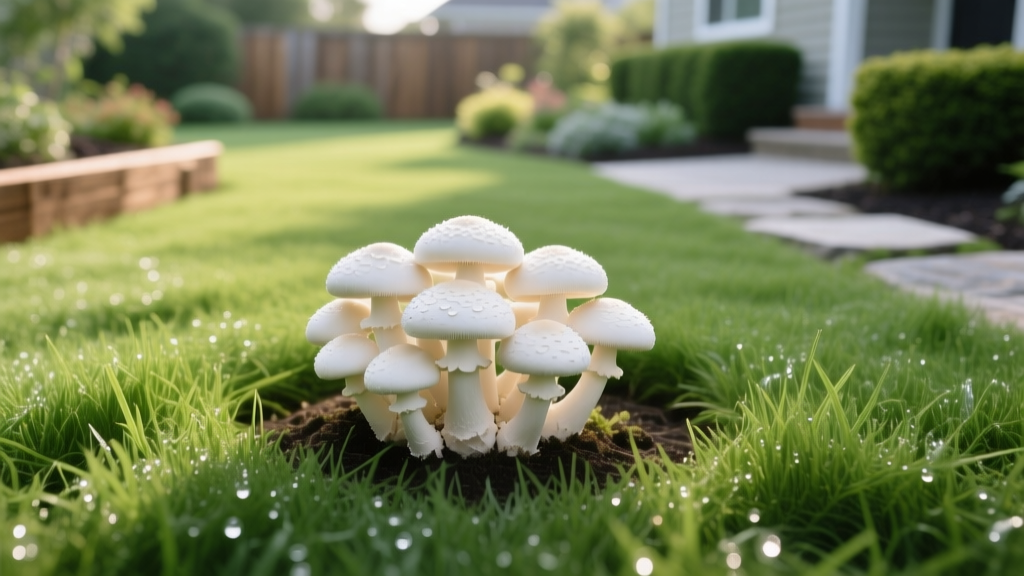
White Mushrooms Growing in Yard: Why They Establish and How to Control Them
The Biology of Fungal Establishment in Turfgrass
Seeing white mushrooms growing in yard spaces is rarely a spontaneous event; it is the visible fruiting phase of a subterranean mycelial network that has already spent months or years establishing itself in your soil profile. In turfgrass environments, fungi establish primarily as saprophytes—organisms that decompose dead organic matter. When you observe these fruiting bodies, it indicates that your soil contains an abundance of buried decaying wood, excessive thatch layers exceeding 0.5 inches, or high concentrations of uncomposted organic amendments.
Unlike plants that rely on photosynthesis, these fungal networks require specific moisture and temperature thresholds to trigger fruiting. Most lawn-dwelling white mushrooms establish their vegetative mycelium in the top 2 to 4 inches of soil. When volumetric water content (VWC) remains above 30% for consecutive days and soil temperatures hover between 60°F and 75°F, the mycelium exhausts its local food source and produces mushrooms to release spores and colonize new areas.
Key Distinction: Spores vs. Mycelium
Pulling the visible white mushrooms does not kill the fungus. The visible cap is merely the reproductive structure. The actual organism—the mycelium—is a web-like network of hyphae spreading through the soil. Eradication requires altering the soil environment to make it inhospitable for mycelial survival, not just removing the surface fruit.
Pulling the visible white mushrooms does not kill the fungus. The visible cap is merely the reproductive structure. The actual organism—the mycelium—is a web-like network of hyphae spreading through the soil. Eradication requires altering the soil environment to make it inhospitable for mycelial survival, not just removing the surface fruit.
Identifying the Culprit: Common White Lawn Mushrooms
Accurate identification is the first step in managing fungal establishment. While hundreds of species can emerge in turf, three specific white mushrooms dominate residential lawns, each with distinct establishment triggers and risk profiles.
| Species | Common Name | Establishment Trigger | Turf Impact & Toxicity |
|---|---|---|---|
| Marasmius oreades | Fairy Ring Mushroom | Decomposing buried roots or old stumps; forms dense hydrophobic mats. | Creates necrotic dead zones in grass; mildly toxic if ingested. |
| Chlorophyllum molybites | False Parasol | High nitrogen soil, buried construction debris, thick thatch. | Minimal turf damage; highly toxic (severe gastrointestinal distress). |
| Agaricus campestris | Meadow Mushroom | Rich, well-manured soil; often found in grazed or heavily composted areas. | Beneficial soil ecology; edible but easily confused with deadly Amanita species. |
For a comprehensive breakdown of regional turfgrass diseases and fungal fruiting bodies, the University of Minnesota Extension provides excellent diagnostic frameworks for homeowners dealing with persistent lawn fungi.
How to Disrupt the Establishment Cycle (Cultural Controls)
Fungicides are rarely a viable long-term solution for white mushrooms in residential lawns. Products containing Azoxystrobin or Flutolanil can suppress mycelial growth, but they are expensive, heavily restricted in many municipalities, and fail to address the underlying organic food source. Instead, you must disrupt the establishment cycle through targeted cultural practices that alter the soil microclimate.
Step 1: Eliminate the Hydrophobic Mat
If you are dealing with Fairy Ring (Marasmius oreades), the mycelium creates a waxy, hydrophobic barrier that repels water, causing the grass inside the ring to die from drought stress while the outer edge thrives on released nitrogen. To break this mat, apply a soil surfactant or wetting agent (such as Aquatrols Revolution or Cascade Plus) at a rate of 3 to 6 ounces per 1,000 square feet. This reduces the surface tension of water, allowing it to penetrate the fungal barrier and rehydrate the soil.
Step 2: Deep Core Aeration and Dethatching
Fungi require consistent moisture in the upper soil profile. Use a mechanical core aerator to pull 3-inch to 4-inch plugs, spacing them no more than 3 inches apart. This physically severs the mycelial networks and increases soil oxygenation, which favors turfgrass roots over anaerobic-tolerant fungi. Follow this with power raking to reduce the thatch layer to a maximum of 0.5 inches, removing the primary food source for saprophytic mushrooms.
Step 3: Alter Irrigation and Nitrogen Protocols
Shallow, daily watering keeps the topsoil perpetually damp, inviting fungal establishment. Transition to deep, infrequent watering—applying 1 inch of water only when the turf shows signs of wilting (footprinting). Furthermore, maintain a nitrogen application rate of 2 to 3 lbs per 1,000 square feet annually. A vigorous, dense turfgrass canopy shades the soil surface, lowering soil temperatures and reducing the moisture retention that triggers mushroom fruiting.
Warning: The Danger of Buried Debris
If white mushrooms are establishing in a highly localized, concentrated cluster (rather than a ring), you likely have buried construction debris, an old tree stump, or decaying landscape timber beneath the soil. The only permanent fix is to excavate the area to a depth of 12 inches, remove all woody organic matter, backfill with clean topsoil, and resod.
If white mushrooms are establishing in a highly localized, concentrated cluster (rather than a ring), you likely have buried construction debris, an old tree stump, or decaying landscape timber beneath the soil. The only permanent fix is to excavate the area to a depth of 12 inches, remove all woody organic matter, backfill with clean topsoil, and resod.
Intentional Establishment: Building a Dedicated Mushroom Bed
If your goal is actually to cultivate edible white mushrooms rather than eradicate them, attempting to establish them directly in a turfgrass lawn is inefficient and hazardous due to the risk of toxic lookalikes. Instead, redirect your cultivation efforts to a dedicated, shaded garden bed using controlled spawning techniques.
Sourcing and Planting Agaricus Bisporus Spawn
The common white button mushroom (Agaricus bisporus) requires a highly specific composting environment that differs vastly from standard lawn soil. To establish a productive bed:
- Construct the Bed: Build a shaded, raised bed or use a shallow wooden tray (minimum 8 inches deep) located in an area that maintains temperatures between 65°F and 75°F.
- Prepare the Substrate: Fill the bed with a mixture of composted horse manure, straw, and gypsum. The substrate must be pasteurized (heated to 140°F for 4 hours) to eliminate competing weed seeds and wild fungal spores.
- Inoculation: Purchase high-quality Agaricus bisporus grain spawn from a reputable mycological supplier. Mix the spawn into the substrate at a rate of 5% by volume.
- Casing Layer: After 14 days of mycelial colonization, apply a 1.5-inch casing layer of peat moss mixed with horticultural lime to buffer the pH to 7.2. This casing layer is critical; without it, Agaricus will not form fruiting bodies.
- Pinning and Harvest: Drop the ambient temperature to 60°F and increase fresh air exchange to trigger pinning. Harvest white mushrooms when the caps are fully rounded but before the veil breaks to expose the gills.
By containing your cultivation in a controlled substrate, you eliminate the ecological overlap with wild, potentially toxic species like Chlorophyllum molybites or Amanita bisporigera (the Destroying Angel), which frequently colonize untreated yard spaces.
Frequently Asked Questions
Are white mushrooms in the yard harmful to my pets?
Yes, they can be highly dangerous. While some species are benign, Chlorophyllum molybites and various Amanita species frequently appear as white mushrooms in yard environments and can cause severe vomiting, diarrhea, and potentially fatal hepatic failure in dogs and cats. If you cannot identify the exact species with 100% certainty, assume toxicity and remove the fruiting bodies immediately, disposing of them in a sealed outdoor trash receptacle.
Will applying lime or altering soil pH kill the mushrooms?
No. A common gardening myth suggests that altering soil pH will eradicate lawn mushrooms. Most turf-dwelling fungi are highly adaptable and will thrive in pH ranges from 5.5 to 7.5. Applying lime to a lawn that already has an optimal pH (6.0 to 7.0) will only induce nutrient lockout (specifically iron and manganese) in your grass, weakening the turf and ultimately giving the fungi less competition. Focus on moisture management and thatch reduction instead. For more on proper soil amendment strategies, consult the Royal Horticultural Society's guidelines on fairy rings and turf management.
Why do the mushrooms keep coming back every autumn?
Autumn provides the exact microclimatic conditions fungi require: cooling soil temperatures (60°F-65°F) combined with increased rainfall and reduced evaporation rates. Because the subterranean mycelium remains alive year-round, it will fruit predictably every autumn until the buried organic food source (wood, roots, thatch) is entirely consumed or physically removed from the soil profile.

