
Gardening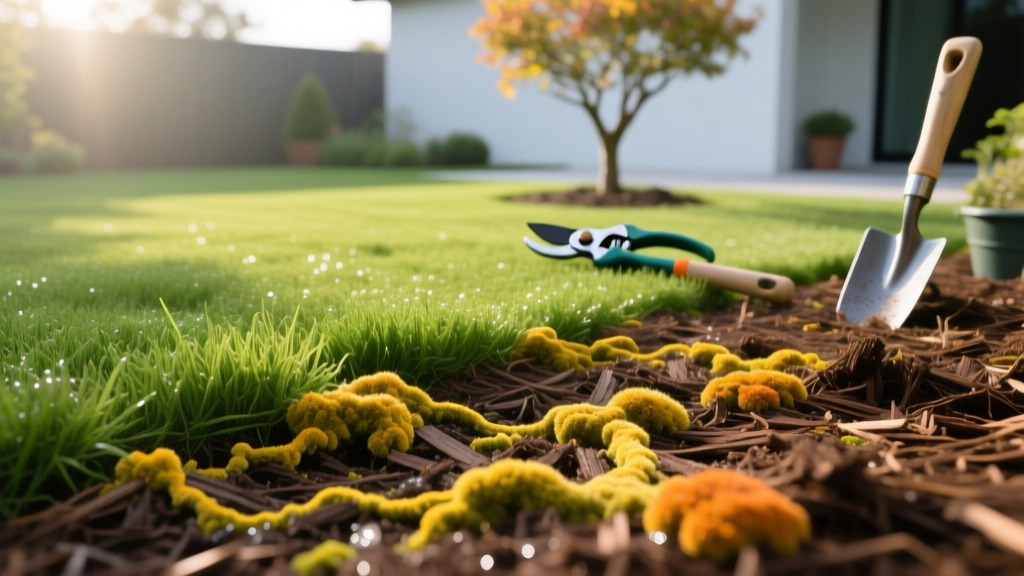
Yellow Mulch Mold: Symptom Diagnosis and Rescue Fixes
The Symptom: What Exactly is Yellow Mulch Mold?
When you walk into your garden and spot a bright yellow, foamy, or crusty mass spreading across your wood chips, your first instinct might be to reach for a fungicide. However, yellow mulch mold—scientifically known as Fuligo septica and commonly called 'dog vomit slime mold'—is not a true fungus. It is a myxomycete, a single-celled organism more closely related to amoebas than to the fungal kingdom. Because it lacks the chitin cell walls of true fungi, standard garden fungicides are completely ineffective against it.
Slime molds feed on bacteria, yeasts, and decaying organic matter in the mulch, not on your living plants. While the symptom is visually alarming, the presence of Fuligo septica is actually an indicator of high organic activity and excessive surface moisture in your garden beds.
Diagnostic Callout: Slime Mold vs. True Fungus
True fungi (like mushrooms or powdery mildew) grow via thread-like hyphae and absorb nutrients directly from host tissue or decaying matter. Slime molds exist as a 'plasmodium'—a creeping, amoeba-like mass that physically engulfs bacteria and micro-particles. When conditions dry out, the plasmodium transforms into a fruiting body (the yellow mass you see) to release spores.
True fungi (like mushrooms or powdery mildew) grow via thread-like hyphae and absorb nutrients directly from host tissue or decaying matter. Slime molds exist as a 'plasmodium'—a creeping, amoeba-like mass that physically engulfs bacteria and micro-particles. When conditions dry out, the plasmodium transforms into a fruiting body (the yellow mass you see) to release spores.
Visual Diagnosis Matrix: Is It Really Fuligo septica?
Gardeners frequently confuse yellow mulch mold with other common landscape organisms. Use this diagnostic matrix to confirm the symptom before applying any rescue fixes.
| Organism | Visual Appearance | Behavior & Spread | Threat Level |
|---|---|---|---|
| Yellow Slime Mold (Fuligo septica) | Bright yellow, foamy, or crusty patches (2-12 inches wide). Turns brown/powdery as it matures. | Appears overnight after heavy rain. Creeps slowly (inches per hour) during the plasmodium stage. | Harmless to plants. Purely cosmetic. |
| Artillery Fungus (Sphaerobolus stellatus) | Tiny, cup-shaped fruiting bodies that shoot black, tar-like spore masses onto siding and cars. | Spores stick aggressively to light-colored surfaces. Thrives in hardwood mulch. | Cosmetic damage to hardscapes; extremely difficult to remove from siding. |
| Bird's Nest Fungi (Crucibulum laeve) | Tiny, brown, cup-shaped structures resembling miniature bird nests containing 'eggs' (peridioles). | Splashed by raindrops. Harmless decomposers. | Harmless. Indicates healthy soil biology. |
The Root Cause: Environmental Triggers
Fuligo septica requires a very specific microclimate to fruit. If you are seeing yellow mulch mold, your garden beds are currently exhibiting at least three of the following conditions:
- Excessive Mulch Depth: Mulch layers thicker than 3 inches trap moisture against the soil surface and create anaerobic pockets. This accelerates the bacterial decay that slime molds feed on.
- Overhead Irrigation: Sprinkler heads that spray directly onto mulch beds keep the top 1 inch of organic matter constantly saturated, creating the perfect humidity dome for plasmodium formation.
- Raw Arborist Chips: Fresh, uncomposted wood chips have a high carbon-to-nitrogen (C:N) ratio. As soil bacteria work to break down the raw wood, they multiply rapidly, providing an abundant food source for the slime mold.
- Heavy Shade and Poor Airflow: Beds surrounded by dense shrubbery or located on the north side of a structure dry out too slowly after rainfall.
Step-by-Step Rescue Fixes (Actionable Protocol)
Because chemical fungicides (such as copper octanoate or chlorothalonil) do not work on myxomycetes, you must rely on mechanical and environmental rescue fixes. Follow this protocol to eliminate the current outbreak and prevent spore dispersal.
Step 1: Mechanical Removal (The Scoop Method)
Do not rake or break apart the yellow mass while it is in its active, foamy (plasmodium) stage. Breaking it open releases millions of microscopic spores into the air and surrounding mulch. Wait until the mass turns crusty and brown (usually within 48 to 72 hours). Using a flat-edged spade, carefully scoop the entire mass along with the top 1 inch of underlying mulch. Dispose of it in your municipal yard waste bin or a hot compost pile (minimum 140°F) to destroy the spores.
Step 2: Break the Hydrophobic Layer
Once the visible mold is removed, use a hand cultivator or garden fork to aggressively scratch the top 2 inches of the remaining mulch. This breaks up any hydrophobic (water-repellent) fungal mats and exposes the lower layers to UV light and air circulation, rapidly drying out the environment.
Step 3: Irrigation Recalibration
Switch from overhead spraying to targeted drip irrigation. Install 1/4-inch drip tubing with 2 GPH (gallons per hour) emitters placed directly at the root zones of your plants. This delivers moisture where the plant needs it while leaving the mulch surface bone-dry, effectively starving the slime mold of the surface humidity it requires to fruit.
Step 4: Nitrogen Balancing (Optional)
If the mold is feeding on raw wood chips, lightly dust the mulch surface with a fast-acting nitrogen source, such as blood meal or a synthetic urea-based fertilizer (e.g., 46-0-0). Apply at a rate of 1 pound per 100 square feet. This alters the C:N ratio, accelerating the breakdown of the wood chips and reducing the specific bacterial populations the slime mold targets. Water it in lightly.
Long-Term Prevention: Mulch Selection Guide
Not all mulches are equally susceptible to yellow slime mold. The physical structure and chemical composition of the mulch dictate how much moisture it retains and how quickly it decays.
| Mulch Type | Slime Mold Susceptibility | Why? | Best Use Case |
|---|---|---|---|
| Raw Arborist Chips | Very High | High moisture retention, massive bacterial food source during initial decay. | Rural paths, deep woodland beds. |
| Double-Shredded Hardwood | High | Fine texture mats together, trapping surface moisture and limiting airflow. | Annual flower beds (replace yearly). |
| Pine Bark Nuggets (Large) | Low | Coarse structure allows rapid drainage and high air circulation between pieces. | Shrub borders, perennial gardens. |
| Cedar Mulch | Moderate | Contains natural thujone oils that resist some decay, but still harbors mold if overwatered. | High-visibility entryways, walkways. |
Expert FAQ: Safety and Plant Impact
Is yellow mulch mold toxic to dogs or children?
According to the Penn State Extension, Fuligo septica is not considered highly toxic, but it can cause respiratory irritation or allergic reactions if spores are inhaled in large quantities. It is also an emetic (causes vomiting) if ingested by pets. Always keep dogs away from active fruiting bodies and wash hands after handling contaminated mulch.
Will it kill my hostas and perennials?
No. Slime molds do not possess the enzymes required to break down living plant tissue. They may temporarily smother small seedlings or low-growing groundcovers (like Creeping Jenny) if the plasmodium physically crawls over them, blocking sunlight. If you see it climbing a plant stem, gently wash it off with a low-pressure stream of water from your hose.
Does baking soda or cornmeal work?
While some organic gardening forums recommend dusting cornmeal or spraying baking soda solutions, university research shows these methods offer negligible control over myxomycetes. The UMass Amherst Extension emphasizes that environmental modification (reducing moisture and increasing airflow) is the only scientifically validated long-term control strategy. Save your money on home remedies and focus on irrigation management.
Pro-Tip for 2026 Landscaping Trends: As xeriscaping and drought-tolerant gardening continue to dominate landscape design, many homeowners are switching to inorganic mulches like 3/4-inch crushed gravel or river rock in high-moisture problem zones. Slime molds cannot feed on stone, making inorganic mulch a permanent, zero-maintenance rescue fix for chronically damp, shaded bed areas.

