
Grass Types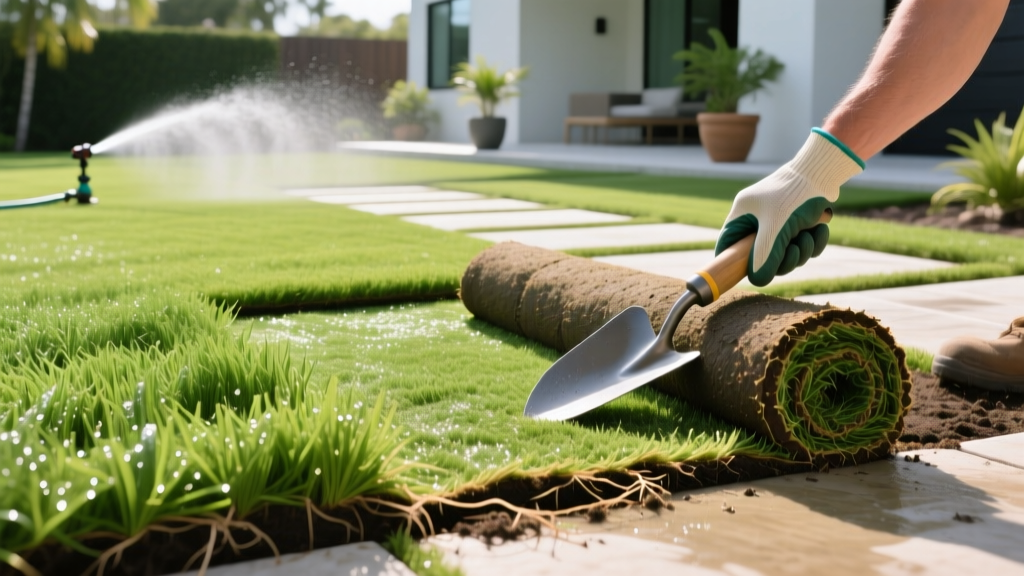
Installing A1A Sod Palmetto St. Augustine Sod: Complete Setup Guide
The 'Seed' Reality Check: Why Sod is the Only Option
Homeowners researching turf options frequently search for St. Augustine grass seed, but this is a fundamental misunderstanding of modern turfgrass genetics. Improved cultivars like Palmetto St. Augustine are vegetatively propagated—meaning they are cloned from parent plants via sod, plugs, or sprigs. This ensures the exact genetic traits that make Palmetto highly desirable, such as its superior shade tolerance and finer leaf blade, are preserved.
Warning: If you find 'St. Augustine seed' for sale online, it is almost certainly common, unimproved St. Augustine. Common varieties lack the disease resistance, cold hardiness, and shade tolerance of patented cultivars like Palmetto. To establish A1A Sod Palmetto St. Augustine sod, you must purchase vegetative plant material, not seed.
Pre-Installation Soil Prep: The 4-Inch Rule
A1A Sod farms harvest their Palmetto with a thin layer of soil attached, but the success of your establishment depends entirely on the native soil beneath it. St. Augustine thrives in a soil pH between 6.0 and 6.5. In coastal regions where A1A Sod primarily operates, native soils are often alkaline (pH 7.2+), which locks up vital nutrients like iron, leading to chlorosis (yellowing).
- Clear and Kill Existing Vegetation: Apply a non-selective systemic herbicide (like glyphosate) 14 days before delivery. Do not skip this step; bermudagrass or torpedo grass will quickly infiltrate and outcompete young Palmetto roots.
- Test and Amend pH: If your soil pH is above 7.0, apply elemental sulfur at a rate of 1 to 1.5 lbs per 1,000 square feet. Incorporate this into the soil to lower the pH before laying sod.
- Till to 4 Inches: Use a rear-tine rototiller to break up soil compaction to a minimum depth of 4 inches. St. Augustine roots will not penetrate hardpan clay or heavily compacted sand.
- Incorporate Organic Matter: Spread a 1-inch layer of screened organic compost and till it into the top 2 inches of soil. This increases the cation exchange capacity (CEC), allowing the soil to hold fertilizer longer.
- Grade and Smooth: Rake the area to ensure a 1% to 2% slope away from your home's foundation. Remove all rocks, roots, and debris larger than 1 inch in diameter.
Laying the Sod: Timing, Spacing, and Rolling
A1A Sod typically harvests and ships Palmetto within 24 hours of your delivery. Once the pallet arrives, you have a strict 24-to-36-hour window to install it before the sod begins to 'sweat' and suffer from heat stress and fungal decay in the center of the stack.
Installation Best Practices
- Stagger the Joints: Lay the sod in a brick-like pattern. Never align the seams in continuous straight lines, as this creates channels for water runoff and erosion.
- Butt the Edges Tightly: Push the edges of the sod rolls tightly together without overlapping. Gaps will dry out and die back, while overlapping creates uneven ridges that will be scalped by your mower.
- The 150-lb Roll: Immediately after laying a section, run over it with a water-filled lawn roller weighing approximately 150 lbs. This is non-negotiable. Rolling eliminates air pockets between the sod roots and the native soil, ensuring immediate capillary action for water uptake.
Establishment Timeline & Watering Matrix
According to Texas A&M AgriLife Extension, improper watering is the number one cause of sod failure. The goal is to keep the root zone moist without drowning the stolon, which invites Pythium root rot.
| Days Post-Install | Watering Frequency | Duration per Zone | Visual / Physical Cues |
|---|---|---|---|
| Days 1 - 10 | 2 to 3 times daily | 10-15 mins (approx. 1/4 inch) | Sod should feel spongy; do not let edges dry out. |
| Days 11 - 21 | 1 time daily | 20-30 mins (approx. 1/2 inch) | Perform the 'tug test'—sod should resist light upward pulling. |
| Days 22 - 30 | Every other day | 30-40 mins (approx. 3/4 inch) | Transitioning to deep, infrequent watering to force root depth. |
| Day 30+ | 1 to 2 times weekly | 45-60 mins (1 inch total) | Water only when footprints remain visible on the grass blades. |
Post-Establishment Care: Mowing and Fertilization
Palmetto St. Augustine requires a specific maintenance regime that differs slightly from the more common Floratam cultivar. Because Palmetto has a finer leaf texture and a slightly more prostrate growth habit, it is highly susceptible to scalping if mowed too short.
The Mowing Matrix
Set your mower deck to 3.5 to 4.5 inches. Never remove more than one-third of the leaf blade in a single mowing. If the grass reaches 6 inches, mow it down to 4 inches, wait three days, and then bring it down to your target 3.5 inches. Cutting Palmetto below 3 inches exposes the thatch layer to direct sunlight, stressing the stolons and inviting weed invasion.
Fertilizer NPK Requirements
Wait until the sod has fully rooted (usually 30 to 45 days) before applying fertilizer. For the initial establishment feed, use a starter fertilizer with a high phosphorus content (e.g., 10-10-10 or 5-10-5) at a rate of 1 lb of nitrogen per 1,000 square feet. Phosphorus is critical for early root development. Once established, transition to a slow-release nitrogen-heavy formula (like 20-0-5) with micronutrients, specifically iron and manganese, to maintain the deep emerald green color Palmetto is known for.
2026 Cost Breakdown: A1A Sod Palmetto vs. Alternatives
Understanding the financial commitment is crucial for budgeting your landscape project. As of 2026, supply chain stabilizations have slightly eased the massive freight spikes seen in previous years, but diesel and fertilizer costs keep sod prices firm.
Estimated Material Costs (Per 450 sq. ft. Pallet)
- A1A Sod Palmetto St. Augustine: $185 - $230 per pallet ($0.41 - $0.51 / sq. ft.)
- Floratam St. Augustine: $150 - $180 per pallet ($0.33 - $0.40 / sq. ft.)
- Zeon Zoysia (Comparison): $270 - $320 per pallet ($0.60 - $0.71 / sq. ft.)
- Palmetto Plugs (Tray of 72): $85 - $110 per tray (Ideal for small patch repairs, not full lawns)
Note: Prices vary based on delivery distance from the farm and local distributor markups. Always factor in an additional $0.15 to $0.25 per square foot for professional soil prep and installation labor.
Troubleshooting Common Palmetto Edge Cases
Even with perfect installation, environmental factors can disrupt establishment. Here is how to handle the most common issues specific to Palmetto St. Augustine:
- Gray Leaf Spot: If you notice small, oval, gray-brown lesions on the blades during the humid establishment phase, you are likely overwatering in the late afternoon. Shift your irrigation schedule to early morning (4:00 AM - 6:00 AM) so the canopy dries before nightfall. Apply a systemic fungicide containing Azoxystrobin if the spread continues.
- Chinch Bug Damage: Palmetto is moderately susceptible to Southern Chinch Bugs. If you see irregular yellowing patches that turn brown and die, specifically in the hottest, sunniest areas of the lawn near driveways, part the grass at the soil line. If you see tiny black insects with white wings, treat immediately with a Bifenthrin-based insecticide.
- Shade Thinning: While Palmetto is the most shade-tolerant St. Augustine available, it still requires a minimum of 3 to 4 hours of filtered or dappled sunlight. If your canopy is too dense, hire an arborist to perform a 'crown thinning' on your oak or pine trees to allow light penetration.
Frequently Asked Questions
Can I lay A1A Sod Palmetto directly over existing dead grass?
No. The dead grass layer will act as a physical barrier, preventing the new sod roots from making contact with the soil. It will also harbor fungal pathogens and pests. You must remove the old turf or rototill it completely into the soil profile.
How long does it take for Palmetto to fully establish?
You will see initial root anchoring in 14 to 21 days, but full biological establishment—where the root system reaches its maximum depth of 6 to 8 inches and the lawn can handle foot traffic and standard drought stress—takes 60 to 90 days under optimal summer conditions.

