Grass Types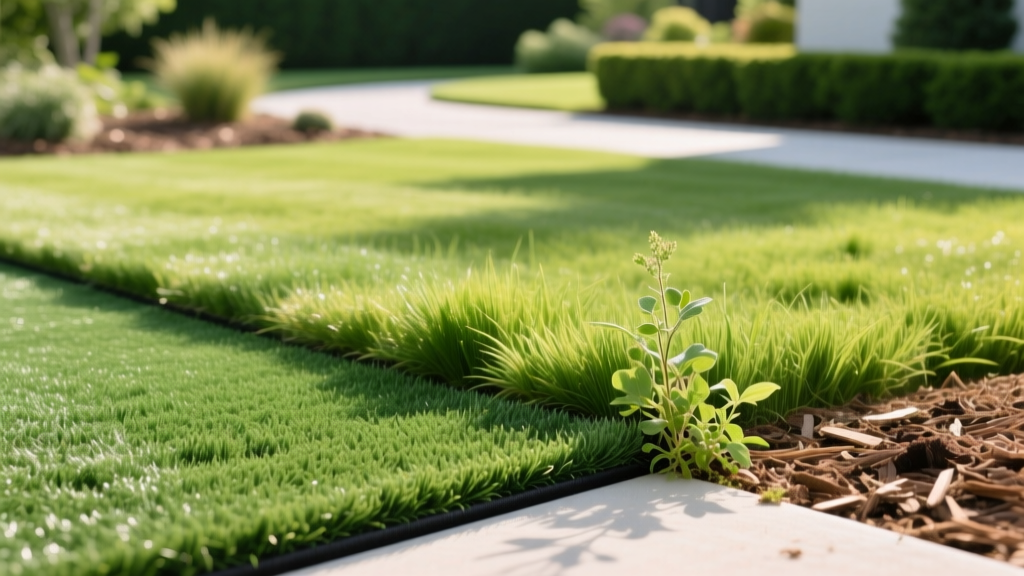
Managing Artificial Turf and Weeds: A Spot-Treatment Guide
The Anatomy of a Synthetic Weed Invasion
A common misconception among homeowners transitioning from natural grass to synthetic landscapes is that artificial lawns are entirely maintenance-free. In reality, the intersection of artificial turf and weeds is a persistent agronomic challenge. Synthetic lawns are not immune to weed pressure; they simply change the environment in which weeds establish.
Weed seeds are continuously introduced to synthetic lawns via wind dispersal, animal vectors, and contaminated top-dressing materials. The primary catalyst for germination is the infill layer. Whether you use silica sand, crumb rubber, or organic alternatives like zeolite, these materials trap windblown silt, decomposing leaves, and atmospheric dust. Over a 24-month period, this trapped organic matter creates a shallow, nutrient-rich 'pseudo-soil' horizon sitting directly on top of the turf backing. This layer provides just enough moisture retention and physical support for opportunistic weed species to anchor their roots, eventually penetrating the primary and secondary backing of the synthetic turf.
Weed Species Identification Matrix
Effective spot-treatment requires accurate species identification. The pseudo-soil layer in synthetic lawns favors specific weed architectures. Below is a diagnostic matrix for the most common invaders found in artificial turf systems.
| Weed Category | Common Species | Scientific Name | Root Architecture in Infill | Primary Threat to Turf System |
|---|---|---|---|---|
| Broadleaf | Dandelion | Taraxacum officinale | Deep taproot penetrating backing | Punctures drainage holes; compromises backing integrity |
| Broadleaf | White Clover | Trifolium repens | Shallow stoloniferous network | Spreads laterally across surface; traps excess moisture |
| Grassy | Annual Bluegrass | Poa annua | Fibrous, shallow root mass | Creates uneven surface profile; dies back leaving bare infill |
| Sedge | Yellow Nutsedge | Cyperus esculentus | Rhizomes and deep tubers (nutlets) | Pierces backing with sharp shoots; highly resistant to pulling |
Spot-Treatment Protocols by Species
When managing artificial turf and weeds, chemical intervention must be highly targeted. Broadcast spraying is unnecessary and increases the risk of chemical interaction with synthetic fibers. Spot-treatment protocols vary strictly by weed taxonomy.
Broadleaf Weeds (Dandelions, Clover, Plantain)
For broadleaf invaders, synthetic auxin herbicides are the standard. A three-way mixture containing 2,4-D amine, Dicamba, and MCPP provides excellent systemic control.
- Application Rate: Mix 1.5 fluid ounces of a water-soluble three-way herbicide per gallon of water to treat 1,000 square feet.
- Technique: Use a shielded spray nozzle or a sponge applicator to apply the solution directly to the weed foliage. Avoid dripping excess solution onto the synthetic blades.
- Timing: Apply when daytime temperatures are between 65°F and 85°F. Temperatures above 90°F increase volatilization, which can cause phytotoxic drift to nearby ornamental plants.
Grassy Weeds (Poa annua, Crabgrass, Dallisgrass)
Grassy weeds blend seamlessly with synthetic turf blades, making manual removal difficult without pulling up the infill. Post-emergent grass-specific herbicides utilizing Fluazifop-p-butyl or Clethodim are highly effective.
- Product Recommendation: Ortho Grass B Gon (Fluazifop) or Envoy Plus (Clethodim).
- Application Rate: For Fluazifop, apply 1.5 oz per gallon of water with a non-ionic surfactant (0.25% v/v) to ensure the herbicide adheres to the waxy cuticle of the grassy weed.
- Efficacy Timeline: Expect to see chlorosis (yellowing) in 7 to 10 days, with complete necrosis in 21 days.
Sedges (Yellow and Purple Nutsedge)
Sedges are the most destructive weed in artificial turf due to their sharp, rigid shoots that can physically pierce the polyurethane backing from below if tubers are present in the base aggregate.
- Active Ingredient: Halosulfuron-methyl (commonly sold as SedgeHammer).
- Application Rate: One 13.5-gram water-soluble packet treats up to 1,000 square feet. Mix with 1 to 2 gallons of water.
- Critical Note: Sedges must be treated when they are actively growing and have reached the 3-to-5 leaf stage. Treating mature sedges with visible seed heads significantly reduces herbicide translocation to the subterranean tubers.
⚠️ CRITICAL WARNING: Herbicide Formulations and Synthetic Fibers
Never use Emulsifiable Concentrate (EC) herbicide formulations on artificial turf. EC formulations rely on petroleum-based solvents and aromatic hydrocarbons to keep the active ingredient in suspension. These petroleum distillates will permanently stain, degrade, and potentially melt polyethylene (PE) and nylon synthetic grass fibers. Always select Water-Soluble (WS), Soluble Liquid (SL), or Water-Dispersible Granule (WDG) formulations. According to turf management guidelines from University of Minnesota Extension, checking the formulation type on the product label is a mandatory first step before applying any chemical to synthetic landscapes.
Pre-Emergent Strategy for Artificial Infill
While spot-treating existing weeds is necessary, preventing germination is the most cost-effective long-term strategy. Pre-emergent herbicides create a chemical barrier in the infill layer that inhibits cell division in germinating seeds.
Prodiamine 65 WDG (Water-Dispersible Granule) is the industry standard for synthetic lawns. Because it is a WDG, it will not stain the turf fibers.
- Application Rate: 0.4 ounces of Prodiamine 65 WDG per 1,000 square feet, suspended in 2 gallons of water.
- Timing: Apply in early spring when soil temperatures at the infill/base interface reach 55°F for three consecutive days. A second application can be made in early fall to prevent winter annuals like Poa annua.
- Watering In: Unlike natural soil, infill does not retain moisture well. You must lightly irrigate the synthetic turf with approximately 0.25 inches of water immediately after application to wash the granules off the blades and down into the infill layer where germination occurs.
For comprehensive integrated pest management strategies, the University of California Integrated Pest Management (UC IPM) database provides excellent regional timing maps for pre-emergent applications based on local microclimates.
Cost and Labor Analysis: Spot-Treatment vs. Infill Replacement
When weed pressure exceeds 15% of the total lawn area, homeowners must decide between aggressive chemical rehabilitation or physical infill replacement. Below is a comparative analysis based on a standard 1,000-square-foot synthetic lawn.
| Intervention Method | Estimated Material Cost | Labor Time | Longevity of Control | Best Use Case |
|---|---|---|---|---|
| Manual Extraction | $0 | 4 - 6 hours | Low (Seeds remain in infill) | Isolated, mature broadleaf weeds |
| Chemical Spot-Treatment | $45 - $85 | 1 - 2 hours | Medium (Requires follow-up) | Mixed weed populations under 15% coverage |
| Pre-Emergent Application | $30 - $50 | 1 hour | High (6-8 months prevention) | Proactive annual maintenance |
| Full Infill Extraction & Replacement | $400 - $700 | 12 - 16 hours (or Pro) | High (Resets organic matter clock) | Severe infestation, compacted/drainage-failed infill |
Routine Infill Maintenance to Suppress Weeds
Chemical controls are only half the equation. Physical disruption of the pseudo-soil layer is required to maintain a sterile synthetic environment.
- Monthly Power Brushing: Use a motorized synthetic turf brush (or a stiff-bristled push broom) to agitate the infill. This brings buried organic debris to the surface where it can be blown away, preventing the accumulation of the germination horizon.
- Enzyme Cleaning: Once per quarter, apply a turf-safe enzymatic cleaner. These biological solutions break down pet waste and decaying organic matter that would otherwise serve as fertilizer for weed seeds.
- Edge Barrier Inspection: 60% of weeds enter the synthetic system from the perimeter. Ensure that physical bender board or concrete curbing is flush with the soil grade, and apply a 2-inch band of non-selective herbicide (like Glyphosate or Glufosinate) to the natural soil immediately adjacent to the turf edge.
By combining precise, formulation-safe spot treatments with rigorous infill management, synthetic lawns can remain visually pristine and structurally sound without the recurring labor demands of natural turfgrass.