Grass Types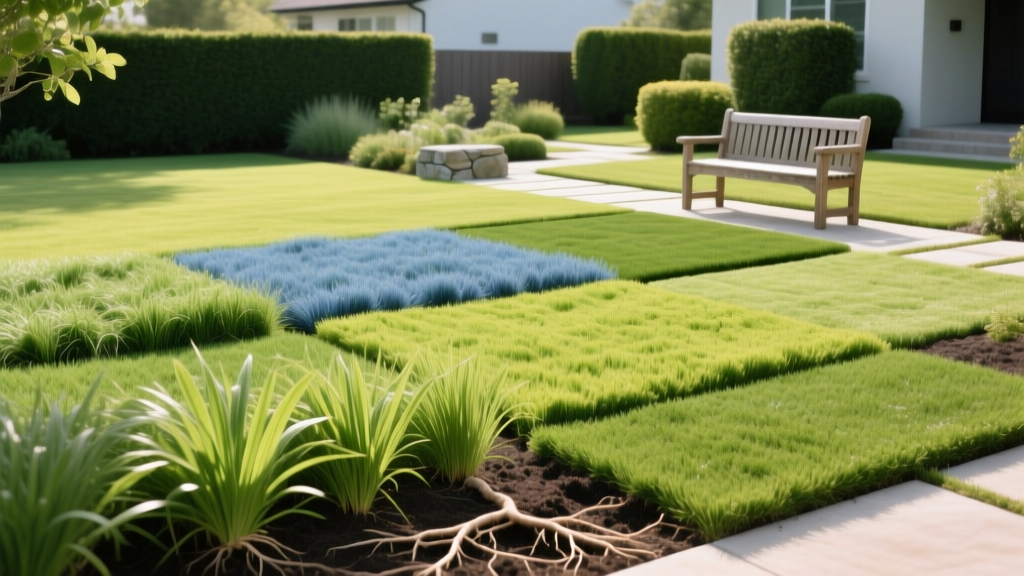
The True Price to Install Sod: 2026 Cost & Coverage Guide
When budgeting for an instant lawn, the price to install sod fluctuates based on turf species, soil preparation requirements, and regional labor rates. In 2026, the national average cost for professional sod installation ranges from $1.50 to $3.20 per square foot. For a standard 1,000-square-foot front yard, this translates to a total project cost between $1,500 and $3,200. However, treating this average as a fixed quote is a common mistake that leads to severe budget overruns.
This guide breaks down the exact material costs, labor variables, and coverage mathematics required to price your project accurately, while highlighting the installation failure modes that force homeowners to pay for the job twice.
2026 Baseline Cost Snapshot:
• DIY Material Only: $0.35 – $0.85 per sq. ft.
• Professional Installation (Labor + Material): $1.50 – $3.20 per sq. ft.
• Old Lawn Removal & Grading: Adds $0.80 – $1.50 per sq. ft.
• DIY Material Only: $0.35 – $0.85 per sq. ft.
• Professional Installation (Labor + Material): $1.50 – $3.20 per sq. ft.
• Old Lawn Removal & Grading: Adds $0.80 – $1.50 per sq. ft.
Cost Breakdown by Grass Type and Cultivar
The species of turfgrass you select dictates both the raw material cost and the density of the root mat, which influences harvesting and palletizing prices. Warm-season grasses generally command a premium over cool-season varieties due to slower lateral growth rates in the nursery.
| Grass Type & Cultivar | Material Cost (per sq. ft.) | Installed Cost (per sq. ft.) | Climate Zone |
|---|---|---|---|
| Bermuda ('Tifway 419') | $0.35 – $0.55 | $1.40 – $2.10 | Warm / Transition |
| Zoysia ('Meyer' or 'Emerald') | $0.50 – $0.85 | $1.80 – $3.20 | Warm / Transition |
| St. Augustine ('Palmetto') | $0.40 – $0.70 | $1.50 – $2.50 | Warm / Coastal |
| Tall Fescue ('Titan Ultra') | $0.35 – $0.60 | $1.50 – $2.40 | Cool / Transition |
| Kentucky Bluegrass | $0.35 – $0.55 | $1.60 – $2.60 | Cool Season |
According to turfgrass establishment data from NC State TurfFiles, selecting a cultivar adapted to your specific microclimate is more critical than the initial material savings. Planting a shade-intolerant Bermuda grass in a heavily canopied yard will result in total turf failure within two seasons, regardless of the installation quality.
Hidden Variables That Spike Your Installation Bill
The per-square-foot quotes provided by contractors rarely include the site preparation required to ensure the sod roots successfully penetrate the native soil. Expect the following line items to alter your final invoice:
- Old Turf Removal: Stripping existing dead grass or weeds using a sod cutter costs $0.20 to $0.40 per square foot. Haul-away fees for the debris typically add a flat $250 to $600 depending on landfill tipping fees in your municipality.
- Rototilling and Soil Amendment: Sod laid directly over hardpan clay will fail. Tilling the top 4 to 6 inches of soil and incorporating 2 cubic yards of compost per 1,000 square feet costs $0.50 to $1.00 per square foot.
- Topsoil Delivery: If your yard lacks sufficient topsoil depth (minimum 4 inches required), importing screened loam costs $30 to $50 per cubic yard, plus $100 to $200 for delivery and machine spreading.
- Accessibility Penalties: If a skid steer or tractor cannot access your backyard through a standard 36-inch gate, crews must move soil and sod pallets by wheelbarrow. This manual labor surcharge can increase the installation price by 20% to 35%.
Calculating Exact Coverage and Material Dosage
Ordering the correct dosage of sod prevents both project delays and the waste of dried-out pallets. Sod is sold by the pallet, with standard industry pallets covering 450 to 500 square feet. This is typically configured as 50 to 60 individual rolls (measuring 2 feet wide by 4.5 feet long) or large slabs.
The 10% Overage Rule
Never order the exact square footage of your lawn. You must account for cutting around curved landscape beds, trees, and property lines. Calculate your total area, then multiply by 1.10. For a 2,000-square-foot yard, you need 2,200 square feet of material. At 500 square feet per pallet, you will order 4.4 pallets. Always round up to the nearest half or full pallet depending on the supplier's return policy, as most sod farms do not accept returns on cut or dried pallets.
Common Installation Failure Modes (And How to Avoid Them)
Understanding why sod dies after installation is crucial for evaluating a contractor's methodology. If your installer skips these steps, the price to install sod effectively doubles when you have to replace it.
1. The Sponge Effect (Hydrophobic Layering)
When sod is laid on top of smooth, compacted clay without tilling, a distinct boundary layer forms. Water applied to the surface saturates the 1-inch sod root zone but cannot penetrate the dense clay below. The grass develops shallow roots and burns out during the first summer heatwave. The Fix: Mandate that the contractor scarifies or tills the native soil to a depth of at least 3 inches before laying the turf.
2. Seam Shrinkage and Desiccation
Sod rolls shrink slightly as they lose moisture after harvest. If an installer lays the rolls with even a 1/4-inch gap between them, those gaps will widen into prominent brown trenches that take months to fill via lateral growth. The Fix: Rolls must be pushed tightly together so the soil edges slightly bulge upward at the seam, and staggered in a brick-like pattern to prevent continuous water channels.
3. Pallet Heat Damage
Sod is a living plant stacked tightly on a wooden pallet. In temperatures above 80°F, the center of the pallet can literally cook and turn yellow within 24 to 48 hours due to microbial respiration. The Fix: Ensure your delivery is scheduled for the exact morning of installation. Never accept pallets where the interior rolls feel hot to the touch or show yellowing.
DIY vs. Professional Installation: A Financial Decision Tree
Deciding whether to hire a crew or lay the sod yourself hinges on your physical capacity and timeline. According to HomeGuide's 2026 landscaping cost data, labor accounts for roughly 50% to 60% of the total project cost.
Choose DIY if:
- Your area is under 800 square feet.
- You have a crew of 3 to 4 able-bodied helpers (laying 1,000 sq. ft. takes a coordinated team roughly 4 to 6 hours).
- You have access to a truck to transport soil amendments and a 48-inch walk-behind rototiller (rental: $45–$65/day).
Hire a Professional if:
- Your yard exceeds 1,500 square feet.
- The site requires heavy grading, retaining wall integration, or complex drainage swales.
- You want a warranty on the turf establishment (most reputable landscapers offer a 30-to-60-day survival guarantee if they also install and audit your irrigation system).
Post-Installation Watering Requirements
The initial watering is non-negotiable. Within 30 minutes of installation, the sod must receive at least 1 inch of water to penetrate through the turf and into the native soil below. The EPA WaterSense program recommends adjusting irrigation schedules based on local evaporation rates, but for the first 14 days, new sod typically requires light, frequent watering (2 to 3 times daily for 10 minutes) to keep the root zone moist without causing waterlogging. After two weeks, transition to deep, infrequent watering to drive roots downward.
Frequently Asked Questions
Does the season affect the price to install sod?
Yes. Spring and early fall are peak seasons for landscaping, meaning contractors charge premium rates and sod farms may have limited cultivar availability. Installing during the shoulder seasons (late fall for cool-season grasses, late winter for warm-season grasses) can yield a 10% to 15% discount on labor, though you risk slower root establishment.
Can I lay sod directly over existing weeds?
No. While the sod will initially smother the weeds, aggressive perennials like Bermuda grass or nutsedge will easily penetrate the new sod mat within a single growing season, ruining the uniform appearance of your new lawn. Always apply a non-selective herbicide two weeks prior, or physically strip the existing vegetation.
How long before I can mow newly installed sod?
Wait until the grass reaches 3 to 4 inches in height and the roots have firmly anchored into the soil. You can test this by gently tugging upward on a corner of the sod; if you feel resistance from the earth below, it is safe to mow. This typically takes 14 to 21 days under optimal growing conditions. Ensure your mower blades are razor-sharp to prevent tearing the shallow root system.